• Fri frakt över 249 kr
  • •
  • Snabba leveranser
  • •
  • Billiga böcker
Kundservice

Du är på sajten för privatpersoner.

Företag, bibliotek eller offentlig verksamhet?

Du handlar på classic.bokus.com, där alla dina funktioner finns intakta.
Till classic.bokus.com
Bokus logotyp. Gå till startsidan.
  • Erbjudanden
  • Nyheter
  • Student
  • Topplistor
  • Barn & ungdom
  • Bokus Play
  • E-böcker
  • Pocketböcker
  • Spel & pussel

Må bättre, för mindre! Upp till 50% rabatt på hälsoböcker

Sidfot

Mina sidor

    Hjälp

    • Kundservice
    • Vanliga frågor och svar
    • Frakt och leverans
    • Retur vid ångerrätt
    • Reklamera vara
    • Betalning
    • Köpvillkor
    • Allmänna villkor
    • Information om webbplatsens tillgänglighet

    Om Bokus

    • Om oss
    • Pressrum
    • För studenter
    • För företag
    • För bibliotek och offentlig verksamhet
    • För leverantörer
    • Hållbarhet

    Populärt

    • Aktuella erbjudanden
    • Presentkort
    • Studentlitteratur
    • Nya böcker
    • Topplistor
    • Signerade böcker
    • Engelska böcker

    Inspiration

    • Boktips
    • BookTok
    • Populära bokserier
    • Barnbokskaraktärer
    • Populära författare
    Logotyp för Bokus
    Följ oss på Facebook (extern länk)Följ oss på Instagram (extern länk)Följ oss på YouTube (extern länk)Följ oss på TikTok (extern länk)
    bokus @ CookiesAnpassa cookiesIntegritetspolicyKöpvillkor
    Till Citymail hemsida (extern länk)Till Budbee hemsida (extern länk)Till Postnord hemsida (extern länk)Till Schenker hemsida (extern länk)Till Early Bird hemsida (extern länk)Till Walleys hemsida (extern länk)
    1. Samhälle och politik
    2. Sociologi och antropologi
    3. Antropologi

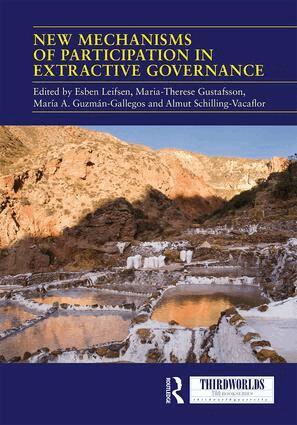
    New Mechanisms of Participation in Extractive Governance

    Between technologies of governance and resistance work

    AvEsben Leifsen,Maria-Therese Gustafsson

    Häftad, Engelska, 2020

    Del i serien ThirdWorlds

    667 kr

    Beställningsvara. Skickas inom 10-15 vardagar. Fri frakt över 249 kr.

    Beskrivning

    The scholarly debate on deliberative democracy often suggests that participatory processes will contribute to make environmental governance not only more legitimate and effective, but also lead to the empowerment of marginalized social groups. Critical studies, however, analyse how technologies of governance make use of participation to draw boundaries that separate technical knowledge from political concerns, direct the focus towards procedural aspects and contractual obligations, and reinforce hegemonic understandings of development and of local people’s relationships to their environment. This book focuses on the dynamics and use of participatory mechanisms related to the rapid expansion of the extractive industries worldwide and the ways it increasingly affects sensitive natural environments populated by indigenous and other marginalized populations. Nine empirically grounded case studies analyse a range of participatory practices ranging from state-led and corporation-led processes like prior consultation and Free Prior and Informed Consent (FPIC), compensation practices, participatory planning exercises and the participation in environmental impact assessments (EIAs), to community-led consultations, community-based FPIC and EIA processes and struggles for community-based governance of natural resource uses. The book provides new insights through a combination of different theoretical strands, which help to scrutinize the limits to deliberation and empowerment on the one hand, and on the other hand to understand the political resistance potential that alternative uses of participatory mechanisms can generate. The chapters originally published as a special issue of Third World Quarterly.

    Produktinformation

    • Utgivningsdatum:2020-06-30
    • Mått:174 x 246 x undefined mm
    • Vikt:350 g
    • Format:Häftad
    • Språk:Engelska
    • Serie:ThirdWorlds
    • Antal sidor:178
    • Förlag:Taylor & Francis Ltd
    • ISBN:9780367588533

    Utforska kategorier

    • Antropologi inom Samhälle och politik
    • Politik och statsskick inom Samhälle och politik
    • Miljöteknik inom Naturvetenskap och teknik

    Mer om författaren

    Esben Leifsen is an Associate Professor at the Department of International Environment and Development Studies, the Norwegian University of Life Sciences, Norway. He teaches anthropology and politics of international development, and carries out research within the fields of the anthropology and political ecology of resource extraction, socio-environmental conflict, environmental justice and indigenous rights. Maria-Therese Gustafsson is a Postdoctoral Research Fellow at the Department of Political Science, Stockholm University, Sweden. Prominent themes in her research are private politics, political participation, natural resource governance and climate security. Her dissertation was awarded with the prize for the best dissertation at the Faculty of Social Science, Stockholm University, in 2015. María A. Guzmán-Gallegos is a Postdoctoral Research Fellow at the Department of Social Anthropology, University of Oslo, Norway. Her research foci include personhood and gender, Amerindian conceptualizations of nature and society, and socio-environmental conflict related to extraction. Current research interests are environmental governance, contamination and Amerindian conceptualizations of human and non-human bodies.Almut Schilling-Vacaflor is a sociologist and anthropologist who is currently a Postdoctoral Research Fellow at the University of Osnabrück, Germany. Her research deals with environmental governance, socio-environmental conflicts, participation, contention and rights. Schilling-Vacaflor headed a research project on "Consultation, Participation and Conflict Transformation", funded by the German Foundation for Peace Research.

    Innehållsförteckning

    • Introduction: New mechanisms of participation in extractive governance between technologies of governance and resistance work Esben Leifsen, Maria-Therese Gustafsson, Maria A. Guzmán-Gallegos and Almut Schilling-Vacaflor 1. Who controls the territory and the resources? Free, prior and informed consent (FPIC) as a contested human rights practice in Bolivia Almut Schilling-Vacaflor 2. Weaving hope in ancestral black territories in Colombia: the reach and limitations of free, prior, and informed consultation and consent Marilyn Machado, David López Matta, María Mercedes Campo, Arturo Escobar and Viviane Weitzner 3. Claiming prior consultation, monitoring environmental impact: counterwork by the use of formal instruments of participatory governance in Ecuador’s emerging mining sector Esben Leifsen, Luis Sánchez-Vázquez and Maleny Gabriela Reyes 4. Between oil contamination and consultation: constrained spaces of influence in Northern Peruvian Amazonia María A. Guzmán-Gallegos 5. A vote to derail extraction: popular consultation and resource sovereignty in Tolima, Colombia John-Andrew McNeish 6. The struggles surrounding ecological and economic zoning in Peru Maria-Therese Gustafsson 7. The politics of planning: assessing the impacts of mining on Sami lands Rebecca Lawrence and Rasmus Kløcker Larsen 8. Shaping projects, shaping impacts: community-controlled impact assessments and negotiated agreements Ciaran O’Faircheallaigh 9. ‘Nosotros Somos Estado’: contested legalities in decision-making about extractives affecting ancestral territories in Colombia Viviane Weitzner