• Fri frakt över 249 kr
  • •
  • Snabba leveranser
  • •
  • Billiga böcker
Kundservice

Du är på sajten för privatpersoner.

Företag, bibliotek eller offentlig verksamhet?

Du handlar på classic.bokus.com, där alla dina funktioner finns intakta.
Till classic.bokus.com
Bokus logotyp. Gå till startsidan.
  • Erbjudanden
  • Nyheter
  • Student
  • Topplistor
  • Barn & ungdom
  • Bokus Play
  • E-böcker
  • Pocketböcker
  • Spel & pussel

10% studentrabatt med kod TERM26

Sidfot

Mina sidor

    Hjälp

    • Kundservice
    • Vanliga frågor och svar
    • Frakt och leverans
    • Retur vid ångerrätt
    • Reklamera vara
    • Betalning
    • Köpvillkor
    • Allmänna villkor
    • Information om webbplatsens tillgänglighet

    Om Bokus

    • Om oss
    • Pressrum
    • För studenter
    • För företag
    • För bibliotek och offentlig verksamhet
    • För leverantörer
    • Hållbarhet

    Populärt

    • Aktuella erbjudanden
    • Presentkort
    • Studentlitteratur
    • Nya böcker
    • Topplistor
    • Signerade böcker
    • Engelska böcker

    Inspiration

    • Boktips
    • BookTok
    • Populära bokserier
    • Barnbokskaraktärer
    • Populära författare
    Logotyp för Bokus
    Följ oss på Facebook (extern länk)Följ oss på Instagram (extern länk)Följ oss på YouTube (extern länk)Följ oss på TikTok (extern länk)
    bokus @ CookiesAnpassa cookiesIntegritetspolicyKöpvillkor
    Till Citymail hemsida (extern länk)Till Budbee hemsida (extern länk)Till Postnord hemsida (extern länk)Till Schenker hemsida (extern länk)Till Early Bird hemsida (extern länk)Till Walleys hemsida (extern länk)
    1. Kultur
    2. Arkitektur
    3. Arkitekturhistoria

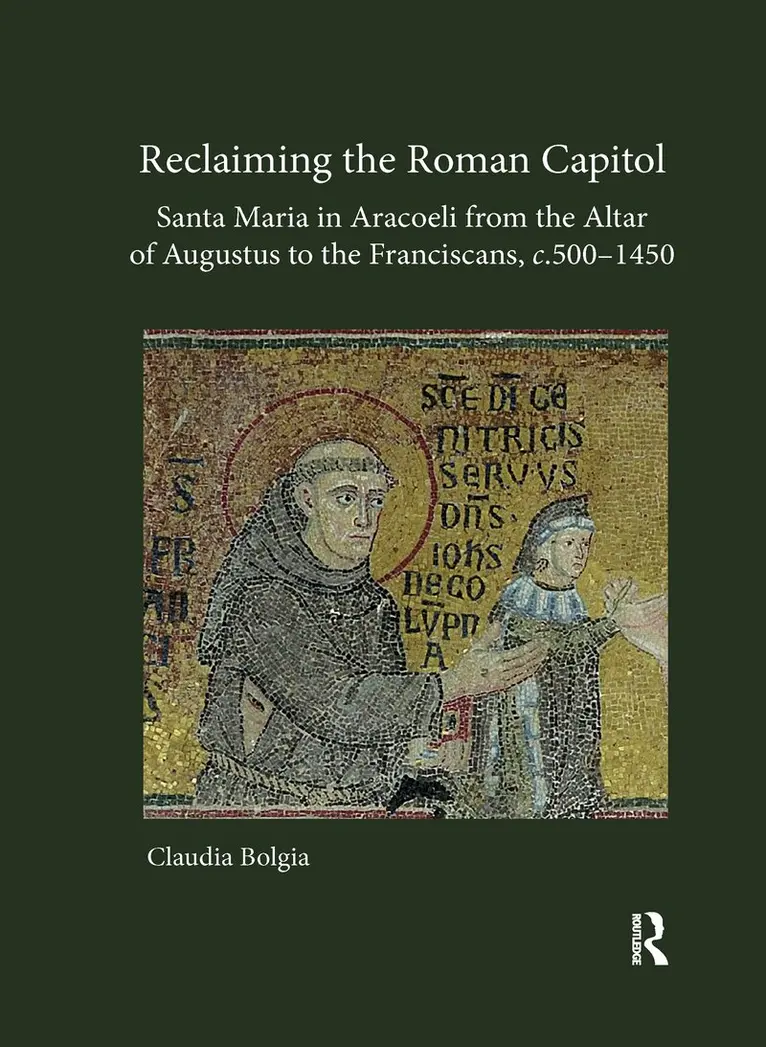
    Reclaiming the Roman Capitol: Santa Maria in Aracoeli from the Altar of Augustus to the Franciscans, c. 500–1450

    AvClaudia Bolgia

    Häftad, Engelska, 2020

    705 kr

    Beställningsvara. Skickas inom 10-15 vardagar. Fri frakt över 249 kr.

    Fler format och utgåvor

    E-bok

    829 kr

    E-bok

    829 kr

    Inbunden

    2 506 kr

    Beskrivning

    Prominently located on the Arx, the northern summit of the Capitoline hill, S. Maria in Aracoeli is the most significant medieval church of Rome to survive to the present day. Second major church of the Lesser Brothers or fratres minores in the Italian peninsula, and Roman headquarters of the Order, the Aracoeli played a vital role in the interaction between the Franciscans and the papacy, the friars and the laity, and the religious and civic authorities, as reflected in its art and architecture. On the basis of an interdisciplinary approach combining archaeological analysis with the finding of new archival evidence, reinterpretation of documents and literary and epigraphic sources, this book offers a reconstruction of the original church, its monuments and its Benedictine as well as eighth/ninth-century predecessors, which differs radically from earlier hypotheses. This reassessment in turn allows the author to revisit a number of major questions, including the Franciscans’ physical and theoretical appropriation of the past, the adaptation of an ancient site by a ‘modern’ religious order, the use and functions of space, the interaction between friars, laity and artists, and the contribution of the Roman Franciscans to the development of Marian devotion, thus shedding new light on the social, political and religious history of late-medieval Italy and its impact beyond the peninsula, from England to Bohemia and the Holy Land.

    Produktinformation

    • Utgivningsdatum:2020-06-30
    • Mått:174 x 246 x 31 mm
    • Vikt:680 g
    • Format:Häftad
    • Språk:Engelska
    • Antal sidor:486
    • Förlag:Taylor & Francis Ltd
    • ISBN:9780367595012

    Utforska kategorier

    • Arkitekturhistoria inom Kultur
    • Romarna inom Historia och arkeologi
    • Arkeologi inom Historia och arkeologi

    Mer om författaren

    Claudia Bolgia is Senior Lecturer in History of Art at the University of Edinburgh. She has published extensively on medieval Rome and Franciscan Art and Architecture in a range of international peer-reviewed journals. Co-editor, with Rosamond McKitterick and John Osborne, of Rome across Time and Space: Cultural Translation and the Exchange of Ideas, c. 500-1400 (2011), her research has attracted major Fellowships, including Villa I Tatti – The Harvard University Center for Italian Renaissance Studies (2009–10), The British School at Rome (2012–14), CASVA – The Center for Advanced Study in the Visual Arts (2016–17), The Newberry Library (2016–17), and The Leverhulme Trust (2017–18).

    Recensioner i media

    " This is an excellent volume, which teems with artisitic insights and valuable information about Santa Maria in Aracoeli and the order's appropriation of this historical site in the centre of Rome. The author is to be warmly congratulated, as are the publishersfor producing such a de luxe book. The volume will be of immense interest to historians of art and students of Franciscan history." - Michael Robson, St. Edmund's College, Cambridge

    Innehållsförteckning

    • Introduction From Isis to Mary: The Arx and its surroundings from Antiquity to the Middle Ages 1 Before the Franciscans: The previous churches on the site - Cunctarum prima quae fuit orbe sita: Literary, documentary, and epigraphic evidence from the earliest times to the thirteenth century- From S. Maria in Capitolio to S. Maria in Aracoeli: the title- Archaeological evidence from the earliest times to the thirteenth century - The previous churches and their relationship with the Franciscan building- Early medieval church furniture - The obelisk- The cloisters- Conclusion2 The Franciscan ‘appropriation’ of the Arx - Franciscan foundations in thirteenth- and fourteenth-century Europe - The Franciscans in Rome and their new headquarters - The ara coeli - The monument and its ‘meaning’- The ara coeli ‘confessio’: Art for the Benedictines or the Franciscans?- New and old cults before the construction of the new church3 The New Franciscan Church: Between tradition and innovation - An architectural analysis of the medieval building - Nave and aisles- Transept- Chapel L9 - Original main chapel- Façade- The decoration of the apse and the Franciscan promotion of the legend of Augustus from Rome to Finland- Marble workshop: Window tracery- Transmission and reception of formal ideas: Artistic exchanges between Rome and England in the thirteenth century- The magister principalis and the builders- The deployment of Spolia and Franciscan ideas- New and old cults in the new Franciscan church: paths for faithful and pilgrims 4 The ‘extended’ space of the Franciscan church: S. Maria in Aracoeli as a lived social and political place - The ‘extended’ space of the church exterior- The original side-entrance and the guardianship of the minors- Preaching, politics, and religious tribunals - The ‘extended’ space of the church interior- Inner appearance and family chapels - Burying in the Franciscan church- Between ‘public’ and ‘private’ in the Rome of the popular regime: Francesco Felici’s icon tabernacle and family chapel (1372)- Beyond Rome: the Legend of Augustus and the Aracoeli icon in Fourteenth- and early Fifteenth-century SienaConclusions Appendix: chart of intercolumniations