• Fri frakt över 249 kr
  • •
  • Snabba leveranser
  • •
  • Billiga böcker
Kundservice

Du är på sajten för privatpersoner.

Företag, bibliotek eller offentlig verksamhet?

Du handlar på classic.bokus.com, där alla dina funktioner finns intakta.
Till classic.bokus.com
Bokus logotyp. Gå till startsidan.
  • Erbjudanden
  • Nyheter
  • Student
  • Topplistor
  • Barn & ungdom
  • Bokus Play
  • E-böcker
  • Pocketböcker
  • Spel & pussel

10% rabatt på allt med kod NYSTART10 →

Sidfot

Mina sidor

    Hjälp

    • Kundservice
    • Vanliga frågor och svar
    • Frakt och leverans
    • Retur vid ångerrätt
    • Reklamera vara
    • Betalning
    • Köpvillkor
    • Allmänna villkor
    • Information om webbplatsens tillgänglighet

    Om Bokus

    • Om oss
    • Pressrum
    • För studenter
    • För företag
    • För bibliotek och offentlig verksamhet
    • För leverantörer
    • Hållbarhet

    Populärt

    • Aktuella erbjudanden
    • Presentkort
    • Studentlitteratur
    • Nya böcker
    • Topplistor
    • Signerade böcker
    • Engelska böcker

    Inspiration

    • Boktips
    • BookTok
    • Populära bokserier
    • Barnbokskaraktärer
    • Populära författare
    Logotyp för Bokus
    Följ oss på Facebook (extern länk)Följ oss på Instagram (extern länk)Följ oss på YouTube (extern länk)Följ oss på TikTok (extern länk)
    bokus @ CookiesAnpassa cookiesIntegritetspolicyKöpvillkor
    Till Citymail hemsida (extern länk)Till Budbee hemsida (extern länk)Till Postnord hemsida (extern länk)Till Schenker hemsida (extern länk)Till Early Bird hemsida (extern länk)Till Walleys hemsida (extern länk)
    1. Samhälle och politik
    2. Samhälle och kultur
    3. Kultur och medier
    4. Referensverk och tvärvetenskap

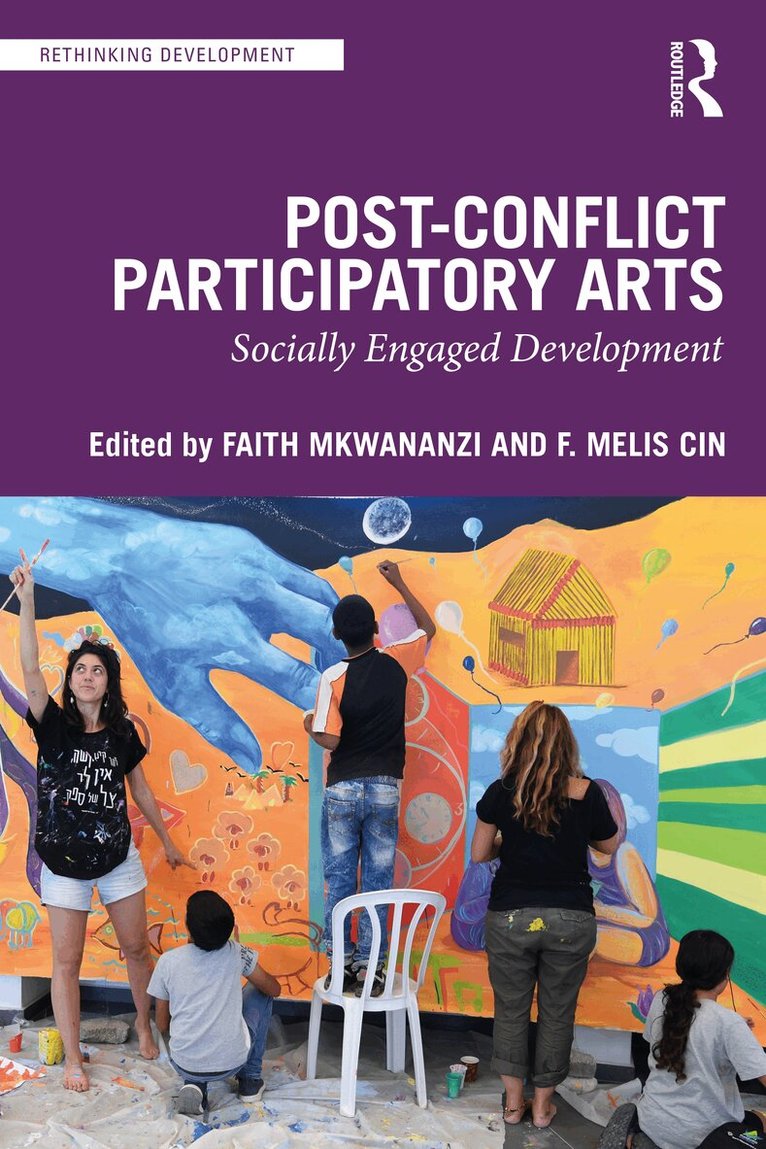
    Post-Conflict Participatory Arts

    Socially Engaged Development

    AvFaith Mkwananzi,F. Melis Cin

    Häftad, Engelska, 2021

    Del i serien Rethinking Development

    615 kr

    Beställningsvara. Skickas inom 10-15 vardagar. Fri frakt över 249 kr.

    Beskrivning

    This book investigates the power of art to enhance human development and to initiate positive social change for individuals and societies recovering from conflict. Interventions aimed at reinforcing social justice and bringing communities together after conflict are often accused of being top-down, or failing to consider all groups and contexts within a society. The use of participatory arts can help to address these challenges by fostering community engagement, social cohesion, influencing public policy, and ultimately, advancing social justice. Arts-based methods can be particularly effective at reaching youth communities, providing voice and political agency to young people who are often not given a platform. Situated at the intersection of participatory arts, social and epistemic justice, this book brings together case studies from across the world to reflect on best practice for the use of bottom-up, participatory, co-produced, and co-designed arts processes in conflict settings. This book provides an important guide to the role that arts can play in addressing epistemic injustice and contributing to social justice and human development. As such, it will be of interest to international development and arts practitioners, policy makers, and to students and researchers across participatory arts, youth studies, international development, social justice, and peace and conflict studies.

    Produktinformation

    • Utgivningsdatum:2021-12-16
    • Mått:156 x 234 x 18 mm
    • Vikt:460 g
    • Format:Häftad
    • Språk:Engelska
    • Serie:Rethinking Development
    • Antal sidor:240
    • Förlag:Taylor & Francis Ltd
    • ISBN:9780367638634

    Utforska kategorier

    • Referensverk och tvärvetenskap inom Samhälle och politik
    • Konstteori inom Kultur
    • Socialt arbete och välfärd inom Samhälle och politik

    Mer om författaren

    Faith Mkwananzi is a Researcher with the SARChI Chair in Higher Education and Human Development at the University of the Free State, South Africa. Her research centres on education, migration, and development in Sub-Saharan Africa. She has interests in the capability approach, as well as educational entrepreneurship and collaborative stakeholder engagement. She has been working on youth projects focusing on choices, opportunities, and aspirations. She also has experience using creative, participatory arts-based methods, including digital storytelling and photovoice with young people in less resourced communities in South Africa and Zimbabwe. Most of her research includes collaborations with NGOs, civic, and community-based organisations.F. Melis Cin is Senior Lecturer in Education and Social Justice at Lancaster University, UK. She is a feminist researcher with a particular interest in exploring the relationship between education and international development. She investigates how education can be used as a peace-building tool in conflict zones and employs socially engaged art interventions as a way to understand the local meanings of peace in formal and informal education settings.

    Recensioner i media

    "The authors and editors of Post-Conflict Participatory Arts have brought together a jewel of a book, weaving together years of experience in many different countries with a strong theoretical framing. It offers much to practitioners and to scholars of both participatory methodology and of peace and social justice. Whether dance, photovoice, graffiti or participatory video, the book demonstrates some of the potential and limitations of participatory arts in challenging environments and offers hope and inspiration for those seeking to work across boundaries in post-conflict contexts." - Chris High, Lecturer in Peace and Development, Linnaeus University, Sweden"This well-inquired book brings together ways in which the public is empowered to act, respond and interact around issues of civic engagement and political spaces through participatory art to improve people’s lives and wellbeing. It investigates concepts such as agency, power, with a focus on human advancement viewpoint in post-conflict communities that are often ignored by unequal epistemic relations and neoliberal development agendas. While the book could be a critical asset for policy-makers, artists, and art-based organisations, it too reminds us of Eugene Delacroix’s decree: ‘What moves men of genius, or rather what rouses their work, is not new ideas, but their obsession with the idea that what has already been said is still not enough.’" - Peggy Himoonde, BBA History, Lusaka National Museum, Zambia"Very insightful... The practicality of arts as an effective media towards the realization of epistemic/ social justice, is indeed a creative colorful approach." - Aubrey Bango, Visual Artist, Zimbabwe

    Innehållsförteckning

    • 1. Introduction: Participatory Arts in Building Socially Just Societies in the Global South, Faith Mkwananzi, F Melis Cin 2. Participatory Arts for Social and Epistemic Justice, F Melis Cin, Faith Mkwananzi Part I: Participatory Process of Arts for Epistemic Justice 3. Seeing Power, Co-creation, Filmmaking, and Intersectionality in Ilizwi Lenyaniso Lomhlaba, Aylwyn Walsh, Scott Burnett 4. Participatory Curatorship: Negotiating Heritage, Memory, and Justice in Northern Uganda, Abiti Nelson Adebo, Francis Nono, Kate Moles, Lizzi Milligan 5. The Use of Political Storytelling in Twitter to Fight Epistemic Injustice Against Women, Aslı Tosuner 6. Re-connecting with Cultural Heritage: How Participatory Video Enabled Youth in Palestine to Protect their Cultural Heritage, Marwan Darweish, Laura Sulin 7. Capturing Epistemic Responsibility and Resistance: Challenging Intercommunal Conflict through Photovoice, F. Melis Cin, Necmettin Doğan, Rahime Süleymanoğlu-Kürüm, Mehmet Melih Cin Part II: Community Engagement through Participatory Arts 8. Collaboration in Research: Insights from a Participatory Art Project in Zimbabwe, Joshua Chikozho, Willard Muntanga, Tendayi Marovah, Faith Mkwananzi 9. YouthLEAD: Measuring the Indirect Impact of Youth Peacebuilding through PhotoVoice and Community Murals in Colombia, Laura K. Taylor, Claudia Pineda Marín, Edwin Cubillos, Diego Alfonso 10. Youth, Police and Civil Society Organisation: Participatory Arts-based Clinics for Strengthening Security and Justice in Nepal, Nub Raj Bhandari 11. Creation and Communication: Reflecting on the Role of Arts Methods to enable Dialogue between Young People and Policy Makers in Kenya, Uganda, and the DRC, Su Lyn Corcoran, Charity Atukunda, Victoria Ferguson, Thomas D’Aquin Rubambura Mituga, Luc Amuri Mufano, Faustin Muliri, Virginie Tallio, Kate Pahl, Mike Ochieng Wamaya 12. Lebanon, The Youth Roll’: Experiencing Conflict as a Transcultural, Transnational Film Language, Paul Cooke, Nour Zeidan, Hana Addam El-Ghali, Cindrella Mizher, Emily Morrison 13. Conclusion: Where to Next? The Potentials and Liminality of Participatory Arts in Conflict, Faith Mkwananzi, F Melis Cin