• Fri frakt över 249 kr
  • •
  • Snabba leveranser
  • •
  • Billiga böcker
Kundservice

Du är på sajten för privatpersoner.

Företag, bibliotek eller offentlig verksamhet?

Du handlar på classic.bokus.com, där alla dina funktioner finns intakta.
Till classic.bokus.com
Bokus logotyp. Gå till startsidan.
  • Erbjudanden
  • Nyheter
  • Student
  • Topplistor
  • Barn & ungdom
  • Bokus Play
  • E-böcker
  • Pocketböcker
  • Spel & pussel

10% studentrabatt med kod TERM26

Sidfot

Mina sidor

    Hjälp

    • Kundservice
    • Vanliga frågor och svar
    • Frakt och leverans
    • Retur vid ångerrätt
    • Reklamera vara
    • Betalning
    • Köpvillkor
    • Allmänna villkor
    • Information om webbplatsens tillgänglighet

    Om Bokus

    • Om oss
    • Pressrum
    • För studenter
    • För företag
    • För bibliotek och offentlig verksamhet
    • För leverantörer
    • Hållbarhet

    Populärt

    • Aktuella erbjudanden
    • Presentkort
    • Studentlitteratur
    • Nya böcker
    • Topplistor
    • Signerade böcker
    • Engelska böcker

    Inspiration

    • Boktips
    • BookTok
    • Populära bokserier
    • Barnbokskaraktärer
    • Populära författare
    Logotyp för Bokus
    Följ oss på Facebook (extern länk)Följ oss på Instagram (extern länk)Följ oss på YouTube (extern länk)Följ oss på TikTok (extern länk)
    bokus @ CookiesAnpassa cookiesIntegritetspolicyKöpvillkor
    Till Citymail hemsida (extern länk)Till Budbee hemsida (extern länk)Till Postnord hemsida (extern länk)Till Schenker hemsida (extern länk)Till Early Bird hemsida (extern länk)Till Walleys hemsida (extern länk)
    1. Språk och ordböcker
    2. Språkundervisning och språkinlärning

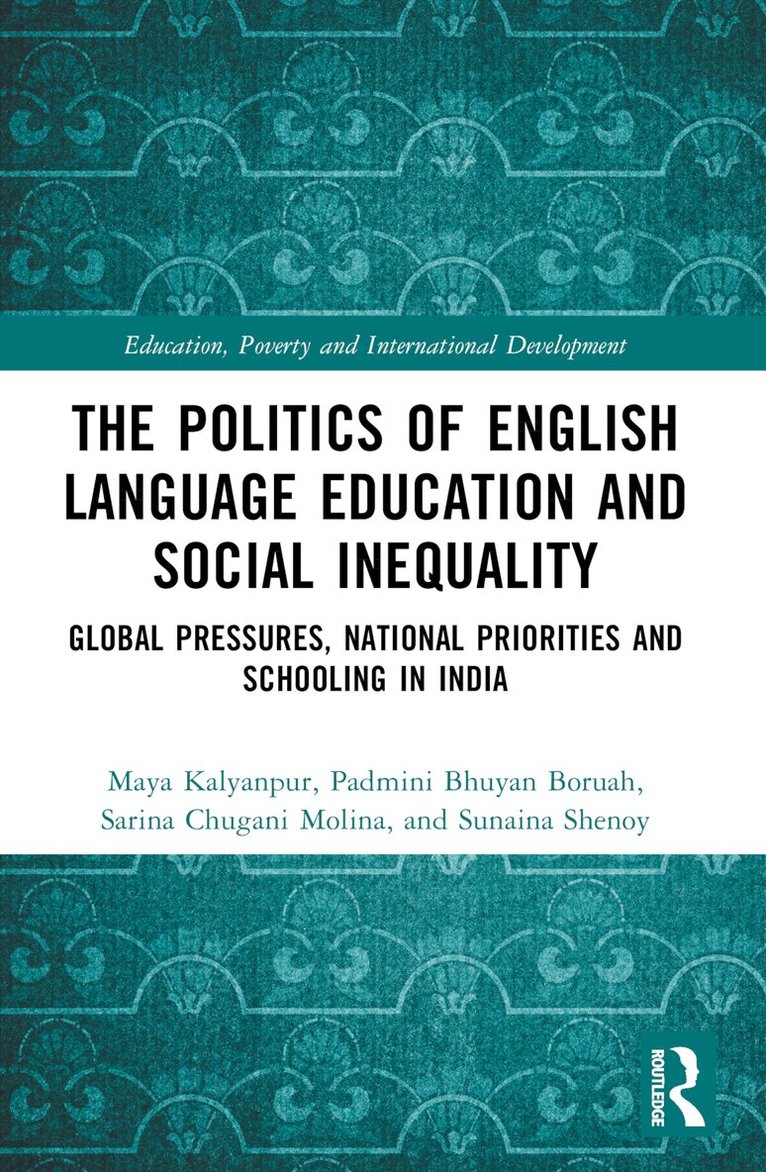
    Politics of English Language Education and Social Inequality

    Global Pressures, National Priorities and Schooling in India

    AvMaya Kalyanpur,Padmini Bhuyan Boruah

    Häftad, Engelska, 2022

    Del i serien Education, Poverty and International Development

    444 kr

    Skickas . Fri frakt över 249 kr.

    Fler format och utgåvor

    Inbunden

    2 009 kr

    Beskrivning

    Based on policy analysis and empirical data, this book examines the problematic consequences of colonial legacies of language policies and English language education in the multilingual contexts of the Global South.Using a postcolonial lens, the volume explores the raciolinguistics of language hierarchies that results in students from low-income backgrounds losing their mother tongues without acquiring academic fluency in English. Using findings from five major research projects, the book analyzes the specific context of India, where ambiguous language policies have led to uneasy tensions between the colonial language of English, national and state languages, and students’ linguistic diversity is mistaken for cognitive deficits when English is the medium of instruction in schools. The authors situate their own professional and personal experiences in their efforts at dismantling postcolonial structures through reflective practice as teacher educators, and present solutions of decolonial resistance to linguistic hierarchies that include critical pedagogical alternatives to bilingual education and opportunities for increased teacher agency.Ultimately, this timely volume will appeal to researchers, scholars, academics, and students in the fields of international and comparative education, English and literacy studies, and language arts more broadly. Those interested in English language learning in low-income countries specifically will also find this book to be of benefit to their research.

    Produktinformation

    • Utgivningsdatum:2022-12-30
    • Mått:156 x 234 x 14 mm
    • Vikt:340 g
    • Format:Häftad
    • Språk:Engelska
    • Serie:Education, Poverty and International Development
    • Antal sidor:200
    • Förlag:Taylor & Francis Ltd
    • ISBN:9780367646189

    Utforska kategorier

    • Språkundervisning och språkinlärning inom Språk och ordböcker
    • Språkvetenskap och lingvistik inom Språk och ordböcker
    • Utbildningsstrategier och utbildningspolitik inom Psykologi och pedagogik

    Mer om författaren

    Maya Kalyanpur is Professor of Inclusive Education, Department of Learning and Teaching at the University of San Diego, USA.Padmini Bhuyan Boruah is Professor and Head, Department of English Language Teaching at Gauhati University, India.Sarina Chugani Molina is Associate Professor in English Language Education, Department of Learning and Teaching, University of San Diego, USA.Sunaina Shenoy is Assistant Professor in the Educational Diagnostic Certificate Program, Department of Special Education, University of New Mexico, USA.

    Recensioner i media

    'This exquisitely complex book is invaluable for those of us seeking deeper understandings of the role played by English in magnifying economic inequalities globally. Building on wisdom drawn from their own life experiences with linguicide, transnationalism, and English-as-medium-of-education policies, these four authors render skilful analyses that shed light on the complicated dilemmas surrounding language-in-education policy. Offering insightful understandings widely applicable beyond the contemporary Indian context, the book provides supportive and constructive guidance for enacting critical resistance in the context of a range of often-neoliberal language policy reforms.'Suhanthie Motha, Associate Professor of Applied Linguistics/TESOL, English Department, University of Washington, USA'This book provides critical insights into processes of globalization and multilingual education from the perspective of the less privileged. Embodied by the personal experiences of four scholars from different regions and language groups, and richly situated in classrooms and communities in India, the book portrays dysfunctional outcomes. Educational policies motivated by the global pressures of economic progress and national goals of development hamper proficiencies in both heritage languages and English. We leave persuaded that a pedagogy that honestly addresses economic disparities, critiques ongoing colonial designs, and values heritage languages and epistemologies is more beneficial for the Global South.'Professor Suresh Canagarajah, Pennsylvania State University, USA. 'This book makes a significant contribution to bringing together post-colonial scholarship on the politics and practices of language policies and language education. It draws on rich lived experiences of the diverse language identities of the authors. This richness is evident throughout the text as the authors engage in a nuanced manner with a complex intellectual terrain on language politics, whilst drawing on research evidence from the field. The arguments presented in the book also problematise the construction of disability and the labelling of learning disability especially in schooling contexts, such as those in India. The book raises important points in relation to how ‘disability’ labels are uncritically adopted in settings such as many English medium schools which provide access to first generation learners and largely non-English speakers from low-income background.'Nidhi Singal, Professor of Disability and Inclusive Education, University of Cambridge, UK'This provocative book will change how you think about language teaching and learning. In The Politics of English Language Education and Social Inequality, Kalyanpur, Boruah, Molina, and Shenoy offer an incisive analysis of how English language education operates as a colonizing presence. With a focus on a multilingual nation that has a complex relationship with English—India—the authors brilliantly weave personal experiences with research data and theory in order to illuminate reverberations of language policy, language teaching, and the language experiences of children across dimensions that range from identity to national policy to global domination.'Christine Sleeter, Professor Emerita, School of Professional Studies, California State University-Monterey Bay, USA'This book, authored by four Indian women, is unlike any other. It is written from the heart and from the women’s own life experiences and academic research. Theory about the role of English education in colonialism and globalization, as well as its relationship to poverty, flow here from the local Indian context, as the authors reflect jointly and foreground their own positionality. The book is an example of decolonial resistance not only to traditional English language education, but also to academic treatises that do not reveal the authors’ selves.'Ofelia García, Professor Emerita, The Graduate Center, City University of New York, USA

    Innehållsförteckning

    • About the AuthorsList of figures and tablesList of abbreviationsAcknowledgementsPrologue: Our language storiesPART I: The global context for language policy1 Introducing a postcolonial perspective on language educationA colonial/postcolonial frameworkLanguage as a tool of oppression in globalizationThe diminishment of non-world languagesSocio-economic barriers to acquisition of the English LanguageThe structure of the book2 Language, linguicide and equity: Navigating the tension between heritage, national and colonial agendasLanguage vitality, status, and terminologyNational language policies in Pakistan and Bangladesh: Issues of linguistic equityThe Chinese language diaspora in East AsiaLanguage challenges in Taiwan and Hong KongLinguicide or the integration of heritage language education?Part II: The politics and practice of India’s language education policy3. Language contestations and the illusions around English in India’s Three Language Formula English in education: From constitutional provisions to policyEnglish as deliverance, English as Indian: Competing social and educational goalsPedagogic models of English Language Teaching: Ground realities and social disadvantageRepositioning English: Empowerment agendas and multiliteracy frameworksConclusion4. English language teachers and teacher education: Challenging normative linguistic positionings The impact of national education policies on language teacher educationMoving beyond the colonial legacy: Alternative pedagogy and curricular models of language educationTeachers’ pedagogy, invisibility, voice and agencyRestructuring English language teacher education: New initiativesConclusion5. English medium private schools: Teaching bilingual and multilingual students in the context of inequalityLanguage teaching in Karnataka private schools: Linguistic and cultural contextsLanguage of instruction: Helping those who struggleEnglish language teaching in classroom contexts Conclusion6. L2 English language acquisition: Dyslexia and learning inequalities in private schoolsDyslexia: the language difference vs learning disorder debateDyslexia and English literary acquisition in the Indian school contextLearning disabilities, dyslexia and disadvantageThe implications for disadvantaged learners in English medium private schoolsConclusionPart III: Decolonizing language education and challenging disadvantage 7. English language education and the case against neutralityLanguage and globalization: Hybridity, neutrality, and the danger of complicityRace and power: The persistence of racio-linguistic ideologiesConsidering postcolonial approaches in the English language classroomReimagining a possible future of English language education8. Challenging disadvantage through language education policy and practice: New postcolonial directionsThe complexities and challenges of language education policies and practices Engaging in decolonial resistance and critical pedagogyThe reflective practitioner: Rethinking our professional selves ConclusionGlossaryIndex