• Fri frakt över 249 kr
  • •
  • Snabba leveranser
  • •
  • Billiga böcker
Kundservice

Du är på sajten för privatpersoner.

Företag, bibliotek eller offentlig verksamhet?

Du handlar på classic.bokus.com, där alla dina funktioner finns intakta.
Till classic.bokus.com
Bokus logotyp. Gå till startsidan.
  • Erbjudanden
  • Nyheter
  • Student
  • Topplistor
  • Barn & ungdom
  • Bokus Play
  • E-böcker
  • Pocketböcker
  • Spel & pussel

10% rabatt på allt med kod: NYSTART10 →

Sidfot

Mina sidor

    Hjälp

    • Kundservice
    • Vanliga frågor och svar
    • Frakt och leverans
    • Retur vid ångerrätt
    • Reklamera vara
    • Betalning
    • Köpvillkor
    • Allmänna villkor
    • Information om webbplatsens tillgänglighet

    Om Bokus

    • Om oss
    • Pressrum
    • För studenter
    • För företag
    • För bibliotek och offentlig verksamhet
    • För leverantörer
    • Hållbarhet

    Populärt

    • Aktuella erbjudanden
    • Presentkort
    • Studentlitteratur
    • Nya böcker
    • Topplistor
    • Signerade böcker
    • Engelska böcker

    Inspiration

    • Boktips
    • BookTok
    • Populära bokserier
    • Barnbokskaraktärer
    • Populära författare
    Logotyp för Bokus
    Följ oss på Facebook (extern länk)Följ oss på Instagram (extern länk)Följ oss på YouTube (extern länk)Följ oss på TikTok (extern länk)
    bokus @ CookiesAnpassa cookiesIntegritetspolicyKöpvillkor
    Till Citymail hemsida (extern länk)Till Budbee hemsida (extern länk)Till Postnord hemsida (extern länk)Till Schenker hemsida (extern länk)Till Early Bird hemsida (extern länk)Till Walleys hemsida (extern länk)
    1. Samhälle och politik
    2. Samhälle och kultur
    3. Kultur och medier
    4. Referensverk och tvärvetenskap

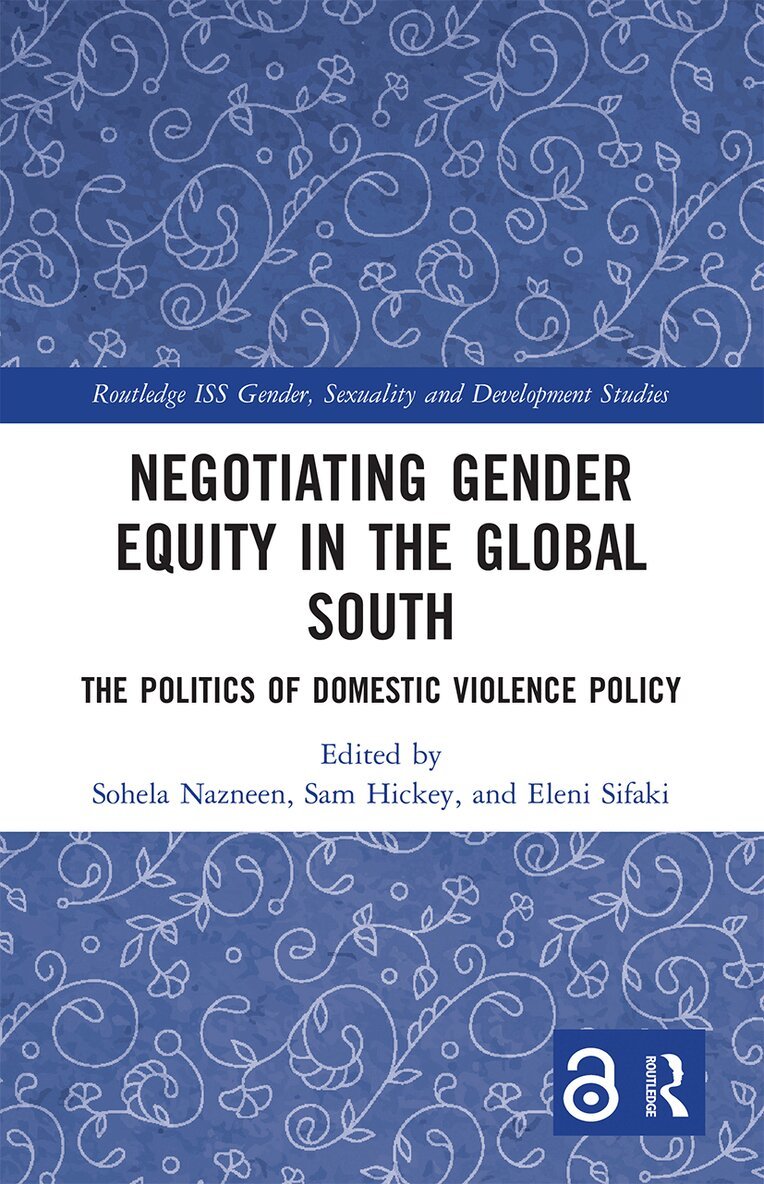
    Negotiating Gender Equity in the Global South

    The Politics of Domestic Violence Policy

    AvSohela Nazneen,Sam Hickey

    Häftad, Engelska, 2020

    Del i serien Routledge ISS Gender, Sexuality and Development Studies

    667 kr

    Beställningsvara. Skickas inom 10-15 vardagar. Fri frakt över 249 kr.

    Beskrivning

    The Open Access version of this book, available at https://doi.org/10.4324/9781351245623, has been made available under a Creative Commons Attribution-Non Commercial-No Derivatives 4.0 license. The fact that women have achieved higher levels of political inclusion within low- and middle-income countries has generated much speculation about whether this is reaping broader benefits in tackling gender-based inequalities. This book uncovers the multiple political dynamics that influence governments to adopt and implement gender equity policies, pushing the debate beyond simply the role of women’s inclusion in influencing policy. Bringing the politics of development into discussion with feminist literature on women's empowerment, the book proposes the new concept of ‘power domains’ as a way to capture how inter-elite bargaining, coalitional politics, and social movement activism combine to shape policies that promote gender equity.In particular, the book investigates the conditions under which countries in sub-Saharan Africa and South Asia have adopted legislation against domestic violence, which remains widespread in many developing countries. The book demonstrates that women’s presence in formal politics and policy spaces does not fully explain the pace in adopting and implementing domestic violence law. Underlying drivers of change within broader domains of power also include the role of clientelistic politics and informal processes of bargaining, coalition-building, and persuasion; the discursive framing of gender-equitable ideas; and how transnational norms influence women’s political inclusion and gender-inclusive policy outcomes. The comparative approach across Uganda, Rwanda, South Africa, Ghana, India, and Bangladesh demonstrates how advancing gender equality varies by political context and according to the interests surrounding a particular issue.Negotiating Gender Equity in the Global South will be of interest to students and scholars of gender and development, as well as to activists within governments, political parties, nongovernmental organizations, women’s movements, and donor agencies, at national and international levels, who are looking to develop effective strategies for advancing gender equality.

    Produktinformation

    • Utgivningsdatum:2020-09-30
    • Mått:156 x 234 x 27 mm
    • Vikt:453 g
    • Format:Häftad
    • Språk:Engelska
    • Serie:Routledge ISS Gender, Sexuality and Development Studies
    • Antal sidor:262
    • Förlag:Taylor & Francis Ltd
    • ISBN:9780367660574

    Utforska kategorier

    • Referensverk och tvärvetenskap inom Samhälle och politik
    • Genusvetenskap inom Samhälle och politik
    • Våld och övergrepp inom Samhälle och politik

    Mer om författaren

    Sohela Nazneen, Research Fellow, Gender and Sexuality, Institute of Development Studies, University of Sussex, UK.Sam Hickey, Professor of Politics and Development and Research Director, Effective States and Inclusive Development Research Centre (ESID), The University of Manchester, UK.Eleni Sifaki, Research Associate, Effective States and Inclusive Development Research Centre (ESID), The University of Manchester, UK.

    Recensioner i media

    'This book provides exciting new ways of thinking about how women’s rights policy change occurs in the Global South. Drawing on meso-level analysis of how six countries passed legislation to combat domestic violence, the book shows, for example, the importance of forming strategic alliances around the interests and ideas of dominant actors; the role of elite cohesion; and the politics of ideas and discursive framing of gender equity. It is certain to influence contemporary thinking about gender-related policy reform and, as such, it is a must read for international and domestic policy makers, women's rights activists, donors, scholars of gender and politics, and many others.'-- Aili Mari Tripp, Wangari Maathai Professor of Political Science & Gender and Women’s Studies, University of Wisconsin-Madison, USA'Understanding the political processes that lead to greater gender equity in the Global South is a first step in tackling problems such as domestic violence in a transformative way. This book makes an important contribution both conceptually and empirically in this highly policy-relevant field – a must read for scholars, activists, and policy-makers committed to promote gender equality and social justice.' -- Katja Hujo, Senior Research Coordinator, Social Policy and Development Programme, UNRISD, Switzerland'This book is a great addition to the literature on gender equality policies, focusing particularly on domestic violence in the Global South. It carefully demonstrates the strategies for confronting deeply entrenched power inequalities across institutions of the state and society. A must read for activists and researchers alike.' -- Nitya Rao, Professor of Gender and Development, University of East Anglia, UK'This is an excellent collection of articles. Not only does it deal with a topic that has been prioritized by the international women’s movement, but it does so in an intellectually coherent way by locating empirical analysis from different parts of the world within a shared theoretical framework and a common research methodology.' -- Naila Kabeer, Professor of Gender and Development, London School of Economics and Political Science (LSE), UK'Bringing together leading experts on gender and politics, this book demonstrates how states come to introduce and implement GBV laws. Diverse case studies draw attention to broad, inclusive feminist coalitions: cultivating both high-level and grassroots support. Enforcement and normative change then emerge as conditional upon three key dynamics: state commitment, state capacity, and state collaboration with civil society.' -- Alice Evans, Lecturer in the Social Science of Development, King’s College London, UK

    Innehållsförteckning

    • PART I: The politics of gender equity: setting the scene 1. Beyond the inclusion-to-influence debate: the politics of negotiating gender equity 2. Investigating the politics of gender equity through a power domains approach 3.Ending domestic violence: the politics of global norm diffusion PART II: The power of strongmen and ruling coalitions: promoting gender equity in dominant settlements 4. Contesting ideas, aligning incentives: the politics of Uganda’s Domestic Violence Act (2010) 5. Establishing a strong political commitment to gender equity: the politics of Rwanda’s law on the Prevention and Punishment of Gender-Based Violence (2008) 6. Achieving a broad-based coalition: the politics of South Africa’s Domestic Violence Act (1998) PART III: The significance of informal networks: promoting gender equity in competitive settlements 7. Building strategic relationships with the political elites: the politics of Bangladesh’s Domestic Violence Act 2010 8. Between democratization and patronage: the politics of Ghana’s Domestic Violence Act (2007) 9. Building strong alliances: the politics of the Protection of Domestic Violence Act in India (2006) PART IV: Concluding thoughts and ways forward 10. How does politics shape the negotiation of gender equity in the Global South? A comparative analysis 11. Researching the politics of gender equity: next steps 12. From transformative policy to transforming political settlements