• Fri frakt över 249 kr
  • •
  • Snabba leveranser
  • •
  • Billiga böcker
Kundservice

Du är på sajten för privatpersoner.

Företag, bibliotek eller offentlig verksamhet?

Du handlar på classic.bokus.com, där alla dina funktioner finns intakta.
Till classic.bokus.com
Bokus logotyp. Gå till startsidan.
  • Erbjudanden
  • Student
  • Topplistor
  • Barn & ungdom
  • Bokus Play
  • E-böcker
  • Ljudböcker
  • Pocketböcker
  • Spel och pussel

Skapa nya rutiner – hälsoböcker upp till 50% →

Sidfot

Mina sidor

    Hjälp

    • Kundservice
    • Vanliga frågor och svar
    • Frakt och leverans
    • Retur vid ångerrätt
    • Reklamera vara
    • Betalning
    • Köpvillkor
    • Allmänna villkor
    • Information om webbplatsens tillgänglighet

    Om Bokus

    • Om oss
    • Pressrum
    • För studenter
    • För företag
    • För bibliotek och offentlig verksamhet
    • För leverantörer
    • Hållbarhet

    Populärt

    • Aktuella erbjudanden
    • Presentkort
    • Studentlitteratur
    • Nya böcker
    • Topplistor
    • Signerade böcker
    • Engelska böcker

    Inspiration

    • Boktips
    • BookTok
    • Barnbokskaraktärer
    • Populära författare
    Logotyp för Bokus
    Följ oss på Facebook (extern länk)Följ oss på Instagram (extern länk)Följ oss på YouTube (extern länk)Följ oss på TikTok (extern länk)
    bokus @ CookiesAnpassa cookiesIntegritetspolicyKöpvillkor
    Till Citymail hemsida (extern länk)Till Budbee hemsida (extern länk)Till Postnord hemsida (extern länk)Till Schenker hemsida (extern länk)Till Early Bird hemsida (extern länk)Till Walleys hemsida (extern länk)
    1. Data och IT
    2. Systemvetenskap och AI

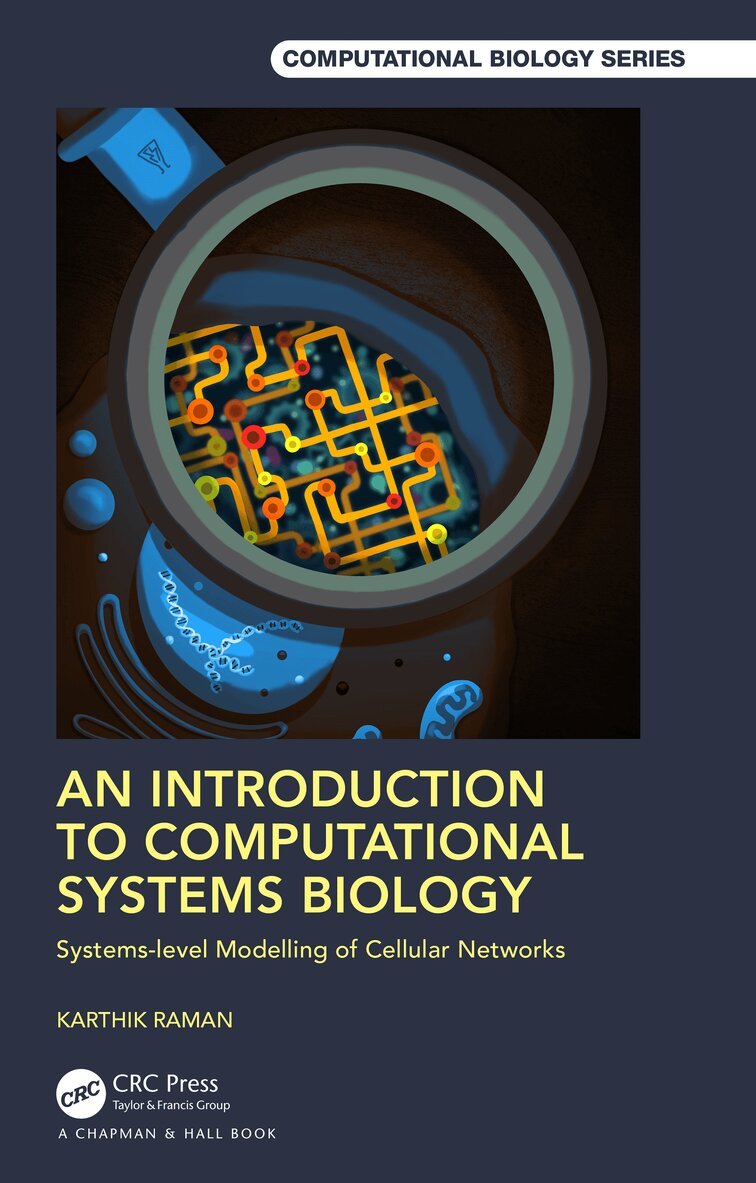
    Introduction to Computational Systems Biology

    Systems-Level Modelling of Cellular Networks

    AvKarthik Raman

    Häftad, Engelska, 2023

    Del i serien Chapman & Hall/CRC Computational Biology Series

    717 kr

    Beställningsvara. Skickas inom 10-15 vardagar. Fri frakt över 249 kr.

    Fler format och utgåvor

    E-bok

    855 kr

    E-bok

    855 kr

    Inbunden

    2 049 kr

    Beskrivning

    This book delivers a comprehensive and insightful account of applying mathematical modelling approaches to very large biological systems and networks—a fundamental aspect of computational systems biology. The book covers key modelling paradigms in detail, while at the same time retaining a simplicity that will appeal to those from less quantitative fields. Key Features: A hands-on approach to modelling Covers a broad spectrum of modelling, from static networks to dynamic models and constraint-based models Thoughtful exercises to test and enable understanding of concepts State-of-the-art chapters on exciting new developments, like community modelling and biological circuit design Emphasis on coding and software tools for systems biology Companion website featuring lecture videos, figure slides, codes, supplementary exercises, further reading, and appendices: https://ramanlab.github.io/SysBioBook/An Introduction to Computational Systems Biology: Systems-Level Modelling of Cellular Networks is highly multi-disciplinary and will appeal to biologists, engineers, computer scientists, mathematicians and others.

    Produktinformation

    • Utgivningsdatum:2023-05-29
    • Mått:156 x 234 x 19 mm
    • Vikt:504 g
    • Format:Häftad
    • Språk:Engelska
    • Serie:Chapman & Hall/CRC Computational Biology Series
    • Antal sidor:358
    • Förlag:Taylor & Francis Ltd
    • ISBN:9780367752507

    Utforska kategorier

    • Systemvetenskap och AI inom Data och IT
    • Tillämpad fysik inom Naturvetenskap och teknik
    • Biokemi inom Naturvetenskap och teknik

    Mer om författaren

    Dr. Karthik Raman is an Associate Professor at the Department of Biotechnology, Bhupat & Jyoti Mehta School of Biosciences, Indian Institute of Technology Madras. He co-founded and co-ordinates the Initiative for Biological Systems Engineering and is a core member of the Robert Bosch Centre for Data Science and Artificial Intelligence (RBCDSAI). He has been a researcher in the area of systems biology for the last 15+ years and has been teaching a course on systems biology for the last eight years, to (mostly) engineers from different backgrounds. His lab works on computational approaches to understand and manipulate biological networks, with applications in metabolic engineering and synthetic biology.

    Recensioner i media

    This is a very comprehensive read that provides a solid base in computational biology. The book is structured in 4 parts and 14 chapters which cover all the way from the more basic concepts to advanced material, including the state-of-the-art methodologies in synthetic and systems biology. This is a bedside book for those researchers embarking to do investigation in computational biology and a great office companion for anyone working on systems and synthetic biology.-- Rodrigo Ledesma Amaro, Lecturer, Imperial College London This is a fantastic book. It offers an elegant introduction to both classical and modern concepts in computational biology. To the uninitiated, it is a terrific first read, bringing alive the glory of the past and the promise of the future. To the interested, it handholds and offers a springboard to dive deep. To the practitioner, it serves as a valuable resource bringing together in a panoramic view many diverse streams that adorn the landscape.-- Narendra M. Dixit, Professor, Indian Institute of Science

    Innehållsförteckning

    • PrefaceIntroduction to modelling 1.1 WHAT IS MODELLING? 1.1.1 What are models? 1.2 WHYBUILD MODELS? 1.2.1 Why model biological systems? 1.2.2 Why systems biology? 1.3 CHALLENGES IN MODELLING BIOLOGICAL SYSTEMS 1.4 THE PRACTICE OF MODELLING 1.4.1 Scope of the model1.4.2 Making assumptions 1.4.3 Modelling paradigms 1.4.4 Building the model 1.4.5 Model analysis, debugging and (in)validation 1.4.6 Simulating the model 1.5 EXAMPLES OF MODELS 1.5.1 Lotka–Volterra predator–prey model 1.5.2 SIR model: a classic example 1.6 TROUBLESHOOTING 1.6.1 Clarity of scope and objectives 1.6.2 The breakdown of assumptions 1.6.3 Ismy model fit for purpose? 1.6.4 Handling uncertainties EXERCISES REFERENCES FURTHER READING Introduction to graph theory 2.1 BASICS 2.1.1 History of graph theory 2.1.2 Examples of graphs 2.2 WHYGRAPHS? 2.3 TYPES OF GRAPHS 2.3.1 Simple vs. non-simple graphs 2.3.2 Directed vs. undirected graphs 2.3.3 Weighted vs. unweighted graphs 2.3.4 Other graph types 2.3.5 Hypergraphs 2.4 COMPUTATIONAL REPRESENTATIONS OF GRAPHS 2.4.1 Data structures 2.4.2 Adjacency matrix 2.4.3 The laplacian matrix 2.5 GRAPH REPRESENTATIONS OF BIOLOGICAL NETWORKS 2.5.1 Networks of protein interactions and functional associations2.5.2 Signalling networks 2.5.3 Protein structure networks 2.5.4 Gene regulatory networks 2.5.5 Metabolic networks 2.6 COMMONCHALLENGES&TROUBLESHOOTING 2.6.1 Choosing a representation 2.6.2 Loading and creating graphs 2.7 SOFTWARE TOOLS EXERCISES REFERENCES FURTHER READING Structure of networks 3.1 NETWORK PARAMETERS 3.1.1 Fundamental parameters 3.1.2 Measures of centrality 3.1.3 Mixing patterns: assortativity 3.2 CANONICAL NETWORK MODELS 3.2.1 Erdos–Rényi (ER) network model 3.2.2 Small-world networks 3.2.3 Scale-free networks 3.2.4 Other models of network generation 3.3 COMMUNITY DETECTION 3.3.1 Modularity maximisation 3.3.2 Similarity-based clustering 3.3.3 Girvan–Newman algorithm 3.3.4 Other methods 3.3.5 Community detection in biological networks 3.4 NETWORKMOTIFS 3.4.1 Randomising networks 3.5 PERTURBATIONS TO NETWORKS 3.5.1 Quantifying e□fects of perturbation 3.5.2 Network structure and attack strategies 3.6 TROUBLESHOOTING 3.6.1 Is your network really scale-free? 3.7 SOFTWARE TOOLS EXERCISES REFERENCESFURTHER READING Applications of network biology 4.1 THE CENTRALITY–LETHALITY HYPOTHESIS 4.1.1 Predicting essential genes fromnetworks 4.2 NETWORKS AND MODULES IN DISEASE 4.2.1 Disease networks 4.2.2 Identification of disease modules 4.2.3 Edgetic perturbation models 4.3 DIFFERENTIAL NETWORK ANALYSIS 4.4 DISEASE SPREADING ON NETWORKS 4.4.1 Percolation-based models 4.4.2 Agent-based simulations 4.5 MOLECULAR GRAPHS AND THEIR APPLICATIONS 4.5.1 Retrosynthesis 4.6 PROTEIN STRUCTURE, ENERGY & CONFORMATIONAL NETWORKS4.6.1 Protein folding pathways 4.7 LINK PREDICTION EXERCISES REFERENCES FURTHER READING Introduction to dynamic modelling5.1 CONSTRUCTING DYNAMIC MODELS 5.1.1 Modelling a generic biochemical system 5.2 MASS-ACTION KINETIC MODELS 5.3 MODELLING ENZYME KINETICS 5.3.1 The Michaelis–Menten model 5.3.2 Extending the Michaelis–Menten model 5.3.3 Limitations of Michaelis–Menten models 5.3.4 Co-operativity: Hill kinetics 5.3.5 An illustrative example: a three-node oscillator 5.4 GENERALISED RATE EQUATIONS 5.4.1 Biochemical systems theory 5.5 SOLVING ODES 5.6 TROUBLESHOOTING 5.6.1 Handing sti□f equations 5.6.2 Handling uncertainty 5.7 SOFTWARE TOOLS EXERCISES REFERENCES FURTHER READING Parameter estimation 6.1 DATA-DRIVEN MECHANISTIC MODELLING: AN OVERVIEW 6.1.1 Pre-processing the data 6.1.2 Model identification 6.2 SETTING UP AN OPTIMISATION PROBLEM 6.2.1 Linear regression 6.2.2 Least squares 6.2.3 Maximumlikelihood estimation 6.3 ALGORITHMS FOR OPTIMISATION 6.3.1 Desiderata 6.3.2 Gradient-based methods 6.3.3 Direct search methods 6.3.4 Evolutionary algorithms 6.4 POST-REGRESSION DIAGNOSTICS 6.4.1 Model selection 6.4.2 Sensitivity and robustness of biological models 6.5 TROUBLESHOOTING 6.5.1 Regularisation 6.5.2 Sloppiness 6.5.3 Choosing a search algorithm 6.5.4 Model reduction 6.5.5 The curse of dimensionality 6.6 SOFTWARE TOOLS EXERCISES REFERENCES FURTHER READING Discrete dynamic models: Boolean networks 7.1 INTRODUCTION 7.2 BOOLEAN NETWORKS: TRANSFER FUNCTIONS 7.2.1 Characterising Boolean network dynamics 7.2.2 Synchronous vs. asynchronous updates 7.3 OTHER PARADIGMS 7.3.1 Probabilistic Boolean networks 7.3.2 Logical interaction hypergraphs 7.3.3 Generalised logical networks 7.3.4 Petri nets 7.4 APPLICATIONS 7.5 TROUBLESHOOTING 7.6 SOFTWARE TOOLS EXERCISES REFERENCES FURTHER READING Introduction to constraint-based modelling 8.1 WHAT ARE CONSTRAINTS? 8.1.1 Types of constraints 8.1.2 Mathematical representation of constraints 8.1.3 Why are constraints useful? 8.2 THE STOICHIOMETRICMATRIX 8.3 STEADY-STATEMASSBALANCE:FLUXBALANCEANALYSIS (FBA)8.4 THE OBJECTIVE FUNCTION 8.4.1 The biomass objective function 8.5 OPTIMISATION TO COMPUTE FLUX DISTRIBUTION 8.6 AN ILLUSTRATION 8.7 FLUX VARIABILITY ANALYSIS (FVA) 8.8 UNDERSTANDING FBA 8.8.1 Blocked reactions and dead-end metabolites 8.8.2 Gaps in metabolic networks 8.8.3 Multiple solutions8.8.4 Loops 8.8.5 Parsimonious FBA (pFBA) 8.8.6 ATP maintenance fluxes 8.9 TROUBLESHOOTING 8.9.1 Zero growth rate 8.9.2 Objective values vs. flux values 8.10 SOFTWARE TOOLS EXERCISES REFERENCES FURTHER READING Extending constraint-based approaches 9.1 MINIMISATION OF METABOLIC ADJUSTMENT (MOMA) 9.1.1 Fitting experimentally measured fluxes 9.2 REGULATORY ON-OFF MINIMISATION (ROOM) 9.2.1 ROOMvs.MoMA 9.3 BI-LEVEL OPTIMISATIONS 9.3.1 OptKnock9.4 INTEGRATING REGULATORY INFORMATION 9.4.1 Embedding regulatory logic: regulatory FBA (rFBA) 9.4.2 Informing metabolic models with omic data 9.4.3 Tissue-specific models 9.5 COMPARTMENTALISED MODELS 9.6 DYNAMIC FLUX BALANCE ANALYSIS (dFBA) 9.7 13C-MFA 9.8 ELEMENTARY FLUX MODES AND EXTREME PATHWAYS 9.8.1 Computing EFMs and EPs 9.8.2 Applications EXERCISES REFERENCES FURTHER READINGPerturbations to metabolic networks10.1 KNOCK-OUTS 10.1.1 Gene deletions vs. reaction deletions 10.2 SYNTHETIC LETHALS 10.2.1 Exhaustive enumeration 10.2.2 Bi-level optimisation 10.2.3 Fast-SL: massively pruning the search space 10.3 OVER-EXPRESSION 10.3.1 Flux Scanning based on Enforced Objective Flux (FSEOF) 10.4 OTHER PERTURBATIONS 10.5 EVALUATING AND RANKING PERTURBATIONS 10.6 APPLICATIONS OF CONSTRAINT-BASED MODELS 10.6.1 Metabolic engineering 10.6.2 Drug target identification 10.7 LIMITATIONS OF CONSTRAINT-BASED APPROACHES 10.7.1 Scope of genome-scale metabolic models 10.7.2 Incorrect predictions 10.8 TROUBLESHOOTING10.8.1 Interpreting gene deletion simulations 10.9 SOFTWARE TOOLSEXERCISES REFERENCES FURTHER READING Modelling cellular interactions 11.1 MICROBIAL COMMUNITIES 11.1.1 Network-based approaches 11.1.2 Population-based and agent-based approaches 11.1.3 Constraint-based approaches 11.2 HOST–PATHOGEN INTERACTIONS (HPIs) 11.2.1 Network models 11.2.2 Dynamic models 11.2.3 Constraint-based models 11.3 SUMMARY11.4 SOFTWARE TOOLS EXERCISES REFERENCES FURTHER READING Designing biological circuits 12.1 WHAT IS SYNTHETIC BIOLOGY? 12.2 FROMLEGO BRICKS TO BIOBRICKS 12.3 CLASSIC CIRCUIT DESIGN EXPERIMENTS 12.3.1 Designing an oscillator: the repressilator 12.3.2 Toggle switch 12.4 DESIGNING MODULES 12.4.1 Exploring the design space 12.4.2 Systems-theoretic approaches 12.4.3 Automating circuit design 12.5 DESIGN PRINCIPLES OF BIOLOGICAL NETWORKS 12.5.1 Redundancy 12.5.2 Modularity 12.5.3 Exaptation 12.5.4 Robustness 12.6 COMPUTING WITH CELLS 12.6.1 Adleman’s classic experiment 12.6.2 Examples of circuits that can compute 12.6.3 DNA data storage 12.7 CHALLENGES 12.8 SOFTWARE TOOLS EXERCISES REFERENCES FURTHER READING Robustness and evolvability of biological systems 13.1 ROBUSTNESS IN BIOLOGICAL SYSTEMS 13.1.1 Key mechanisms 13.1.2 Hierarchies and protocols 13.1.3 Organising principles 13.2 GENOTYPE SPACES AND GENOTYPE NETWORKS 13.2.1 Genotype spaces 13.2.2 Genotype–phenotype mapping 13.3 QUANTIFYING ROBUSTNESS AND EVOLVABILITY 13.4 SOFTWARE TOOLS EXERCISES REFERENCES FURTHER READING Epilogue: The Road Ahead Index 325
    Hoppa över listan

    Mer från samma författare

    Karthik Raman, Aarthi Ravikrishnan - Systems-Level Modelling of Microbial Communities, E-bok

    Systems-Level Modelling of Microbial Communities

    Karthik Raman, Aarthi Ravikrishnan

    E-bok
    2018

    370 kr

    Karthik Raman, Aarthi Ravikrishnan - Systems-Level Modelling of Microbial Communities, E-bok

    Systems-Level Modelling of Microbial Communities

    Karthik Raman, Aarthi Ravikrishnan

    E-bok
    2018

    369 kr

    Aarthi Ravikrishnan, Karthik Raman - Systems-Level Modelling of Microbial Communities, Häftad

    Systems-Level Modelling of Microbial Communities

    Aarthi Ravikrishnan, Karthik Raman

    Häftad, 2021

    315 kr

    Karthik Raman, Gayathri Sambamoorthy - Modelling the Microbiome, Inbunden
    Del 3006

    Modelling the Microbiome

    Karthik Raman, Gayathri Sambamoorthy

    Inbunden, 2026

    2 149 kr

    Gayathri Sambamoorthy, Karthik Raman - Modelling the Microbiome, E-bok

    Modelling the Microbiome

    Gayathri Sambamoorthy, Karthik Raman

    E-bok
    2026

    2 833 kr

    Aarthi Ravikrishnan, Karthik Raman - Systems-Level Modelling of Microbial Communities, Inbunden

    Systems-Level Modelling of Microbial Communities

    Aarthi Ravikrishnan, Karthik Raman

    Inbunden, 2018

    958 kr

    Karthik Raman - Twenty Years to Judgement Day, E-bok

    Twenty Years to Judgement Day

    Karthik Raman

    E-bok

    31 kr

    Vishwesh V. Kulkarni, Guy-Bart Stan, Karthik Raman - Systems Theoretic Approach to Systems and Synthetic Biology I: Models and System Characterizations, Inbunden

    Systems Theoretic Approach to Systems and Synthetic Biology I: Models and System Characterizations

    Vishwesh V. Kulkarni, Guy-Bart Stan, Karthik Raman

    Inbunden, 2014

    1 608 kr

    Karthik Raman, Guy-Bart Stan, Vishwesh V. Kulkarni - Systems Theoretic Approach to Systems and Synthetic Biology I: Models and System Characterizations, E-bok

    Systems Theoretic Approach to Systems and Synthetic Biology I: Models and System Characterizations

    Karthik Raman, Guy-Bart Stan, Vishwesh V. Kulkarni

    E-bok
    2014

    2 105 kr

    Vishwesh V. Kulkarni, Guy-Bart Stan, Karthik Raman - Systems Theoretic Approach to Systems and Synthetic Biology II: Analysis and Design of Cellular Systems, Inbunden

    Systems Theoretic Approach to Systems and Synthetic Biology II: Analysis and Design of Cellular Systems

    Vishwesh V. Kulkarni, Guy-Bart Stan, Karthik Raman

    Inbunden, 2014

    1 608 kr

    Hoppa över listan

    Mer från samma serie

    Uri Alon - Systems Medicine, Häftad

    Systems Medicine

    Uri Alon

    Häftad, 2023

    916 kr

    Momiao Xiong - Big Data in Omics and Imaging, Two Volume Set, Övrigt

    Big Data in Omics and Imaging, Two Volume Set

    Momiao Xiong

    4 606 kr

    Inna Kuperstein, Emmanuel Barillot - Computational Systems Biology Approaches in Cancer Research, Inbunden

    Computational Systems Biology Approaches in Cancer Research

    Inna Kuperstein, Emmanuel Barillot

    Inbunden, 2019

    1 498 kr

    Ralf Blossey - Computational Biology, Häftad

    Computational Biology

    Ralf Blossey

    Häftad, 2019

    954 kr

    Golan Yona - Introduction to Computational Proteomics, Häftad

    Introduction to Computational Proteomics

    Golan Yona

    Häftad, 2019

    996 kr

    Kiyoko F. Aoki-Kinoshita - Glycome Informatics, Häftad

    Glycome Informatics

    Kiyoko F. Aoki-Kinoshita

    Häftad, 2019

    968 kr

    Kim-Anh Lê Cao, Zoe Marie Welham - Multivariate Data Integration Using R, Inbunden

    Multivariate Data Integration Using R

    Kim-Anh Lê Cao, Zoe Marie Welham

    Inbunden, 2021

    1 455 kr

    Hongmei Zhang - Analyzing High-Dimensional Gene Expression and DNA Methylation Data with R, Häftad

    Analyzing High-Dimensional Gene Expression and DNA Methylation Data with R

    Hongmei Zhang

    Häftad, 2020

    1 135 kr

    Dmitrij Frishman, Manja Marz - Virus Bioinformatics, Inbunden

    Virus Bioinformatics

    Dmitrij Frishman, Manja Marz

    Inbunden, 2021

    954 kr

    Dmitrij Frishman, Manja Marz - Virus Bioinformatics, Häftad

    Virus Bioinformatics

    Dmitrij Frishman, Manja Marz

    Häftad, 2024

    703 kr

    Hoppa över listan

    Du kanske också är intresserad av

    Karthik Raman - Introduction to Computational Systems Biology, E-bok

    Introduction to Computational Systems Biology

    Karthik Raman

    E-bok
    2021

    855 kr

    Karthik Raman, Karthik Raman - Introduction to Computational Systems Biology, Inbunden

    Introduction to Computational Systems Biology

    Karthik Raman, Karthik Raman

    Inbunden, 2021

    2 049 kr

    Karthik Raman - Introduction to Computational Systems Biology, E-bok

    Introduction to Computational Systems Biology

    Karthik Raman

    E-bok
    2021

    855 kr

    Vishwesh V. Kulkarni, Guy-Bart Stan, Karthik Raman - Systems Theoretic Approach to Systems and Synthetic Biology II: Analysis and Design of Cellular Systems, Inbunden

    Systems Theoretic Approach to Systems and Synthetic Biology II: Analysis and Design of Cellular Systems

    Vishwesh V. Kulkarni, Guy-Bart Stan, Karthik Raman

    Inbunden, 2014

    1 608 kr

    Karthik Raman, Guy-Bart Stan, Vishwesh V. Kulkarni - Systems Theoretic Approach to Systems and Synthetic Biology I: Models and System Characterizations, E-bok

    Systems Theoretic Approach to Systems and Synthetic Biology I: Models and System Characterizations

    Karthik Raman, Guy-Bart Stan, Vishwesh V. Kulkarni

    E-bok
    2014

    2 105 kr

    Aarthi Ravikrishnan, Karthik Raman - Systems-Level Modelling of Microbial Communities, Häftad

    Systems-Level Modelling of Microbial Communities

    Aarthi Ravikrishnan, Karthik Raman

    Häftad, 2021

    315 kr

    Karthik Raman, Aarthi Ravikrishnan - Systems-Level Modelling of Microbial Communities, E-bok

    Systems-Level Modelling of Microbial Communities

    Karthik Raman, Aarthi Ravikrishnan

    E-bok
    2018

    369 kr

    Karthik Raman, Aarthi Ravikrishnan - Systems-Level Modelling of Microbial Communities, E-bok

    Systems-Level Modelling of Microbial Communities

    Karthik Raman, Aarthi Ravikrishnan

    E-bok
    2018

    370 kr

    Gayathri Sambamoorthy, Karthik Raman - Modelling the Microbiome, E-bok

    Modelling the Microbiome

    Gayathri Sambamoorthy, Karthik Raman

    E-bok
    2026

    2 833 kr

    Karthik Raman, Gayathri Sambamoorthy - Modelling the Microbiome, Inbunden
    Del 3006

    Modelling the Microbiome

    Karthik Raman, Gayathri Sambamoorthy

    Inbunden, 2026

    2 149 kr