• Fri frakt över 249 kr
  • •
  • Snabba leveranser
  • •
  • Billiga böcker
Kundservice

Du är på sajten för privatpersoner.

Företag, bibliotek eller offentlig verksamhet?

Du handlar på classic.bokus.com, där alla dina funktioner finns intakta.
Till classic.bokus.com
Bokus logotyp. Gå till startsidan.
  • Erbjudanden
  • Nyheter
  • Student
  • Topplistor
  • Barn & ungdom
  • Bokus Play
  • E-böcker
  • Pocketböcker
  • Spel & pussel

10% rabatt på allt med kod: NYSTART10 →

Sidfot

Mina sidor

    Hjälp

    • Kundservice
    • Vanliga frågor och svar
    • Frakt och leverans
    • Retur vid ångerrätt
    • Reklamera vara
    • Betalning
    • Köpvillkor
    • Allmänna villkor
    • Information om webbplatsens tillgänglighet

    Om Bokus

    • Om oss
    • Pressrum
    • För studenter
    • För företag
    • För bibliotek och offentlig verksamhet
    • För leverantörer
    • Hållbarhet

    Populärt

    • Aktuella erbjudanden
    • Presentkort
    • Studentlitteratur
    • Nya böcker
    • Topplistor
    • Signerade böcker
    • Engelska böcker

    Inspiration

    • Boktips
    • BookTok
    • Populära bokserier
    • Barnbokskaraktärer
    • Populära författare
    Logotyp för Bokus
    Följ oss på Facebook (extern länk)Följ oss på Instagram (extern länk)Följ oss på YouTube (extern länk)Följ oss på TikTok (extern länk)
    bokus @ CookiesAnpassa cookiesIntegritetspolicyKöpvillkor
    Till Citymail hemsida (extern länk)Till Budbee hemsida (extern länk)Till Postnord hemsida (extern länk)Till Schenker hemsida (extern länk)Till Early Bird hemsida (extern länk)Till Walleys hemsida (extern länk)
    1. Naturvetenskap och teknik
    2. Matematik och naturvetenskap
    3. Fysik
    4. Tillämpad fysik

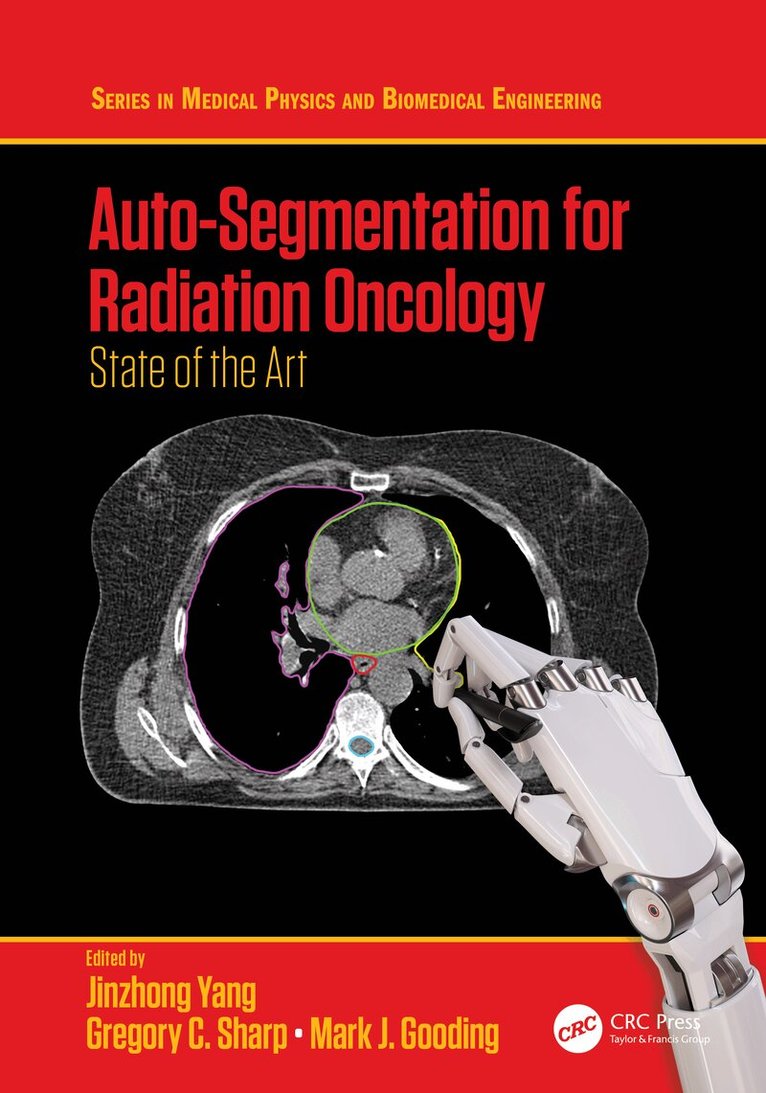
    Auto-Segmentation for Radiation Oncology

    State of the Art

    AvJinzhong Yang,Gregory C. Sharp

    Häftad, Engelska, 2023

    Del i serien Series in Medical Physics and Biomedical Engineering

    759 kr

    Beställningsvara. Skickas inom 10-15 vardagar. Fri frakt över 249 kr.

    Beskrivning

    This book provides a comprehensive introduction to current state-of-the-art auto-segmentation approaches used in radiation oncology for auto-delineation of organs-of-risk for thoracic radiation treatment planning. Containing the latest, cutting edge technologies and treatments, it explores deep-learning methods, multi-atlas-based methods, and model-based methods that are currently being developed for clinical radiation oncology applications. Each chapter focuses on a specific aspect of algorithm choices and discusses the impact of the different algorithm modules to the algorithm performance as well as the implementation issues for clinical use (including data curation challenges and auto-contour evaluations). This book is an ideal guide for radiation oncology centers looking to learn more about potential auto-segmentation tools for their clinic in addition to medical physicists commissioning auto-segmentation for clinical use. Features: Up-to-date with the latest technologies in the field Edited by leading authorities in the area, with chapter contributions from subject area specialists All approaches presented in this book are validated using a standard benchmark dataset established by the Thoracic Auto-segmentation Challenge held as an event of the 2017 Annual Meeting of American Association of Physicists in Medicine

    Produktinformation

    • Utgivningsdatum:2023-05-31
    • Mått:178 x 254 x 15 mm
    • Vikt:560 g
    • Format:Häftad
    • Språk:Engelska
    • Serie:Series in Medical Physics and Biomedical Engineering
    • Antal sidor:256
    • Förlag:Taylor & Francis Ltd
    • ISBN:9780367761226

    Utforska kategorier

    • Tillämpad fysik inom Naturvetenskap och teknik
    • Onkologi inom Medicin
    • Medicinsk bildbehandling inom Medicin

    Mer om författaren

    Jinzhong Yang earned his BS and MS degrees in Electrical Engineering from the University ofScience and Technology of China, in 1998 and 2001, and his PhD degree in Electrical Engineeringfrom Lehigh University in 2006. In July 2008, Dr Yang joined the University of Texas MD AndersonCancer Center as a Senior Computational Scientist, and since January 2015 he has been an AssistantProfessor of Radiation Physics. Dr Yang is a board-certified medical physicist. His research interestfocuses on deformable image registration and image segmentation for radiation treatment planningand image-guided adaptive radiotherapy, radiomics for radiation treatment outcome modeling andprediction, and novel imaging methodologies and applications in radiotherapy.Greg Sharp earned a PhD in Computer Science and Engineering from the University of Michiganand is currently Associate Professor in Radiation Oncology at Massachusetts General Hospitaland Harvard Medical School. His primary research interests are in medical image processing andimage-guided radiation therapy, where he is active in the open source software community.Mark Gooding earned his MEng in Engineering Science in 2000 and DPhil in Medical Imagingin 2004, both from the University of Oxford. He was employed as a postdoctoral researcher bothin university and hospital settings, where his focus was largely around the use of 3D ultrasoundsegmentation in women’s health. In 2009, he joined Mirada Medical Ltd, motivated by a desire tosee technical innovation translated into clinical practice. While there, he has worked on a broadspectrum of clinical applications, developing algorithms and products for both diagnostic and therapeuticpurposes. If given a free choice of research topic, his passion is for improving image segmentation,but in practice he is keen to address any technical challenge. Dr Gooding now leads theresearch team at Mirada, where in addition to the commercial work he continues to collaborate bothclinically and academically.

    Recensioner i media

    "This textbook provides a comprehensive overview of multi-atlas and deep learning approaches to auto-contouring. Furthermore, key questions on clinical implementation are considered. The first introductory chapter describes the main focus of this book being the Thoracic Auto-segmentation Challenge held as an event of the 2017 Annual Meeting of the American Association of Physicists in Medicine (AAPM). Several challenge participants contributed a chapter to this book, addressing a specific strength of their segmentation algorithms. The lack of broad clinical introduction of auto-segmentation, which according to the editors is partly due to the lack of commissioning guidelines, made them dedicate the third part of the book to clinical implementation concerns. The book is written for everyone working in the field of auto-segmentation in radiotherapy. The experienced editors are from academia, clinical physics, and industry; their broad experience gives excellent perspective to this book…This book was useful toward improving my understanding of deep learning-based methods in medical image segmentation. To the best of my knowledge, this is the only textbook available on auto-segmentation dedicated to radiation oncology. Practical concerns and recommendations for implementation make this textbook a must-have for every radiation oncology department."— Charlotte Brouwer, M.Sc. in Medical Physics (December, 2021)

    Innehållsförteckning

    • ContentsForeword I..........................................................................................................................................ixForeword II........................................................................................................................................xiEditors............................................................................................................................................. xiiiContributors......................................................................................................................................xvChapter 1 Introduction to Auto-Segmentation in Radiation Oncology.........................................1Jinzhong Yang, Gregory C. Sharp, and Mark J. GoodingPart I Multi-Atlas for Auto-SegmentationChapter 2 Introduction to Multi-Atlas Auto-Segmentation......................................................... 13Gregory C. SharpChapter 3 Evaluation of Atlas Selection: How Close Are We to Optimal Selection?................. 19Mark J. GoodingChapter 4 Deformable Registration Choices for Multi-Atlas Segmentation............................... 39Keyur Shah, James Shackleford, Nagarajan Kandasamy, and Gregory C. SharpChapter 5 Evaluation of a Multi-Atlas Segmentation System......................................................49Raymond Fang, Laurence Court, and Jinzhong YangPart II Deep Learning for Auto-SegmentationChapter 6 Introduction to Deep Learning-Based Auto-Contouring for Radiotherapy................ 71Mark J. GoodingChapter 7 Deep Learning Architecture Design for Multi-Organ Segmentation......................... 81Yang Lei, Yabo Fu, Tonghe Wang, Richard L.J. Qiu, Walter J. Curran,Tian Liu, and Xiaofeng YangChapter 8 Comparison of 2D and 3D U-Nets for Organ Segmentation.................................... 113Dongdong Gu and Zhong XueChapter 9 Organ-Specific Segmentation Versus Multi-Class Segmentation Using U-Net....... 125Xue Feng and Quan ChenChapter 10 Effect of Loss Functions in Deep Learning-Based Segmentation............................ 133Evan Porter, David Solis, Payton Bruckmeier, Zaid A. Siddiqui,Leonid Zamdborg, and Thomas GuerreroChapter 11 Data Augmentation for Training Deep Neural Networks ........................................ 151Zhao Peng, Jieping Zhou, Xi Fang, Pingkun Yan, Hongming Shan, Ge Wang,X. George Xu, and Xi PeiChapter 12 Identifying Possible Scenarios Where a Deep Learning Auto-SegmentationModel Could Fail...................................................................................................... 165Carlos E. CardenasPart III Clinical Implementation ConcernsChapter 13 Clinical Commissioning Guidelines......................................................................... 189Harini VeeraraghavanChapter 14 Data Curation Challenges for Artificial Intelligence................................................ 201Ken Chang, Mishka Gidwani, Jay B. Patel, Matthew D. Li, andJayashree Kalpathy-CramerChapter 15 On the Evaluation of Auto-Contouring in Radiotherapy.......................................... 217Mark J. GoodingIndex............................................................................................................................................... 253