• Fri frakt över 249 kr
  • •
  • Snabba leveranser
  • •
  • Billiga böcker
Kundservice

Du är på sajten för privatpersoner.

Företag, bibliotek eller offentlig verksamhet?

Du handlar på classic.bokus.com, där alla dina funktioner finns intakta.
Till classic.bokus.com
Bokus logotyp. Gå till startsidan.
  • Erbjudanden
  • Nyheter
  • Student
  • Topplistor
  • Barn & ungdom
  • Bokus Play
  • E-böcker
  • Pocketböcker
  • Spel & pussel

10% studentrabatt med kod TERM26

Sidfot

Mina sidor

    Hjälp

    • Kundservice
    • Vanliga frågor och svar
    • Frakt och leverans
    • Retur vid ångerrätt
    • Reklamera vara
    • Betalning
    • Köpvillkor
    • Allmänna villkor
    • Information om webbplatsens tillgänglighet

    Om Bokus

    • Om oss
    • Pressrum
    • För studenter
    • För företag
    • För bibliotek och offentlig verksamhet
    • För leverantörer
    • Hållbarhet

    Populärt

    • Aktuella erbjudanden
    • Presentkort
    • Studentlitteratur
    • Nya böcker
    • Topplistor
    • Signerade böcker
    • Engelska böcker

    Inspiration

    • Boktips
    • BookTok
    • Populära bokserier
    • Barnbokskaraktärer
    • Populära författare
    Logotyp för Bokus
    Följ oss på Facebook (extern länk)Följ oss på Instagram (extern länk)Följ oss på YouTube (extern länk)Följ oss på TikTok (extern länk)
    bokus @ CookiesAnpassa cookiesIntegritetspolicyKöpvillkor
    Till Citymail hemsida (extern länk)Till Budbee hemsida (extern länk)Till Postnord hemsida (extern länk)Till Schenker hemsida (extern länk)Till Early Bird hemsida (extern länk)Till Walleys hemsida (extern länk)
    1. Kultur
    2. Arkitektur

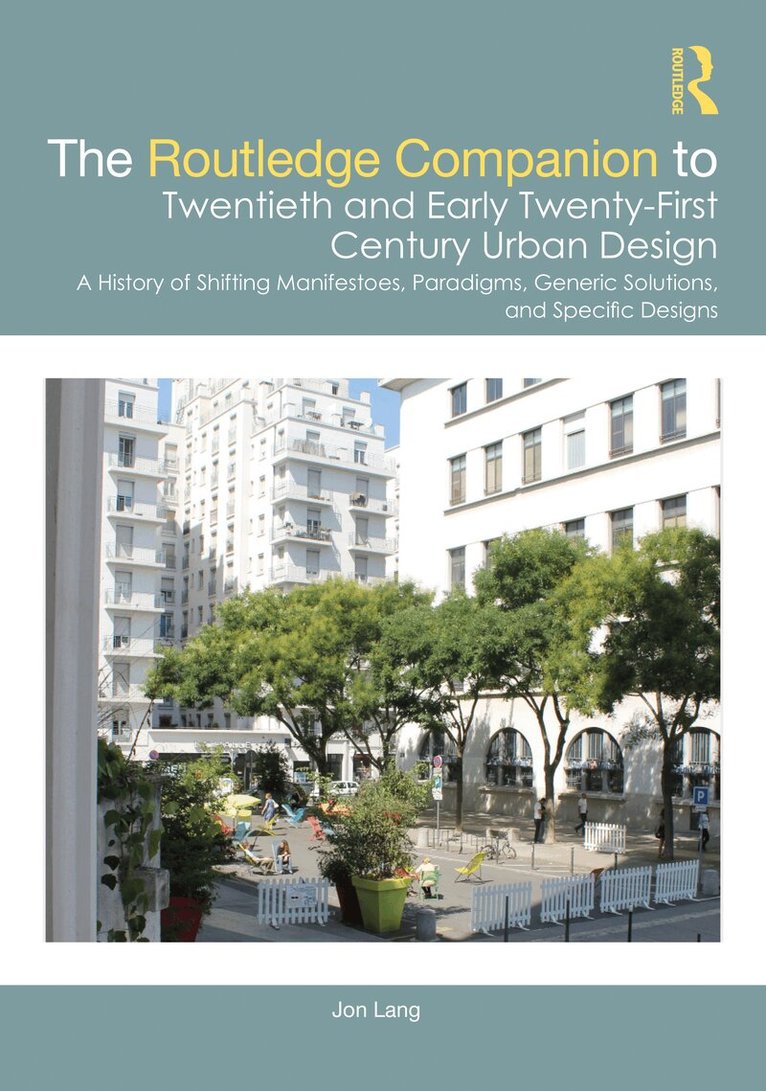
    Routledge Companion to Twentieth and Early Twenty-First Century Urban Design

    A History of Shifting Manifestoes, Paradigms, Generic Solutions, and Specific Designs

    AvJon Lang

    Inbunden, Engelska, 2020

    Del i serien Routledge Companions

    3 785 kr

    Beställningsvara. Skickas inom 10-15 vardagar. Fri frakt över 249 kr.

    Fler format och utgåvor

    Häftad

    748 kr

    E-bok

    881 kr

    E-bok

    881 kr

    Beskrivning

    The Routledge Companion to Twentieth and Early Twenty-First Century Urban Design is a fully illustrated descriptive and explanatory history of the development of urban design ideas and paradigms of the past 150 years. The ideas and projects, hypothetical and built, range in scale from the city to the urban block level. The focus is on where the generic ideas originated, the projects that were designed following their precepts, the functions they address and/or afford, and what we can learn from them.The morphology of a city—its built environment—evolves unselfconsciously as private and governmental investors self-consciously erect buildings and infrastructure in a pragmatic, piecemeal manner to meet their own ends. Philosophers, novelists, architects, and social scientists have produced myriad ideas about the nature of the built environment that they consider to be superior to those forms resulting from a laissez-faire attitude to urban development.Rationalist theorists dream of ideal futures based on assumptions about what is good; empiricists draw inspirations from what they perceive to be working well in existing situations. Both groups have presented their advocacies in manifestoes and often in the form of generic solutions or illustrative designs. This book traces the history of these ideas and will become a standard reference for scholars and students interested in the history of urban spaces, including architects, planners, urban historians, urban geographers, and urban morphologists.

    Produktinformation

    • Utgivningsdatum:2020-11-10
    • Mått:178 x 254 x 25 mm
    • Vikt:994 g
    • Format:Inbunden
    • Språk:Engelska
    • Serie:Routledge Companions
    • Antal sidor:424
    • Förlag:Taylor & Francis Ltd
    • ISBN:9780367860509

    Utforska kategorier

    • Arkitektur inom Kultur
    • Arkitekturhistoria inom Kultur
    • Regional planering inom Naturvetenskap och teknik

    Mer om författaren

    Jon Lang, Emeritus Professor, is the principal of his own consulting firm and formerly the director of urban design for ERG in Philadelphia, Pennsylvania. His consultancy work has taken him to all the continents of the world, except Antarctica. Born in India, he was educated in that country, England, South Africa, and the United States. He received his architectural degree from the University of the Witwatersrand and city planning from Cornell, where he also obtained his doctorate. Before settling in Australia in 1990, he headed the joint MArch/MCP Program in Urban Design at the University of Pennsylvania. At the University of New South Wales, he headed the School of Architecture and was the associate dean for research in the Faculty of the Built Environment in the 1990s and early 2000s. He has served as a visiting professor at universities in North and South America and Asia and has authored books on architectural theory, on urban design, and on modern architecture in India. His writings on urban design include Urban Design: The American Experience (1994), Urban Design: A Typology of Procedures and Products (2005; 2017), and, with Nancy Marshall, Urban Squares as Places, Links, and Displays (Routledge 2016). His book with Walter Moleski, Functionalism Revisited (2010), provides the intellectual basis for this endeavor. He has been a juror on several international urban design competitions. In 2010, he received the Reed and Malik Medal from the Institution of Civil Engineers in London.

    Recensioner i media

    "Jon Lang firmly situates Urban Design as a discipline and discerns with great clarity a compelling narrative about its influence as a practice in shaping our cities and their physical manifestations over the last 150 years. His argument foregrounds architecture at scale – its compulsions, ambitions as well as aspirations in understanding how it has historically propelled the protocols for Urban Design."—Rahul Mehrotra, Professor of Urban Design and Planning, Graduate School of Design, Harvard University"This is a comprehensive book on the history and theory of urban design, focusing on the paradigms that have transformed the built environment, in a rich combination of theory and practice from around the world. It is written by a leading urban design scholar and would be valuable for all urban students." —Ali Madanipour, Professor of Urban Design, School of Architecture, Planning and Landscape, Newcastle University,"Focusing on urban design paradigms, Lang establishes the much-needed generative history of our discipline in the 20th and early 21st centuries, connecting urban design to its roots across space, time, and cultures. More than a historical a narrative, Lang’s critical perspective highlights the various ideologies that have shaped urban design practice and projects. This book should become a standard text for anyone interested in the contemporary built environments."—Ali Modarres, Director of Urban Studies and the Assistant Chancellor for Community Engagement at University of Washington Tacoma

    Innehållsförteckning

    • Prologue: The Nature of Urban Design Part One: Antecedents of Twentieth Century Urban DesignChapter 1. Religious Canons and PrescriptionsChapter 2. The Classical and Beaux Arts TraditionChapter 3. Social and Philanthropic Urban DesignChapter 4. The Garden SuburbChapter 5. The Urbanist TraditionPart Two: Early Twentieth Century Manifestoes, Paradigms, Generic Concepts, and Specific DesignsChapter 6. The City BeautifulChapter 7. Modern EmpiricismChapter 8. The Rationalist ResponsePart Three: Post-World War Two Pragmatic Urban Design and The Rationalist and Empiricist ResponsesChapter 9. The Post-World War Two RationalistsChapter 10. The Post-World War Two EmpiricistsChapter 11. The Postmodernist and The Deconstructivist ResponsePart Four: Urban Design in an Age of Corporate Financial CapitalChapter 12. Modernist, Neo-Modernist, and Hyper-Modernist Urban DesignChapter 13. Hyper-Modernism, Parametricism, and Urban DesignChapter 14. The Empiricist ResponsesChapter 15, Sustainable Urbanism and Urban DesignChapter 16. Smart Cities and Urban DesignEpilogue: Looking Back to Look ForwardChapter 17. A Critique of Twenty and Early Twenty-First Century Urban DesignChapter 18. The Way Forward: Toward Compact Cities