• Fri frakt över 249 kr
  • •
  • Snabba leveranser
  • •
  • Billiga böcker
Kundservice

Du är på sajten för privatpersoner.

Företag, bibliotek eller offentlig verksamhet?

Du handlar på classic.bokus.com, där alla dina funktioner finns intakta.
Till classic.bokus.com
Bokus logotyp. Gå till startsidan.
  • Erbjudanden
  • Nyheter
  • Student
  • Topplistor
  • Barn & ungdom
  • Bokus Play
  • E-böcker
  • Pocketböcker
  • Spel & pussel

10% rabatt på allt med kod: NYSTART10 →

Sidfot

Mina sidor

    Hjälp

    • Kundservice
    • Vanliga frågor och svar
    • Frakt och leverans
    • Retur vid ångerrätt
    • Reklamera vara
    • Betalning
    • Köpvillkor
    • Allmänna villkor
    • Information om webbplatsens tillgänglighet

    Om Bokus

    • Om oss
    • Pressrum
    • För studenter
    • För företag
    • För bibliotek och offentlig verksamhet
    • För leverantörer
    • Hållbarhet

    Populärt

    • Aktuella erbjudanden
    • Presentkort
    • Studentlitteratur
    • Nya böcker
    • Topplistor
    • Signerade böcker
    • Engelska böcker

    Inspiration

    • Boktips
    • BookTok
    • Populära bokserier
    • Barnbokskaraktärer
    • Populära författare
    Logotyp för Bokus
    Följ oss på Facebook (extern länk)Följ oss på Instagram (extern länk)Följ oss på YouTube (extern länk)Följ oss på TikTok (extern länk)
    bokus @ CookiesAnpassa cookiesIntegritetspolicyKöpvillkor
    Till Citymail hemsida (extern länk)Till Budbee hemsida (extern länk)Till Postnord hemsida (extern länk)Till Schenker hemsida (extern länk)Till Early Bird hemsida (extern länk)Till Walleys hemsida (extern länk)
    1. Samhälle och politik
    2. Sociologi och antropologi
    3. Sociologi

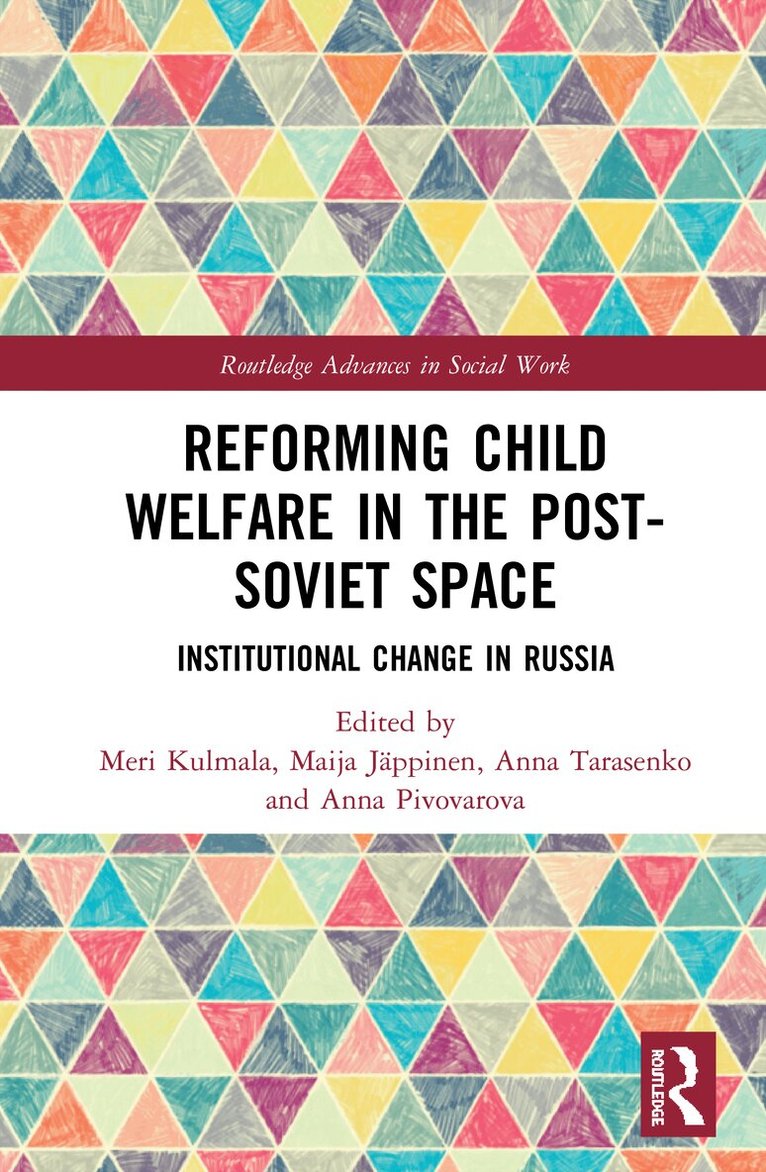
    Reforming Child Welfare in the Post-Soviet Space

    Institutional Change in Russia

    AvMeri Kulmala,Maija Jäppinen

    Inbunden, Engelska, 2020

    Del i serien Routledge Advances in Social Work

    2 423 kr

    Beställningsvara. Skickas inom 10-15 vardagar. Fri frakt över 249 kr.

    Beskrivning

    This book provides new and empirically grounded research-based knowledge and insights into the current transformation of the Russian child welfare system. It focuses on the major shift in Russia’s child welfare policy: deinstitutionalisation of the system of children’s homes inherited from the Soviet era and an increase in fostering and adoption.Divided into four sections, this book details both the changing role and function of residential institutions within the Russian child welfare system and the rapidly developing form of alternative care in foster families, as well as work undertaken with birth families. By analysing the consequences of deinstitutionalisation and its effects on children and young people as well as their foster and birth parents, it provides a model for understanding this process across the whole of the post-Soviet space. It will be of interest to academics and students of social work, sociology, child welfare, social policy, political science, and Russian and East European politics more generally.

    Produktinformation

    • Utgivningsdatum:2020-09-25
    • Mått:156 x 234 x 21 mm
    • Vikt:502 g
    • Format:Inbunden
    • Språk:Engelska
    • Serie:Routledge Advances in Social Work
    • Antal sidor:236
    • Förlag:Taylor & Francis Ltd
    • ISBN:9780367904241

    Utforska kategorier

    • Sociologi inom Samhälle och politik
    • Politik och statsskick inom Samhälle och politik
    • Socialt arbete och välfärd inom Samhälle och politik

    Mer om författaren

    Meri Kulmala holds a PhD in sociology and works as a university researcher and research coordinator of the Helsinki Inequality Initiative (INEQ) in the Faculty of Social Sciences at University of Helsinki, Finland. She works and publishes on issues of post-socialist welfare state and civil society development, women’s activism, family and child welfare policy and feminist research methods. She leads an international interdisciplinary research project on child welfare in Russia and is involved in a project exploring youth well-being in the Arctic region, with her focus being on the well-being of young care leavers, which she studies principally through participatory research methods.Maija Jäppinen holds a PhD in social work and works as both a university lecturer in the Faculty of Social Sciences in University of Helsinki and a postdoctoral researcher in the Åbo Akademi University, Finland. Her research interests include Russian studies, gender violence, child welfare, social work practice research, social work with migrants, power asymmetries in social work encounters, migrant citizenisation, and human rights. Methodologically, she specialises in ethnographic research, qualitative research in different kinds of transnational settings, and feminist methodology.Anna Tarasenko holds a PhD in political science. Her current research focuses on the non-profit sector development in Russia. She has accomplished empirical research on various types of non-profits and their involvement in social service provision as well as engagement in interest representation in contemporary Russia. She has worked as a researcher in several international research projects, including the UNRISD research project ‘New Directions in Social Policy: Alternatives from and for the Global South’and the international research project based at the University of Helsinki entitled ‘A Child’s Right to a Family: Deinstitutionalisation of Child Welfare in Putin’s Russia’.Anna Pivovarova is a social anthropologist working on parenting, childhood and kinship. She holds a master’s degree in anthropology from the European University at St. Petersburg and works as a doctoral researcher at the University of Helsinki focusing on adoptive and foster parenthood in today Russia. She has conducted research and published on modern home birth practice and independent midwifery, and participated in research projects on maternity healthcare, child welfare and alternative family care in Russia. Her research interests include medical anthropology, new kinship studies, narrative analysis, invented traditions, rituals and modern folklore.

    Innehållsförteckning

    • Part 1: Introduction. 1. Introduction: Russian Child Welfare Reform and Institutional Change. Part 2: Changing Numbers, Shifting Discourses. 2. Statistics on the Deinstitutionalization of Child Welfare in Russia. 3. The ‘Last-minute Children’: Where did they come from, where will they go? Media Portrayals of Children Deprived of Parental care 2006-2018. Part 3: Transforming Institutions. 4. The Ideal (Re)organization of Care: Child Welfare Reform as a Battlefield over Resources and Recognition. 5. Institutional Variety rather than the End of Residential Care: Regional Responses to Deinstitutionalisation Reform in Russia. 6. ‘One has to Stop Chasing Numbers!’ The Unintended Consequences of Russian Child Welfare Reform. Part 4: Foster And Birth Families Under Institutional Change. 7. ‘Making’ a Family: The Motives and Practices of Foster Parenting. 8. No Longer Parents or Parents in Need of Support? Views of Child Welfare Experts on Birth Parents. Part 5: Children In Care: Social Adaptation And Aftercare. 9. The Successful Transition to Foster Care: The Child's Perspective. 10. Young Adults Leaving Care: Agency and Educational Choice. Part 6: Conclusions. 11. In Conclusion: The Fragmented Implementation of the New Child Welfare Policy