• Fri frakt över 249 kr
  • •
  • Snabba leveranser
  • •
  • Billiga böcker
Kundservice

Du är på sajten för privatpersoner.

Företag, bibliotek eller offentlig verksamhet?

Du handlar på classic.bokus.com, där alla dina funktioner finns intakta.
Till classic.bokus.com
Bokus logotyp. Gå till startsidan.
  • Erbjudanden
  • Nyheter
  • Student
  • Topplistor
  • Barn & ungdom
  • Bokus Play
  • E-böcker
  • Pocketböcker
  • Spel & pussel

10% rabatt på allt med kod: NYSTART10 →

Sidfot

Mina sidor

    Hjälp

    • Kundservice
    • Vanliga frågor och svar
    • Frakt och leverans
    • Retur vid ångerrätt
    • Reklamera vara
    • Betalning
    • Köpvillkor
    • Allmänna villkor
    • Information om webbplatsens tillgänglighet

    Om Bokus

    • Om oss
    • Pressrum
    • För studenter
    • För företag
    • För bibliotek och offentlig verksamhet
    • För leverantörer
    • Hållbarhet

    Populärt

    • Aktuella erbjudanden
    • Presentkort
    • Studentlitteratur
    • Nya böcker
    • Topplistor
    • Signerade böcker
    • Engelska böcker

    Inspiration

    • Boktips
    • BookTok
    • Populära bokserier
    • Barnbokskaraktärer
    • Populära författare
    Logotyp för Bokus
    Följ oss på Facebook (extern länk)Följ oss på Instagram (extern länk)Följ oss på YouTube (extern länk)Följ oss på TikTok (extern länk)
    bokus @ CookiesAnpassa cookiesIntegritetspolicyKöpvillkor
    Till Citymail hemsida (extern länk)Till Budbee hemsida (extern länk)Till Postnord hemsida (extern länk)Till Schenker hemsida (extern länk)Till Early Bird hemsida (extern länk)Till Walleys hemsida (extern länk)
    1. Naturvetenskap och teknik
    2. Matematik och naturvetenskap
    3. Matematik
    4. Tillämpad matematik

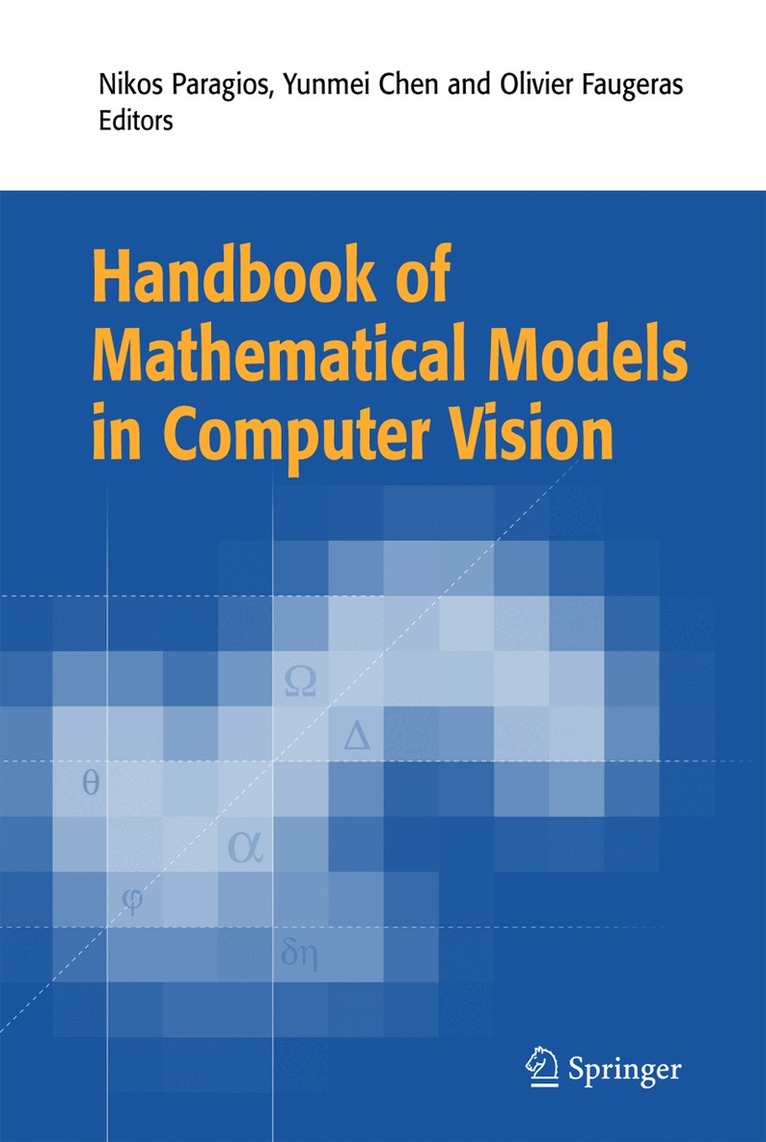
    Handbook of Mathematical Models in Computer Vision

    AvNikos Paragios,Yunmei Chen

    Inbunden, Engelska, 2005

    1 086 kr

    Beställningsvara. Skickas inom 10-15 vardagar. Fri frakt över 249 kr.

    Beskrivning

    Abstract Biological vision is a rather fascinating domain of research. Scientists of various origins like biology, medicine, neurophysiology, engineering, math­ ematics, etc. aim to understand the processes leading to visual perception process and at reproducing such systems. Understanding the environment is most of the time done through visual perception which appears to be one of the most fundamental sensory abilities in humans and therefore a significant amount of research effort has been dedicated towards modelling and repro­ ducing human visual abilities. Mathematical methods play a central role in this endeavour. Introduction David Marr's theory v^as a pioneering step tov^ards understanding visual percep­ tion. In his view human vision was based on a complete surface reconstruction of the environment that was then used to address visual subtasks. This approach was proven to be insufficient by neuro-biologists and complementary ideas from statistical pattern recognition and artificial intelligence were introduced to bet­ ter address the visual perception problem. In this framework visual perception is represented by a set of actions and rules connecting these actions. The emerg­ ing concept of active vision consists of a selective visual perception paradigm that is basically equivalent to recovering from the environment the minimal piece information required to address a particular task of interest.

    Produktinformation

    • Utgivningsdatum:2005-10-31
    • Mått:156 x 235 x 46 mm
    • Vikt:1 100 g
    • Format:Inbunden
    • Språk:Engelska
    • Antal sidor:606
    • Upplaga:2006
    • Förlag:Springer-Verlag New York Inc.
    • ISBN:9780387263717

    Utforska kategorier

    • Tillämpad matematik inom Naturvetenskap och teknik
    • 3D-grafik och modellering inom Data och IT

    Recensioner i media

    From the reviews: "The focus of the book is on mathematical methods that both model and reproduce human visual abilities. ... This book is a must-have for those interested in the full breadth of research done in the biological & computer vision community. As a bonus, the chapters can also be used in a seminar-based, advanced undergraduate course in mathematical based computer vision. " (Arjan Kuijper, IAPR Newsletter, October, 2006) "Computational visual perception can be defined as the discipline of enabling computers to identify features in image data. ... I found this book to be detailed and comprehensive enough to be well worth the time spent on it. Citations linking the text to the relevant literature are profusely sprinkled throughout the text, and a very extensive bibliography is included ... . the production qualities are excellent. ... it should be a useful reference text for researchers or practitioners in this field." (R. M. Malyankar, Computing Reviews, January, 2006) "The editors of this important compendium view their task as a contribution to modeling and simulating human vision by machine. ... The editors should be congratulated for bringing together high-level researchers to contribute chapters on cutting-edge technologies based on mathematical modeling. This compendium is a solid contribution to the recent literature combining the theories and applications of mathematical modeling to the domain of computer vision." (R. Goldberg, Computing Reviews, June, 2006)

    Innehållsförteckning

    • Image Reconstruction.- Diffusion Filters and Wavelets: What Can They Learn from Each Other?.- Total Variation Image Restoration: Overview and Recent Developments.- PDE-Based Image and Surface Inpainting.- Boundary Exraction, Segmentation and Grouping.- Levelings: Theory and Practice.- Graph Cuts in Vision and Graphics: Theories and Applications.- Minimal Paths and Fast Marching Methods for Image Analysis.- Integrating Shape and Texture in DeformabIe Models: from Hybrid Methods to Metamorphs.- Variational Segmentation with Shape Priors.- Curve Propagation, Level Set Methods and Grouping.- On a Stochastic Model of Geometric Snakes.- Shape Modeling & Registration.- Invariant Processing and Occlusion Resistant Recognition of Planar Shapes.- Planar Shape Analysis and Its Applications in Image-Based Inferences.- Diffeomorphic Point Matching.- Uncertainty-Driven, Point-Based Image Registration.- Motion Analysis, Optical Flow & Tracking.- Optical Flow Estimation.- From Bayes to PDEs in Image Warping.- Image Alignment and Stitching.- Visual Tracking: A Short Research Roadmap.- Shape Gradient for Image and Video Segmentation.- Model-Based Human Motion Capture.- Modeling Dynamic Scenes: An Overview of Dynamic Textures.- 3D from Images, Projective Geometry & Stereo Reconstruction.- Differential Geometry from the Frenet Point of View: Boundary Detection, Stereo, Texture and Color.- Shape From Shading.- 3D from Image Sequences: Calibration, Motion and Shape Recovery.- Multi-view Reconstruction of Static and Dynamic Scenes.- Graph Cut Algorithms for Binocular Stereo with Occlusions.- Modelling Non-Rigid Dynamic Scenes from Multi-View Image Sequences.- Applications: Medical Image Analysis.- Interactive Graph-Based Segmentation Methods in Cardiovascular Imaging.- 3D Active Shape and Appearance Models in Cardiac Image Analysis.- Characterization of Diffusion Anisotropy in DWI.- Segmentation of Diffusion Tensor Images.- Variational Approaches to the Estimation, Regularizatinn and Segmentation of Diffusion Tensor Images.- An Introduction to Statistical Methods of Medical Image Registration.