• Fri frakt över 249 kr
  • •
  • Snabba leveranser
  • •
  • Billiga böcker
Kundservice

Du är på sajten för privatpersoner.

Företag, bibliotek eller offentlig verksamhet?

Du handlar på classic.bokus.com, där alla dina funktioner finns intakta.
Till classic.bokus.com
Bokus logotyp. Gå till startsidan.
  • Erbjudanden
  • Student
  • Topplistor
  • Barn & ungdom
  • Bokus Play
  • E-böcker
  • Ljudböcker
  • Pocketböcker
  • Spel & pussel

Upp till 25% på utvalda nyheter →

Sidfot

Mina sidor

    Hjälp

    • Kundservice
    • Vanliga frågor och svar
    • Frakt och leverans
    • Retur vid ångerrätt
    • Reklamera vara
    • Betalning
    • Köpvillkor
    • Allmänna villkor
    • Information om webbplatsens tillgänglighet

    Om Bokus

    • Om oss
    • Pressrum
    • För studenter
    • För företag
    • För bibliotek och offentlig verksamhet
    • För leverantörer
    • Hållbarhet

    Populärt

    • Aktuella erbjudanden
    • Presentkort
    • Studentlitteratur
    • Nya böcker
    • Topplistor
    • Signerade böcker
    • Engelska böcker

    Inspiration

    • Boktips
    • BookTok
    • Populära bokserier
    • Barnbokskaraktärer
    • Populära författare
    Logotyp för Bokus
    Följ oss på Facebook (extern länk)Följ oss på Instagram (extern länk)Följ oss på YouTube (extern länk)Följ oss på TikTok (extern länk)
    bokus @ CookiesAnpassa cookiesIntegritetspolicyKöpvillkor
    Till Citymail hemsida (extern länk)Till Budbee hemsida (extern länk)Till Postnord hemsida (extern länk)Till Schenker hemsida (extern länk)Till Early Bird hemsida (extern länk)Till Walleys hemsida (extern länk)
    1. Naturvetenskap och teknik
    2. Matematik och naturvetenskap
    3. Matematik
    4. Tillämpad matematik

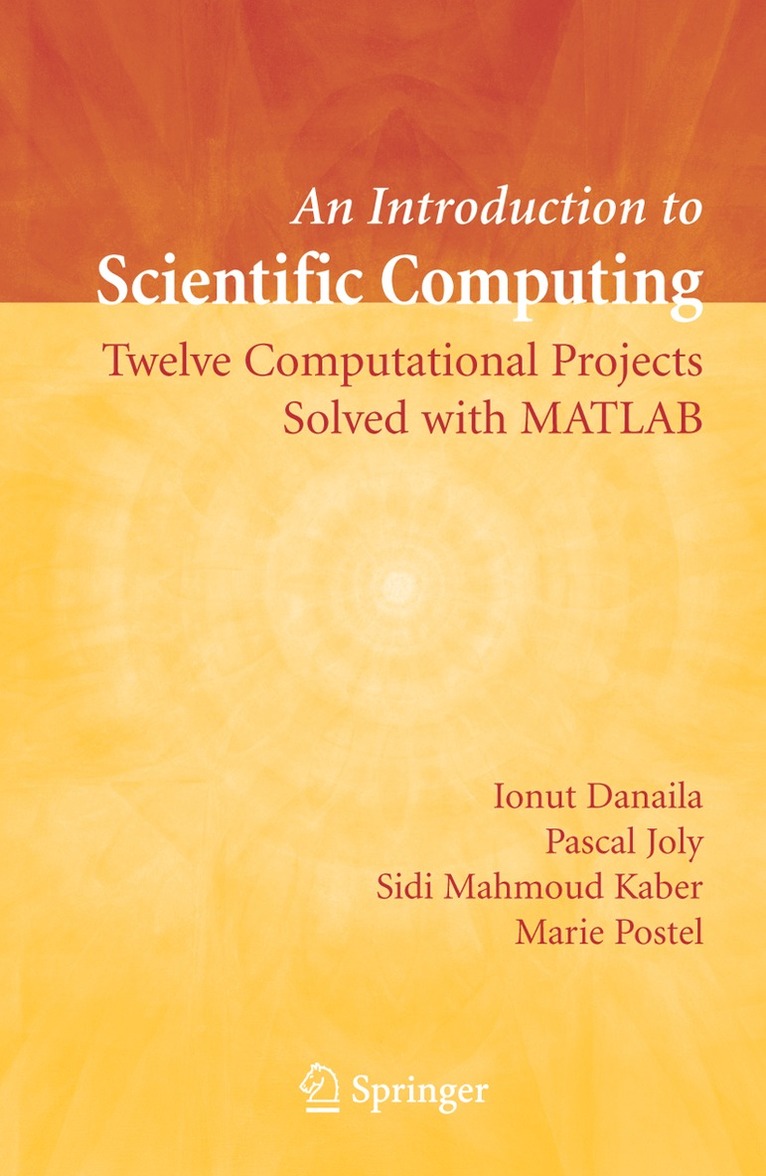
    Introduction to Scientific Computing

    Twelve Computational Projects Solved with MATLAB

    AvIonut Danaila,Pascal Joly

    Inbunden, Engelska, 2006

    725 kr

    Beställningsvara. Skickas inom 5-8 vardagar. Fri frakt över 249 kr.

    Fler format och utgåvor

    Inbunden

    763 kr

    Häftad

    547 kr

    Beskrivning

    Teaching or learning numerical methods in applied mathematics cannot be conceived nowadays without numerical experimentation on computers. There is a vast literature devoted either to theoretical numerical methods or - merical programming of basic algorithms, but there are few texts o?ering a complete discussion of numerical issues involved in the solution of concrete and relatively complex problems. This book is an attempt to ?ll this need. It is our belief that advantages and drawbacks of a numerical method cannot be accounted for without one’s experiencing all the steps of scienti?c comp- ing, from physical and mathematical description of the problem to numerical formulation and programming and, ?nally, to critical discussion of numerical results. The book provides twelve computational projects aimed at numerically solving problems selected to cover a broad spectrum of applications, from ?uid mechanics, chemistry, elasticity, thermal science, computer-aided design, signal and imageprocessing, etc. Even though the main volume of this text concerns the numerical analysis of computational methods and their imp- mentation, we have tried to start, when possible, from realistic problems of practical interest for researchers and engineers. For each project, an introductory record card summarizes the mathem- ical and numerical topics explained and the ?elds of application of the - proach. A level of di?culty, scaling from 1 to 3, is assigned to each project.

    Produktinformation

    • Utgivningsdatum:2006-11-27
    • Mått:155 x 235 x undefined mm
    • Format:Inbunden
    • Språk:Engelska
    • Antal sidor:294
    • Förlag:Springer-Verlag New York Inc.
    • ISBN:9780387308890

    Utforska kategorier

    • Tillämpad matematik inom Naturvetenskap och teknik

    Recensioner i media

    From the reviews: "In An Introduction to Scientific Computing, the authors present approaches to the numerical solution of problems drawn from a variety of applications. ... This is a graduate-level introduction and the pace is brisk. ... This is a strong text on scientific computing for advanced students in applied mathematics. ... the book is most appropriate for students with some prior experience in scientific computing ... ." (William J. Satzer, MathDL, February, 2007) "The book is based on material offered by the authors at Universite Pierre et Marie Curie (Paris, France) and different engineering schools. It is intended as a graduate-level text in applied mathematics, but it may also be used by students in engineering or physical sciences. It may also be used as a reference for researchers and practicing engineers. Since different possible levels of each project are suggested, the text can be used to propose assignments at different graduate levels." (I. N. Katz, Zentralblatt MATH, Vol. 1119 (21), 2007) "An Introduction to Scientific Computing plunges into solving PDEs by numerical approximation. ... the book is an attempt to completely discuss numerical issues for reasonably complex problems at the level of a graduate textbook. A project-based approach is used. ... Overall, this is a pleasing and useful companion to more complete expositions of the topic. ... If you're preparing advanced students for a workshop, or organizing a numerical analysis club for the semester, then the book is perfect." (Sorin Mitran, SIAM Review, Vol. 50 (1), 2008)

    Innehållsförteckning

    • Numerical Approximation of Model Partial Differential Equations.- Nonlinear Differential Equations: Application to Chemical Kinetics.- Polynomial Approximation.- Solving an Advection-Diffusion Equation by a Finite Element Method.- Solving a Differential Equation by a Spectral Method.- Signal Processing: Multiresolution Analysis.- Elasticity: Elastic Deformation of a Thin Plate.- Domain Decomposition Using a Schwarz Method.- Geometrical Design: Bézier Curves and Surfaces.- Gas Dynamics: The Riemann Problem and Discontinuous Solutions: Application to the Shock Tube Problem.- Thermal Engineering: Optimization of an Industrial Furnace.- Fluid Dynamics: Solving the Two-Dimensional Navier-Stokes Equations.