E-bok, Engelska, 2009
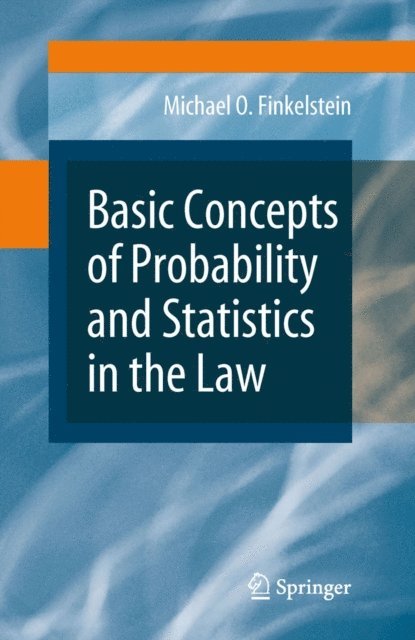
Basic Concepts of Probability and Statistics in the Law
825 kr
Läs direkt i Bokus Reader – eller ladda ned till din enhet (PDF kräver ofta zoom och scroll på små skärmar).
Beskrivning
When as a practicing lawyer I published my ?rst article on statistical evidence in 1966, the editors of the Harvard Law Review told me that a mathematical equa- 1 tion had never before appeared in the review. This hardly seems possible - but if they meant a serious mathematical equation, perhaps they were right. Today all that has changed in legal academia. Whole journals are devoted to scienti?c methods in law or empirical studies of legal institutions. Much of this work involves statistics. Columbia Law School, where I teach, has a professor of law and epidemiology and other law schools have similar “law and” professorships. Many offer courses on statistics (I teach one) or, more broadly, on law and social science. The same is true of practice. Where there are data to parse in a litigation, stat- ticians and other experts using statistical tools now frequently testify. And judges must understand them. In 1993, in its landmark Daubert decision, the Supreme Court commanded federal judges to penetrate scienti?c evidence and ?nd it “re- 2 liable” before allowing it in evidence. It is emblematic of the rise of statistics in the law that the evidence at issue in that much-cited case included a series of epidemiological studies. The Supreme Court’s new requirement made the Federal Judicial Center’s Reference Manual on Scienti?c Evidence, which appeared at about the same time, a best seller. It has several important chapters on statistics.
Produktinformation
- Utgivningsdatum: 2009-06-04
- Språk: Engelska
- Filformat: PDF
- Kopieringsskydd: LCP
- ISBN: 9780387875019
- Förlag: Springer New York
Utforska kategorier
Betyg & recensioner
0 recensioner
Inga recensioner tillgängliga.