• Fri frakt över 249 kr
  • •
  • Snabba leveranser
  • •
  • Billiga böcker
Kundservice

Du är på sajten för privatpersoner.

Företag, bibliotek eller offentlig verksamhet?

Du handlar på classic.bokus.com, där alla dina funktioner finns intakta.
Till classic.bokus.com
Bokus logotyp. Gå till startsidan.
  • Erbjudanden
  • Nyheter
  • Student
  • Topplistor
  • Barn & ungdom
  • Bokus Play
  • E-böcker
  • Pocketböcker
  • Spel & pussel

10% rabatt på allt med kod NYSTART10 →

Sidfot

Mina sidor

    Hjälp

    • Kundservice
    • Vanliga frågor och svar
    • Frakt och leverans
    • Retur vid ångerrätt
    • Reklamera vara
    • Betalning
    • Köpvillkor
    • Allmänna villkor
    • Information om webbplatsens tillgänglighet

    Om Bokus

    • Om oss
    • Pressrum
    • För studenter
    • För företag
    • För bibliotek och offentlig verksamhet
    • För leverantörer
    • Hållbarhet

    Populärt

    • Aktuella erbjudanden
    • Presentkort
    • Studentlitteratur
    • Nya böcker
    • Topplistor
    • Signerade böcker
    • Engelska böcker

    Inspiration

    • Boktips
    • BookTok
    • Populära bokserier
    • Barnbokskaraktärer
    • Populära författare
    Logotyp för Bokus
    Följ oss på Facebook (extern länk)Följ oss på Instagram (extern länk)Följ oss på YouTube (extern länk)Följ oss på TikTok (extern länk)
    bokus @ CookiesAnpassa cookiesIntegritetspolicyKöpvillkor
    Till Citymail hemsida (extern länk)Till Budbee hemsida (extern länk)Till Postnord hemsida (extern länk)Till Schenker hemsida (extern länk)Till Early Bird hemsida (extern länk)Till Walleys hemsida (extern länk)
    1. Ekonomi och Ledarskap
    2. Nationalekonomi

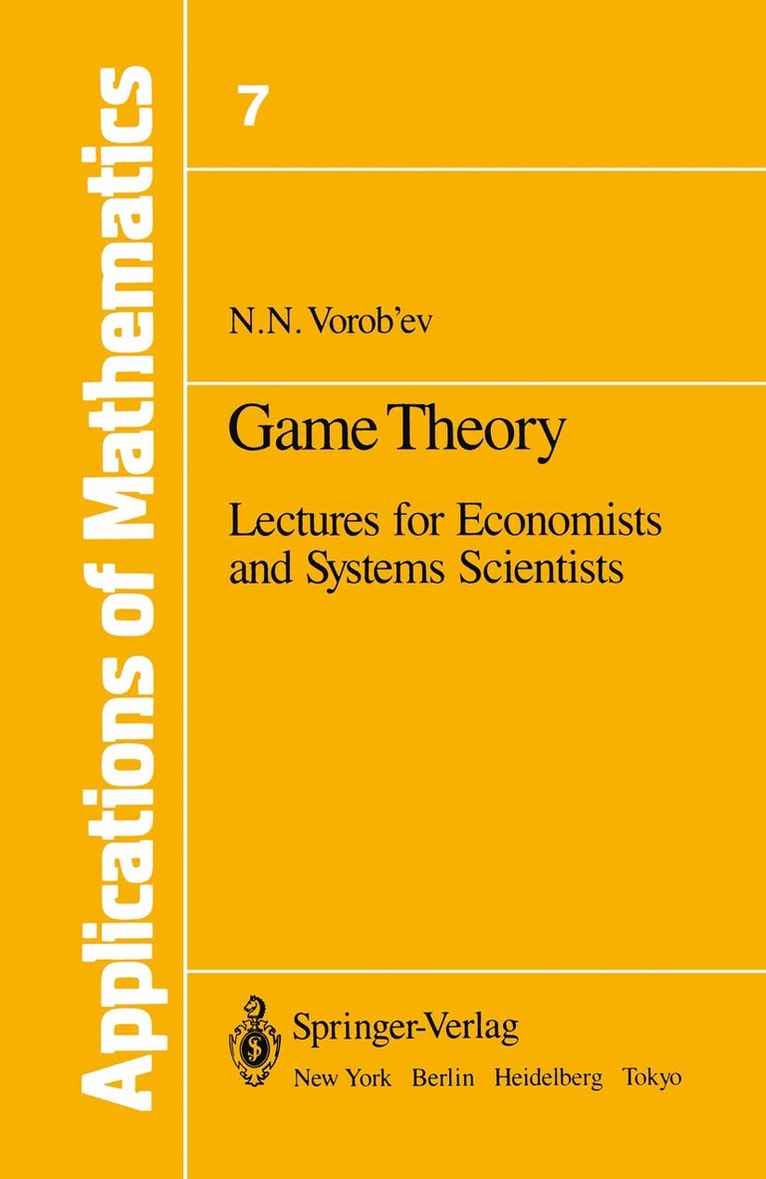
    Game Theory

    Lectures for Economists and Systems Scientists

    AvNikolai N. Vorob'ev,S. Kotz

    Inbunden, Engelska, 1977

    Del i serien Stochastic Modelling and Applied Probability

    1 086 kr

    Beställningsvara. Skickas inom 10-15 vardagar. Fri frakt över 249 kr.

    Fler format och utgåvor

    E-bok

    1 413 kr

    Häftad

    1 086 kr

    Beskrivning

    The basis for this book is a number of lectures given frequently by the author to third year students of the Department of Economics at Leningrad State University who specialize in economical cybernetics. The main purpose of this book is to provide the student with a relatively simple and easy-to-understand manual containing the basic mathematical machinery utilized in the theory of games. Practical examples (including those from the field of economics) serve mainly as an interpretation of the mathematical foundations of this theory rather than as indications of their actual or potential applicability. The present volume is significantly different from other books on the theory of games. The difference is both in the choice of mathematical problems as well as in the nature of the exposition. The realm of the problems is somewhat limited but the author has tried to achieve the greatest possible systematization in his exposition. Whenever possible the author has attempted to provide a game-theoretical argument with the necessary mathematical rigor and reasonable generality. Formal mathematical prerequisites for this book are quite modest. Only the elementary tools of linear algebra and mathematical analysis are used.

    Produktinformation

    • Utgivningsdatum:1977-10-13
    • Mått:155 x 235 x 13 mm
    • Vikt:450 g
    • Format:Inbunden
    • Språk:Engelska
    • Serie:Stochastic Modelling and Applied Probability
    • Antal sidor:179
    • Upplaga:1977
    • Förlag:Springer-Verlag New York Inc.
    • ISBN:9780387902388
    • Översättare:S. Kotz

    Utforska kategorier

    • Nationalekonomi inom Ekonomi och Ledarskap
    • Optimering inom Naturvetenskap och teknik
    • Referensverk och tvärvetenskap inom Samhälle och politik

    Innehållsförteckning

    • 1 Matrix games.- 1.1 Definition of a noncooperative game.- 1.2 Admissible situations and the equilibrium situation.- 1.3 Strategic equivalence of games.- 1.4 Antagonistic games.- 1.5 Saddle points.- 1.6 Auxiliary propositions about extrema.- 1.7 Minimax equalities and saddle points.- 1.8 Matrix games.- 1.9 Mixed strategies.- 1.10 A mixed extension of a game.- 1.11 Existence of minimaxes in mixed strategies.- 1.12 Convex sets.- 1.13 The lemma on two alternatives.- 1.14 The minimax theorem.- 1.15 The value of the game and optimal strategies.- 1.16 Three properties of the value of a game.- 1.17 An example: 2×2 games.- 1.18 A graphical solution of 2×n games.- 1.19 A graphical solution of m×2 games.- 1.20 Sufficient criteria for the value of a game and optimal strategies.- 1.21 Domination of strategies.- 1.22 Diagonal games.- 1.23 Sets of optimal strategies in a matrix game.- 1.24 An example: 3×3 games.- 1.25 Symmetric games.- 1.26 Matrix games and linear programming.- 2 Infinite antagonistic games.- 2.1 Introduction and motivation.- 2.2 Situations of ?-equilibrium; ?-saddle points and ?-optimal strategies.- 2.3 ?-optimal strategies and minimaxes.- 2.4 Mixed strategies.- 2.5 Properties of the value of a game and of optimal strategies.- 2.6 The Helly metric.- 2.7 Conditionally compact games.- 2.8 The basic theorem for conditionally compact games.- 2.9 Continuous games on the unit square.- 2.10 Convex functions.- 2.11 Convex games; pure optimal strategies for player II.- 2.12 Convex games; optimal strategies for player I.- 2.13 Strictly convex games.- 2.14 Examples of convex games and their solutions.- 2.15 Market competition.- 2.16 Allocation of production capacities; minimization of the maximal intensity of a production scheme.- 2.17 Allocation of productioncapacities under partial uncertainty.- 3 Noncooperative games.- 3.1 Mixed extensions of noncooperative games.- 3.2 Equilibrium situations.- 3.3 Nash’s theorem.- 3.4 Properties of equilibrium situations.- 3.5 Bi-matrix games.- 3.6 Solutions of bi-matrix games.- 3.7 Almost antagonistic games.- 3.8 Prisoner’s dilemma.- 3.9 The battle of the sexes.- 3.10 Noncooperative games with two pure strategies for each of the players.- 3.11 False advertising.- 3.12 Preservation of ecology.- 4 Cooperative games.- 4.1 Characteristic functions.- 4.2 Characteristic functions of noncooperative games.- 4.3 Properties of characteristic functions for noncooperative games.- 4.4 Imputations and cooperative games.- 4.5 Essential and inessential games.- 4.6 Strategic equivalence of cooperative games.- 4.7 Zero games.- 4.8 The 0-1 reduced form.- 4.9 Classification of cooperative games with a small number of players.- 4.10 Dominance of imputations.- 4.11 The core of a game.- 4.12 The core of a general three-person game.- 4.13 von Neumann-Morgenstern solutions.- 4.14 vN-M solutions for three person constant sum games.- 4.15 vN-M solutions for general three-person cooperative games.- 4.31 Shapley’s vector; axiomatization.- 4.32 Shapley’s vector; existence and determination.- 4.33 Examples of Shapley vectors.- Exercises.- Selected bibliography.