• Fri frakt över 249 kr
  • •
  • Snabba leveranser
  • •
  • Billiga böcker
Kundservice

Du är på sajten för privatpersoner.

Företag, bibliotek eller offentlig verksamhet?

Du handlar på classic.bokus.com, där alla dina funktioner finns intakta.
Till classic.bokus.com
Bokus logotyp. Gå till startsidan.
  • Erbjudanden
  • Nyheter
  • Student
  • Topplistor
  • Barn & ungdom
  • Bokus Play
  • E-böcker
  • Pocketböcker
  • Spel & pussel

10% rabatt på allt med kod: NYSTART10 →

Sidfot

Mina sidor

    Hjälp

    • Kundservice
    • Vanliga frågor och svar
    • Frakt och leverans
    • Retur vid ångerrätt
    • Reklamera vara
    • Betalning
    • Köpvillkor
    • Allmänna villkor
    • Information om webbplatsens tillgänglighet

    Om Bokus

    • Om oss
    • Pressrum
    • För studenter
    • För företag
    • För bibliotek och offentlig verksamhet
    • För leverantörer
    • Hållbarhet

    Populärt

    • Aktuella erbjudanden
    • Presentkort
    • Studentlitteratur
    • Nya böcker
    • Topplistor
    • Signerade böcker
    • Engelska böcker

    Inspiration

    • Boktips
    • BookTok
    • Populära bokserier
    • Barnbokskaraktärer
    • Populära författare
    Logotyp för Bokus
    Följ oss på Facebook (extern länk)Följ oss på Instagram (extern länk)Följ oss på YouTube (extern länk)Följ oss på TikTok (extern länk)
    bokus @ CookiesAnpassa cookiesIntegritetspolicyKöpvillkor
    Till Citymail hemsida (extern länk)Till Budbee hemsida (extern länk)Till Postnord hemsida (extern länk)Till Schenker hemsida (extern länk)Till Early Bird hemsida (extern länk)Till Walleys hemsida (extern länk)
    1. Naturvetenskap och teknik
    2. Matematik och naturvetenskap
    3. Matematik
    4. Talteori

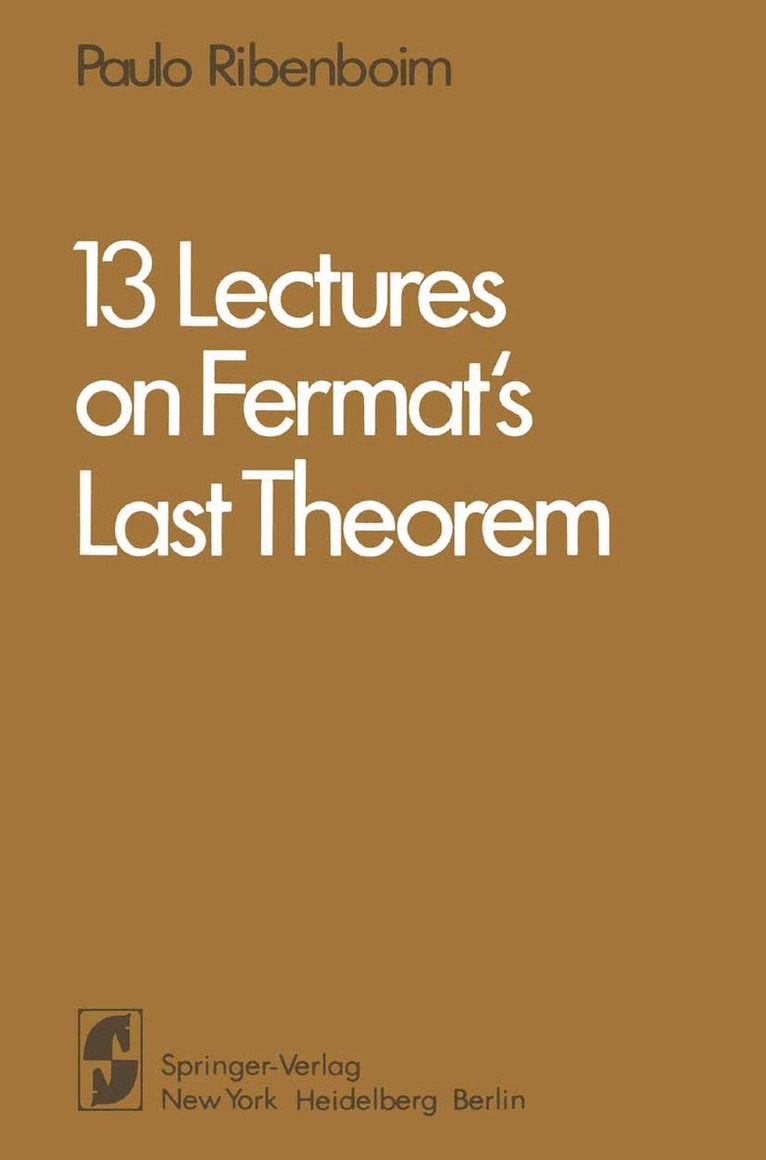
    13 Lectures on Fermat's Last Theorem

    AvPaulo Ribenboim

    Inbunden, Engelska, 1979

    547 kr

    Beställningsvara. Skickas inom 10-15 vardagar. Fri frakt över 249 kr.

    Fler format och utgåvor

    Häftad

    547 kr

    E-bok

    710 kr

    Beskrivning

    Fermat's problem, also ealled Fermat's last theorem, has attraeted the attention of mathematieians far more than three eenturies. Many clever methods have been devised to attaek the problem, and many beautiful theories have been ereated with the aim of proving the theorem. Yet, despite all the attempts, the question remains unanswered. The topie is presented in the form of leetures, where I survey the main lines of work on the problem. In the first two leetures, there is a very brief deseription of the early history , as well as a seleetion of a few of the more representative reeent results. In the leetures whieh follow, I examine in sue- eession the main theories eonneeted with the problem. The last two lee tu res are about analogues to Fermat's theorem. Some of these leetures were aetually given, in a shorter version, at the Institut Henri Poineare, in Paris, as well as at Queen's University, in 1977. I endeavoured to produee a text, readable by mathematieians in general, and not only by speeialists in number theory. However, due to a limitation in size, I am aware that eertain points will appear sketehy.Another book on Fermat's theorem, now in preparation, will eontain a eonsiderable amount of the teehnieal developments omitted here. It will serve those who wish to learn these matters in depth and, I hope, it will clarify and eomplement the present volume.

    Produktinformation

    • Utgivningsdatum:1979-12-18
    • Mått:156 x 234 x 23 mm
    • Vikt:664 g
    • Format:Inbunden
    • Språk:Engelska
    • Antal sidor:302
    • Upplaga:1979
    • Förlag:Springer-Verlag New York Inc.
    • ISBN:9780387904320

    Utforska kategorier

    • Talteori inom Naturvetenskap och teknik

    Innehållsförteckning

    • Lecture I The Early History of Fermat’s Last Theorem.- 1 The Problem.- 2 Early Attempts.- 3 Kummer’s Monumental Theorem.- 4 Regular Primes.- 5 Kummer’s Work on Irregular Prime Exponents.- 6 Other Relevant Results.- 7 The Golden Medal and the Wolfskehl Prize.- Lecture II Recent Results.- 1 Stating the Results.- 2 Explanations.- Lecture III B.K. = Before Kummer.- 1 The Pythagorean Equation.- 2 The Biquadratic Equation.- 3 The Cubic Equation.- 4 The Quintic Equation.- 5 Fermat’s Equation of Degree Seven.- Lecture IV The Naïve Approach.- 1 The Relations of Barlow and Abel.- 2 Sophie Germain.- 3 Congruences.- 4 Wendt’s Theorem.- 5 Abel’s Conjecture.- 6 Fermat’s Equation with Even Exponent.- 7 Odds and Ends.- Lecture V Kummer’s Monument.- 1 A Justification of Kummer’s Method.- 2 Basic Facts about the Arithmetic of Cyclotomic Fields.- 3 Kummer’s Main Theorem.- Lecture VI Regular Primes.- 1 The Class Number of Cyclotomic Fields.- 2 Bernoulli Numbers and Kummer’s Regularity Criterion.- 3 Various Arithmetic Properties of Bernoulli Numbers.- 4 The Abundance of Irregular Primes.- 5 Computation of Irregular Primes.- Lecture VII Kummer Exits.- 1 The Periods of the Cyclotomic Equation.- 2 The Jacobi Cyclotomic Function.- 3 On the Generation of the Class Group of the Cyclotomic Field.- 4 Kummer’s Congruences.- 5 Kummer’s Theorem for a Class of Irregular Primes.- 6 Computations of the Class Number.- Lecture VIII After Kummer, a New Light.- 1 The Congruences of Mirimanoff.- 2 The Theorem of Krasner.- 3 The Theorems of Wieferich and Mirimanoff.- 4 Fermat’s Theorem and the Mersenne Primes.- 5 Summation Criteria.- 6 Fermat Quotient Criteria.- Lecture IX The Power of Class Field Theory.- 1 The Power Residue Symbol.- 2 Kummer Extensions.- 3 The Main Theorems ofFurtwängler.- 4 The Method of Singular Integers.- 5 Hasse.- 6 The p-Rank of the Class Group of the Cyclotomic Field.- 7 Criteria of p-Divisibility of the Class Number.- 8 Properly and Improperly Irregular Cyclotomic Fields.- Lecture X Fresh Efforts.- 1 Fermat’s Last Theorem Is True for Every Prime Exponent Less Than 125000.- 2 Euler Numbers and Fermat’s Theorem.- 3 The First Case Is True for Infinitely Many Pairwise Relatively Prime Exponents.- 4 Connections between Elliptic Curves and Fermat’s Theorem.- 5 Iwasawa’s Theory.- 6 The Fermat Function Field.- 7 Mordell’s Conjecture.- 8 The Logicians.- Lecture XI Estimates.- 1 Elementary (and Not So Elementary) Estimates.- 2 Estimates Based on the Criteria Involving Fermat Quotients.- 3 Thue, Roth, Siegel and Baker.- 4 Applications of the New Methods.- Lecture XII Fermat’s Congruence.- 1 Fermat’s Theorem over Prime Fields.- 2 The Local Fermat’s Theorem.- 3 The Problem Modulo a Prime-Power.- Lecture XIII Variations and Fugue on a Theme.- 1 Variation I (In the Tone of Polynomial Functions).- 2 Variation II (In the Tone of Entire Functions).- 3 Variation III (In the Theta Tone).- 4 Variation IV (In the Tone of Differential Equations).- 5 Variation V (Giocoso).- 6 Variation VI (In the Negative Tone).- 7 Variation VII (In the Ordinal Tone).- 8 Variation VIII (In a Nonassociative Tone).- 9 Variation IX (In the Matrix Tone).- 10 Fugue (In the Quadratic Tone).- Epilogue.- Index of Names.