• Fri frakt över 249 kr
  • •
  • Snabba leveranser
  • •
  • Billiga böcker
Kundservice

Du är på sajten för privatpersoner.

Företag, bibliotek eller offentlig verksamhet?

Du handlar på classic.bokus.com, där alla dina funktioner finns intakta.
Till classic.bokus.com
Bokus logotyp. Gå till startsidan.
  • Erbjudanden
  • Nyheter
  • Student
  • Topplistor
  • Barn & ungdom
  • Bokus Play
  • E-böcker
  • Pocketböcker
  • Spel & pussel

10% rabatt på allt med kod NYSTART10 →

Sidfot

Mina sidor

    Hjälp

    • Kundservice
    • Vanliga frågor och svar
    • Frakt och leverans
    • Retur vid ångerrätt
    • Reklamera vara
    • Betalning
    • Köpvillkor
    • Allmänna villkor
    • Information om webbplatsens tillgänglighet

    Om Bokus

    • Om oss
    • Pressrum
    • För studenter
    • För företag
    • För bibliotek och offentlig verksamhet
    • För leverantörer
    • Hållbarhet

    Populärt

    • Aktuella erbjudanden
    • Presentkort
    • Studentlitteratur
    • Nya böcker
    • Topplistor
    • Signerade böcker
    • Engelska böcker

    Inspiration

    • Boktips
    • BookTok
    • Populära bokserier
    • Barnbokskaraktärer
    • Populära författare
    Logotyp för Bokus
    Följ oss på Facebook (extern länk)Följ oss på Instagram (extern länk)Följ oss på YouTube (extern länk)Följ oss på TikTok (extern länk)
    bokus @ CookiesAnpassa cookiesIntegritetspolicyKöpvillkor
    Till Citymail hemsida (extern länk)Till Budbee hemsida (extern länk)Till Postnord hemsida (extern länk)Till Schenker hemsida (extern länk)Till Early Bird hemsida (extern länk)Till Walleys hemsida (extern länk)
    1. Psykologi och pedagogik
    2. Psykologi
    3. Kognitiv psykologi

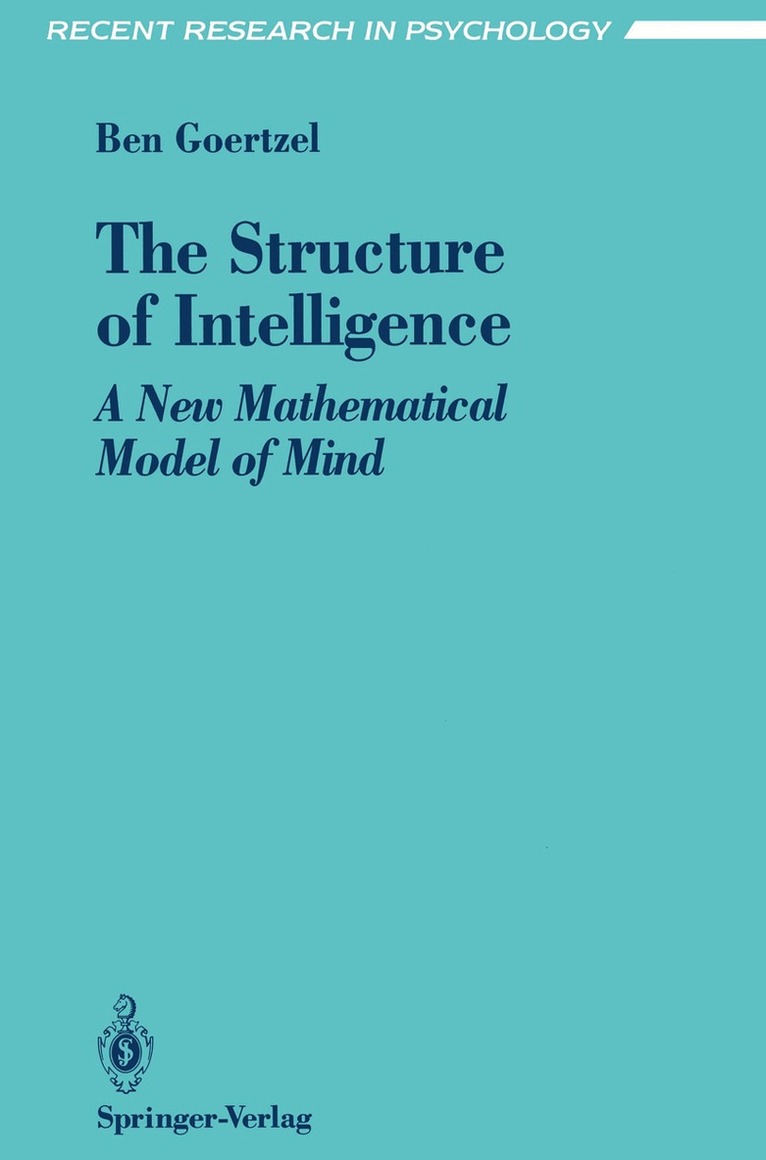
    Structure of Intelligence

    A New Mathematical Model of Mind

    AvBen Goertzel

    Häftad, Engelska, 1993

    Del i serien Recent Research in Psychology

    1 263 kr

    Beställningsvara. Skickas inom 10-15 vardagar. Fri frakt över 249 kr.

    Fler format och utgåvor

    E-bok

    1 679 kr

    Beskrivning

    0. 0 Psychology versus Complex Systems Science Over the last century, psychology has become much less of an art and much more of a science. Philosophical speculation is out; data collection is in. In many ways this has been a very positive trend. Cognitive science (Mandler, 1985) has given us scientific analyses of a variety of intelligent behaviors: short-term memory, language processing, vision processing, etc. And thanks to molecular psychology (Franklin, 1985), we now have a rudimentary understanding of the chemical processes underlying personality and mental illness. However, there is a growing feeling-particularly among non-psychologists (see e. g. Sommerhoff, 1990) - that, with the new emphasis on data collection, something important has been lost. Very little attention is paid to the question of how it all fits together. The early psychologists, and the classical philosophers of mind, were concerned with the general nature of mentality as much as with the mechanisms underlying specific phenomena. But the new, scientific psychology has made disappointingly little progress toward the resolution of these more general questions. One way to deal with this complaint is to dismiss the questions themselves. After all, one might argue, a scientific psychology cannot be expected to deal with fuzzy philosophical questions that probably have little empirical signifi­ cance. It is interesting that behaviorists and cognitive scientists tend to be in agreement regarding the question of the overall structure of the mind.

    Produktinformation

    • Utgivningsdatum:1993-06-24
    • Mått:155 x 235 x 14 mm
    • Vikt:371 g
    • Format:Häftad
    • Språk:Engelska
    • Serie:Recent Research in Psychology
    • Antal sidor:187
    • Förlag:Springer-Verlag New York Inc.
    • ISBN:9780387940045

    Utforska kategorier

    • Kognitiv psykologi inom Psykologi och pedagogik

    Innehållsförteckning

    • 0. Introduction.- 0.0 Psychology versus Complex Systems Science.- 0.1 Mind and Computation.- 0.2 Synopsis.- 0.3 Mathematics, Philosophy, and Science.- 1. Mind and Computation.- 1.0 Rules.- 1.1 Stochastic and Quantum Computation.- 1.2 Computational Complexity.- 1.3 Network, Program, or Network of Programs?.- 2. Optimization.- 2.0 Thought as Optimization.- 2.1 Monte Carlo and Multistart.- 2.2 Simulated Annealing.- 2.3 Multilevel Optimization.- 3. Quantifying Structure.- 3.0 Algorithmic Complexity.- 3.1 Randomness.- 3.2 Pattern.- 3.3 Meaningful Complexity.- 3.4 Structural Complexity.- 4. Intelligence and Mind.- 4.0 The Triarchic Theory of Intelligence.- 4.1 Intelligence as Flexible Optimization.- 4.2 Unpredictability.- 4.3 Intelligence as Flexible Optimization, Revisited.- 4.4 Mind and Behavior.- 5. Induction.- 5.0 Justifying Induction.- 5.1 The Tendency to Take Habits.- 5.2 Toward a General Induction Algorithm.- 5.3 Induction, Probability, and Intelligence.- 6. Analogy.- 6.0 The Structure-Mapping Theory of Analogy.- 6.1 A Typology of Analogy.- 6.2 Analogy and Induction.- 6.3 Hierarchical Analogy.- 6.4 Structural Analogy in the Brain.- 7. Long-Term Memory.- 7.0 Structurally Associative Memory.- 7.1 Quillian Networks.- 7.2 Implications of Structurally Associative Memory.- 7.3 Image and Process.- 8. Deduction.- 8.0 Deduction and Analogy in Mathematics.- 8.1 The Structure of Deduction.- 8.2 Paraconsistency.- 8.3 Deduction Cannot Stand Alone.- 9. Perception.- 9.0 The Perceptual Hierarchy.- 9.1 Probability Theory.- 9.2 The Maximum Entropy Principle.- 9.3 The Logic of Perception.- 10. Motor Learning.- 10.0 Generating Motions.- 10.1 Parameter Adaptation.- 10.2 The Motor Control Hierarchy.- 10.3 A Neural-Darwinist Perceptual-Motor Hierarchy.- 11. Consciousness and Computation.- 11.0 Toward a Quantum Theory of Consciousness.- 11.1 Implications of the Quantum Theory of Consciousness.- 11.2 Consciousness and Emotion.- 12. The Master Network.- 12.0 The Structure of Intelligence.- 12.1 Design for a Thinking Machine.- Appendix 1. Components of the Master Network.- Appendix 2. Automata Networks.- Appendix 3. A Quick Review of Boolean Logic.- References.