• Fri frakt över 249 kr
  • •
  • Snabba leveranser
  • •
  • Billiga böcker
Kundservice

Du är på sajten för privatpersoner.

Företag, bibliotek eller offentlig verksamhet?

Du handlar på classic.bokus.com, där alla dina funktioner finns intakta.
Till classic.bokus.com
Bokus logotyp. Gå till startsidan.
  • Erbjudanden
  • Nyheter
  • Student
  • Topplistor
  • Barn & ungdom
  • Bokus Play
  • E-böcker
  • Pocketböcker
  • Spel & pussel

10% rabatt på allt med kod: NYSTART10 →

Sidfot

Mina sidor

    Hjälp

    • Kundservice
    • Vanliga frågor och svar
    • Frakt och leverans
    • Retur vid ångerrätt
    • Reklamera vara
    • Betalning
    • Köpvillkor
    • Allmänna villkor
    • Information om webbplatsens tillgänglighet

    Om Bokus

    • Om oss
    • Pressrum
    • För studenter
    • För företag
    • För bibliotek och offentlig verksamhet
    • För leverantörer
    • Hållbarhet

    Populärt

    • Aktuella erbjudanden
    • Presentkort
    • Studentlitteratur
    • Nya böcker
    • Topplistor
    • Signerade böcker
    • Engelska böcker

    Inspiration

    • Boktips
    • BookTok
    • Populära bokserier
    • Barnbokskaraktärer
    • Populära författare
    Logotyp för Bokus
    Följ oss på Facebook (extern länk)Följ oss på Instagram (extern länk)Följ oss på YouTube (extern länk)Följ oss på TikTok (extern länk)
    bokus @ CookiesAnpassa cookiesIntegritetspolicyKöpvillkor
    Till Citymail hemsida (extern länk)Till Budbee hemsida (extern länk)Till Postnord hemsida (extern länk)Till Schenker hemsida (extern länk)Till Early Bird hemsida (extern länk)Till Walleys hemsida (extern länk)
    1. Naturvetenskap och teknik
    2. Matematik och naturvetenskap
    3. Matematik
    4. Tillämpad matematik

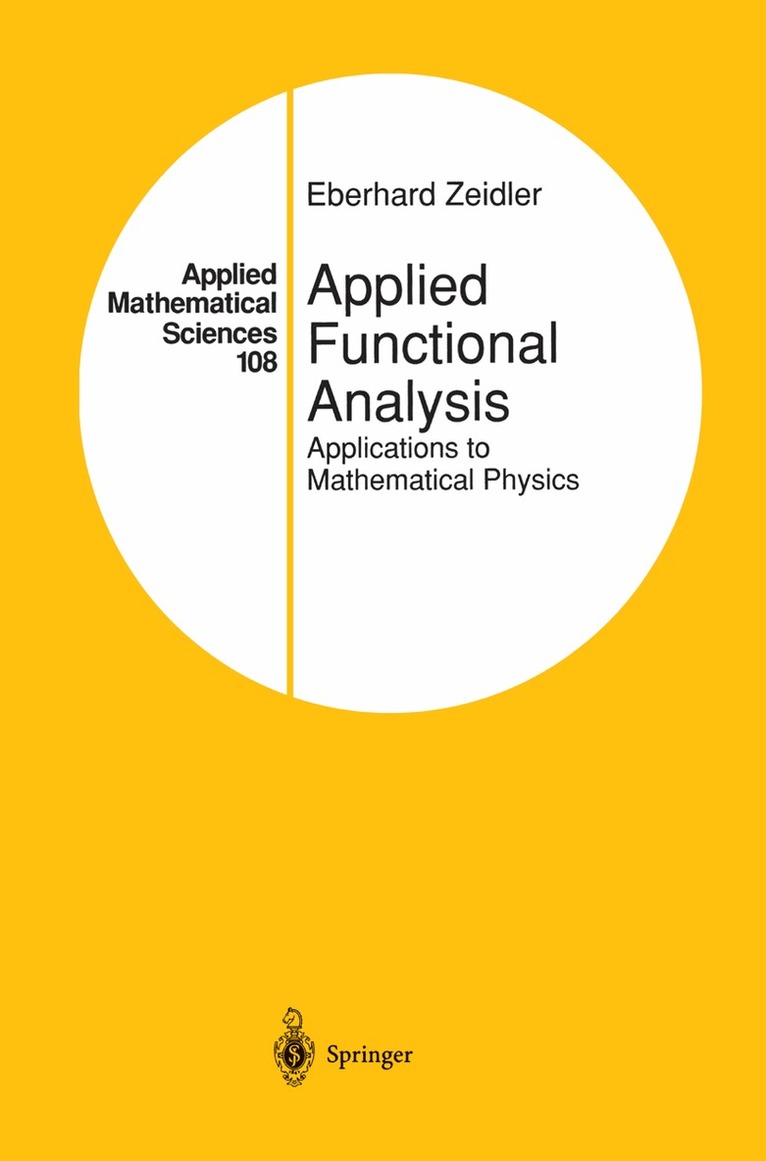
    Applied Functional Analysis

    Applications to Mathematical Physics

    AvEberhard Zeidler

    Inbunden, Engelska, 1995

    Del 108 i serien Applied Mathematical Sciences

    1 301 kr

    Beställningsvara. Skickas inom 10-15 vardagar. Fri frakt över 249 kr.

    Fler format och utgåvor

    Inbunden

    1 086 kr

    E-bok

    1 665 kr

    E-bok

    1 393 kr

    Häftad

    1 301 kr

    Häftad

    1 086 kr

    Beskrivning

    A theory is the more impressive, the simpler are its premises, the more distinct are the things it connects, and the broader is its range of applicability. Albert Einstein There are two different ways of teaching mathematics, namely, (i) the systematic way, and (ii) the application-oriented way. More precisely, by (i), I mean a systematic presentation of the material governed by the desire for mathematical perfection and completeness of the results. In contrast to (i), approach (ii) starts out from the question "What are the most important applications?" and then tries to answer this question as quickly as possible. Here, one walks directly on the main road and does not wander into all the nice and interesting side roads. The present book is based on the second approach. It is addressed to undergraduate and beginning graduate students of mathematics, physics, and engineering who want to learn how functional analysis elegantly solves mathematical problems that are related to our real world and that have played an important role in the history of mathematics. The reader should sense that the theory is being developed, not simply for its own sake, but for the effective solution of concrete problems. viii Preface This introduction to functional analysis is divided into the following two parts: Part I: Applications to mathematical physics (the present AMS Vol. 108); Part II: Main principles and their applications (AMS Vol. 109).

    Produktinformation

    • Utgivningsdatum:1995-06-23
    • Mått:155 x 235 x 34 mm
    • Vikt:934 g
    • Format:Inbunden
    • Språk:Engelska
    • Serie:Applied Mathematical Sciences
    • Antal sidor:481
    • Förlag:Springer-Verlag New York Inc.
    • ISBN:9780387944425

    Utforska kategorier

    • Tillämpad matematik inom Naturvetenskap och teknik
    • Beräkning och matematisk analys inom Naturvetenskap och teknik

    Innehållsförteckning

    • 1 Banach Spaces and Fixed-Point Theorems.- 1.1 Linear Spaces and Dimension.- 1.2 Normed Spaces and Convergence.- 1.3 Banach Spaces and the Cauchy Convergence Criterion.- 1.4 Open and Closed Sets.- 1.5 Operators.- 1.6 The Banach Fixed-Point Theorem and the Iteration Method.- 1.7 Applications to Integral Equations.- 1.8 Applications to Ordinary Differential Equations.- 1.9 Continuity.- 1.10 Convexity.- 1.11 Compactness.- 1.12 Finite-Dimensional Banach Spaces and Equivalent Norms.- 1.13 The Minkowski Functional and Homeomorphisms.- 1.14 The Brouwer Fixed-Point Theorem.- 1.15 The Schauder Fixed-Point Theorem.- 1.16 Applications to Integral Equations.- 1.17 Applications to Ordinary Differential Equations.- 1.18 The Leray-Schauder Principle and a priori Estimates.- 1.19 Sub- and Supersolutions, and the Iteration Method in Ordered Banach Spaces.- 1.20 Linear Operators.- 1.21 The Dual Space.- 1.22 Infinite Series in Normed Spaces.- 1.23 Banach Algebras and Operator Functions.- 1.24 Applications to Linear Differential Equations in Banach Spaces.- 1.25 Applications to the Spectrum.- 1.26 Density and Approximation.- 1.27 Summary of Important Notions.- 2 Hilbert Spaces, Orthogonality, and the Dirichlet Principle.- 2.1 Hilbert Spaces.- 2.2 Standard Examples.- 2.3 Bilinear Forms.- 2.4 The Main Theorem on Quadratic Variational Problems.- 2.5 The Functional Analytic Justification of the Dirichlet Principle.- 2.6 The Convergence of the Ritz Method for Quadratic Variational Problems.- 2.7 Applications to Boundary-Value Problems, the Method of Finite Elements, and Elasticity.- 2.8 Generalized Functions and Linear Functionals.- 2.9 Orthogonal Projection.- 2.10 Linear Functionals and the Riesz Theorem.- 2.11 The Duality Map.- 2.12 Duality for Quadratic Variational Problems.- 2.13 The Linear Orthogonality Principle.- 2.14 Nonlinear Monotone Operators.- 2.15 Applications to the Nonlinear Lax-Milgram Theorem and the Nonlinear Orthogonality Principle.- 3 Hilbert Spaces and Generalized Fourier Series.- 3.1 Orthonormal Series.- 3.2 Applications to Classical Fourier Series.- 3.3 The Schmidt Orthogonalization Method.- 3.4 Applications to Polynomials.- 3.5 Unitary Operators.- 3.6 The Extension Principle.- 3.7 Applications to the Fourier Transformation.- 3.8 The Fourier Transform of Tempered Generalized Functions.- 4 Eigenvalue Problems for Linear Compact Symmetric Operators.- 4.1 Symmetric Operators.- 4.2 The Hilbert-Schmidt Theory.- 4.3 The Fredholm Alternative.- 4.4 Applications to Integral Equations.- 4.5 Applications to Boundary-Eigenvalue Value Problems.- 5 Self-Adjoint Operators, the Friedrichs Extension and the Partial Differential Equations of Mathematical Physics.- 5.1 Extensions and Embeddings.- 5.2 Self-Adjoint Operators.- 5.3 The Energetic Space.- 5.4 The Energetic Extension.- 5.5 The Friedrichs Extension of Symmetric Operators.- 5.6 Applications to Boundary-Eigenvalue Problems for the Laplace Equation.- 5.7 The Poincaré Inequality and Rellich’s Compactness Theorem.- 5.8 Functions of Self-Adjoint Operators.- 5.9 Semigroups, One-Parameter Groups, and Their Physical Relevance.- 5.10 Applications to the Heat Equation.- 5.11 Applications to the Wave Equation.- 5.12 Applications to the Vibrating String and the Fourier Method.- 5.13 Applications to the Schrödinger Equation.- 5.14 Applications to Quantum Mechanics.- 5.15 Generalized Eigenfunctions.- 5.16 Trace Class Operators.- 5.17 Applications to Quantum Statistics.- 5.18 C*-Algebras and the Algebraic Approach to Quantum Statistics.- 5.19 The Fock Space in Quantum Field Theory and the Pauli Principle.- 5.20 A Look at Scattering Theory.- 5.21 The Language of Physicists in Quantum Physics and the Justification of the Dirac Calculus.- 5.22 The Euclidean Strategy in Quantum Physics.- 5.23 Applications to Feynman’s Path Integral.- 5.24 The Importance of the Propagator in Quantum Physics.- 5.25 A Look at Solitons and Inverse Scattering Theory.- Epilogue.- References.- Hints for Further Reading.- List of Symbols.- List of Theorems.- List of the Most Important Definitions.