• Fri frakt över 249 kr
  • •
  • Snabba leveranser
  • •
  • Billiga böcker
Kundservice

Du är på sajten för privatpersoner.

Företag, bibliotek eller offentlig verksamhet?

Du handlar på classic.bokus.com, där alla dina funktioner finns intakta.
Till classic.bokus.com
Bokus logotyp. Gå till startsidan.
  • Erbjudanden
  • Student
  • Topplistor
  • Barn & ungdom
  • Bokus Play
  • E-böcker
  • Ljudböcker
  • Pocketböcker
  • Spel och pussel

5% studentrabatt – använd koden KURSBOK27 →

Sidfot

Mina sidor

    Hjälp

    • Kundservice
    • Vanliga frågor och svar
    • Frakt och leverans
    • Retur vid ångerrätt
    • Reklamera vara
    • Betalning
    • Köpvillkor
    • Allmänna villkor
    • Information om webbplatsens tillgänglighet

    Om Bokus

    • Om oss
    • Pressrum
    • För studenter
    • För företag
    • För bibliotek och offentlig verksamhet
    • För leverantörer
    • Hållbarhet

    Populärt

    • Aktuella erbjudanden
    • Presentkort
    • Studentlitteratur
    • Nya böcker
    • Topplistor
    • Signerade böcker
    • Engelska böcker

    Inspiration

    • Boktips
    • BookTok
    • Barnbokskaraktärer
    • Populära författare
    Logotyp för Bokus
    Följ oss på Facebook (extern länk)Följ oss på Instagram (extern länk)Följ oss på YouTube (extern länk)Följ oss på TikTok (extern länk)
    bokus @ CookiesAnpassa cookiesIntegritetspolicyKöpvillkor
    Till Citymail hemsida (extern länk)Till Budbee hemsida (extern länk)Till Postnord hemsida (extern länk)Till Schenker hemsida (extern länk)Till Early Bird hemsida (extern länk)Till Walleys hemsida (extern länk)
    1. Naturvetenskap och teknik
    2. Matematik och naturvetenskap
    3. Matematik
    4. Optimering

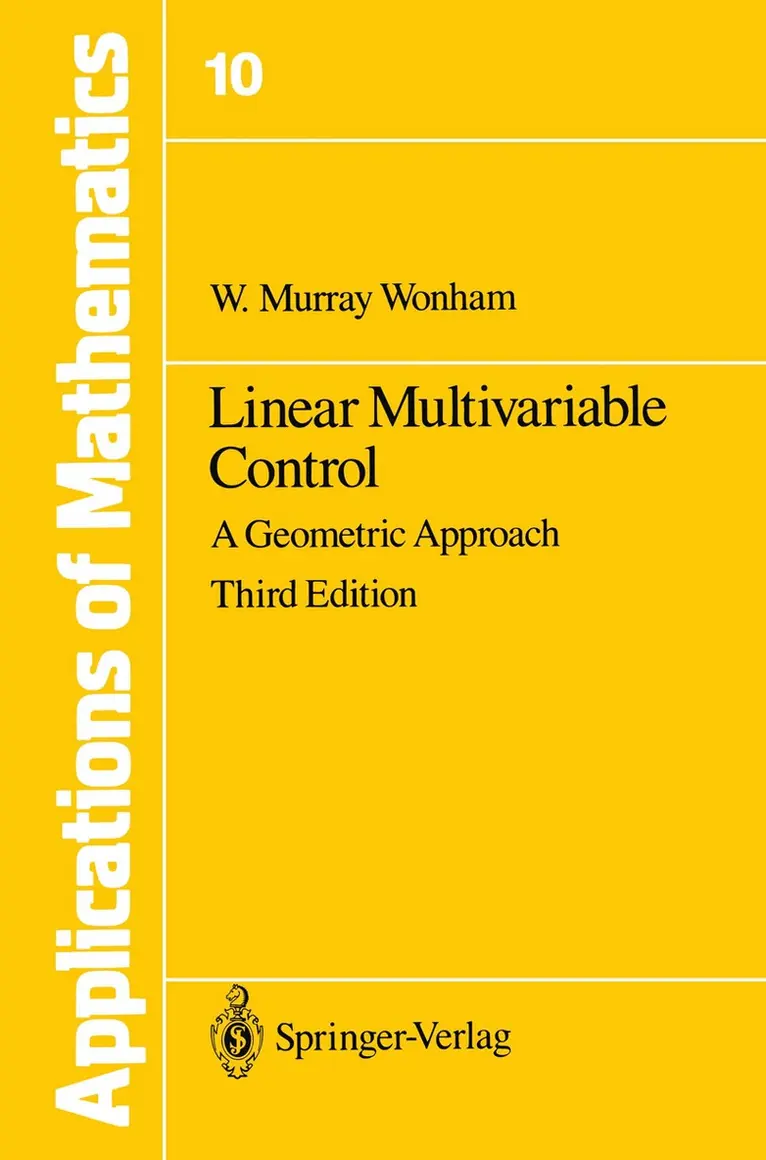
    Linear Multivariable Control

    A Geometric Approach

    AvW.M. Wonham

    Inbunden, Engelska, 1985

    Del i serien Stochastic Modelling and Applied Probability

    1 834 kr

    Beställningsvara. Skickas inom 10-15 vardagar. Fri frakt över 249 kr.

    Fler format och utgåvor

    E-bok

    2 044 kr

    Häftad

    1 619 kr

    Beskrivning

    In wntmg this monograph my aim has been to present a "geometric" approach to the structural synthesis of multivariable control systems that are linear, time-invariant and of finite dynamic order. The book is ad­ dressed to graduate students specializing in control, to engineering scientists involved in control systems research and development, and to mathemati­ cians interested in systems control theory. The label "geometric" in the title is applied for several reasons. First and obviously, the setting is linear state space and the mathematics chiefly linear algebra in abstract (geometric) style. The basic ideas are the familiar system concepts of controllability and observability, thought of as geometric prop­ erties of distinguished state subspaces. Indeed, the geometry was first brought in out of revulsion against the orgy of matrix manipulation which linear control theory mainly consisted of, around fifteen years ago. But secondly and of greater interest, the geometric setting rather quickly sug­ gested new methods of attacking synthesis which have proved to be intuitive and economical; they are also easily reduced to matrix arithmetic as soon as you want to compute. The essence of the "geometric" approach is just this: instead of looking directly for a feedback law (say u = Fx) which would solve your synthesis problem if a solution exists, first characterize solvability as a verifiable property of some constructible state subspace, say Y. Then, if all is well, you may calculate F from Y quite easily.

    Produktinformation

    • Utgivningsdatum:1985-12-01
    • Mått:155 x 235 x 21 mm
    • Vikt:670 g
    • Format:Inbunden
    • Språk:Engelska
    • Serie:Stochastic Modelling and Applied Probability
    • Antal sidor:334
    • Upplaga:3
    • Förlag:Springer-Verlag New York Inc.
    • ISBN:9780387960715

    Utforska kategorier

    • Optimering inom Naturvetenskap och teknik
    • Referensverk och tvärvetenskap inom Samhälle och politik

    Innehållsförteckning

    • 0 Mathematical Preliminaries.- 0.1 Notation.- 0.2 Linear Spaces.- 0.3 Subspaces.- 0.4 Maps and Matrices.- 0.5 Factor Spaces.- 0.6 Commutative Diagrams.- 0.7 Invariant Subspaces. Induced Maps.- 0.8 Characteristic Polynomial. Spectrum.- 0.9 Polynomial Rings.- 0.10 Rational Canonical Structure.- 0.11 Jordan Decomposition.- 0.12 Dual Spaces.- 0.13 Tensor Product. The Sylvester Map.- 0.14 Inner Product Spaces.- 0.15 Hermitian and Symmetric Maps.- 0.16 Well-Posedness and Genericity.- 0.17 Linear Systems.- 0.18 Transfer Matrices. Signal Flow Graphs.- 0.19 Rouché’s Theorem.- 0.20 Exercises.- 0.21 Notes and References.- 1 Introduction to Controllability.- 1.1 Reachability.- 1.2 Controllability.- 1.3 Single-Input Systems.- 1.4 Multi-Input Systems.- 1.5 Controllability is Generic.- 1.6 Exercises.- 1.7 Notes and References.- 2 Controllability, Feedback and Pole Assignment.- 2.1 Controllability and Feedback.- 2.2 Pole Assignment.- 2.3 Incomplete Controllability and Pole Shifting.- 2.4 Stabilizability.- 2.5 Exercises.- 2.6 Notes and References.- 3 Observability and Dynamic Observers.- 3.1 Observability.- 3.2 Unobservable Subspace.- 3.3 Full Order Dynamic Observer.- 3.4 Minimal Order Dynamic Observer.- 3.5 Observers and Pole Shifting.- 3.6 Detectability.- 3.7 Detectors and Pole Shifting.- 3.8 Pole Shifting by Dynamic Compensation.- 3.9 Observer for a Single Linear Functional.- 3.10 Preservation of Observability and Detectability.- 3.11 Exercises.- 3.12 Notes and References.- 4 Disturbance Decoupling and Output Stabilization.- 4.1 Disturbance Decoupling Problem (DDP).- 4.2 (A, B)-Invariant Subspaces.- 4.3 Solution of DDP.- 4.4 Output Stabilization Problem (OSP).- 4.5 Exercises.- 4.6 Notes and References.- 5 Controllability Subspaces.- 5.1 Controllability Subspaces.- 5.2 Spectral Assignability.- 5.3 Controllability Subspace Algorithm.- 5.4 Supremal Controllability Subspace.- 5.5 Transmission Zeros.- 5.6 Disturbance Decoupling with Stability.- 5.7 Controllability Indices.- 5.8 Exercises.- 5.9 Notes and References.- 6 Tracking and Regulation I: Output Regulation.- 6.1 Restricted Regulator Problem (RRP).- 6.2 Solvability of RRP.- 6.3 Example 1 : Solution of RRP.- 6.4 Extended Regulator Problem (ERP).- 6.5 Example 2: Solution of ERP.- 6.6 Concluding Remarks.- 6.7 Exercises.- 6.8 Notes and References.- 7 Tracking and Regulation II: Output Regulation with Internal Stability.- 7.1 Solvability of RPIS: General Considerations.- 7.2 Constructive Solution of RPIS: N= 0.- 7.3 Constructive Solution of RPIS: N Arbitrary.- 7.4 Application: Regulation Against Step Disturbances.- 7.5 Application: Static Decoupling.- 7.6 Example 1 : RPIS Unsolvable.- 7.7 Example 2: Servo-Regulator.- 7.8 Exercises.- 7.9 Notes and References.- 8 Tracking and Regulation III: Structurally Stable Synthesis.- 8.1 Preliminaries.- 8.2 Example 1: Structural Stability.- 8.3 Well-Posedness and Genericity.- 8.4 Well-Posedness and Transmission Zeros.- 8.5 Example 2: RPIS Solvable but Ill-Posed.- 8.6 Structurally Stable Synthesis.- 8.7 Example 3: Well-Posed RPIS: Strong Synthesis.- 8.8 The Internal Model Principle.- 8.9 Exercises.- 8.10 Notes and References.- 9 Noninteraeting Control I: Basic Principles.- 9.1 Decoupling: Systems Formulation.- 9.2 Restricted Decoupling Problem (RDP).- 9.3 Solution of RDP: Outputs Complete.- 9.4 Extended Decoupling Problem (EDP).- 9.5 Solution of EDP.- 9.6 Naive Extension.- 9.7 Example.- 9.8 Partial Decoupling.- 9.9 Exercises.- 9.10 Notes and References.- 10 Noninteraeting Control II: Efficient Compensation.- 10.1 The Radical.- 10.2 Efficient Extension.- 10.3 Efficient Decoupling.- 10.4 Minimal Order Compensation: d(?) = 2.- 10.5 Minimal Order Compensation: d(?) = k.- 10.6 Exercises.- 10.7 Notes and References.- 11 Noninteraeting Control III: Generic Solvability.- 11.1 Generic Solvability of EDP.- 11.2 State Space Extension Bounds.- 11.3 Significance of Generic Solvability.- 11.4 Exercises.- 11.5 Notes and References.- 12 Quadratic Optimization I: Existence and Uniqueness.- 12.1 Quadratic Optimization.- 12.2 Dynamic Programming: Heuristics.- 12.3 Dynamic Programming: Formal Treatment.- 12.4 Matrix Quadratic Equation.- 12.5 Exercises.- 12.6 Notes and References.- 13 Quadratic Optimization II: Dynamic Response.- 13.1 Dynamic Response: Generalities.- 13.2 Example 1 : First-Order System.- 13.3 Example 2: Second-Order System.- 13.4 Hamiltoman Matrix.- 13.5 Asymptotic Root Locus: Single Input System.- 13.6 Asymptotic Root Locus: Multivariable System.- 13.7 Upper and Lower Bounds on P0.- 13.8 Stability Margin. Gain Margin.- 13.9 Return Difference Relations.- 13.10 Applicability of Quadratic Optimization.- 13.11 Exercises.- 13.12 Notes and References.- References.- Relational and Operational Symbols.- Letter Symbols.- Synthesis Problems.