• Fri frakt över 249 kr
  • •
  • Snabba leveranser
  • •
  • Billiga böcker
Kundservice

Du är på sajten för privatpersoner.

Företag, bibliotek eller offentlig verksamhet?

Du handlar på classic.bokus.com, där alla dina funktioner finns intakta.
Till classic.bokus.com
Bokus logotyp. Gå till startsidan.
  • Erbjudanden
  • Nyheter
  • Student
  • Topplistor
  • Barn & ungdom
  • Bokus Play
  • E-böcker
  • Pocketböcker
  • Spel & pussel

10% rabatt på allt med kod: NYSTART10 →

Sidfot

Mina sidor

    Hjälp

    • Kundservice
    • Vanliga frågor och svar
    • Frakt och leverans
    • Retur vid ångerrätt
    • Reklamera vara
    • Betalning
    • Köpvillkor
    • Allmänna villkor
    • Information om webbplatsens tillgänglighet

    Om Bokus

    • Om oss
    • Pressrum
    • För studenter
    • För företag
    • För bibliotek och offentlig verksamhet
    • För leverantörer
    • Hållbarhet

    Populärt

    • Aktuella erbjudanden
    • Presentkort
    • Studentlitteratur
    • Nya böcker
    • Topplistor
    • Signerade böcker
    • Engelska böcker

    Inspiration

    • Boktips
    • BookTok
    • Populära bokserier
    • Barnbokskaraktärer
    • Populära författare
    Logotyp för Bokus
    Följ oss på Facebook (extern länk)Följ oss på Instagram (extern länk)Följ oss på YouTube (extern länk)Följ oss på TikTok (extern länk)
    bokus @ CookiesAnpassa cookiesIntegritetspolicyKöpvillkor
    Till Citymail hemsida (extern länk)Till Budbee hemsida (extern länk)Till Postnord hemsida (extern länk)Till Schenker hemsida (extern länk)Till Early Bird hemsida (extern länk)Till Walleys hemsida (extern länk)
    1. Psykologi och pedagogik
    2. Psykologi

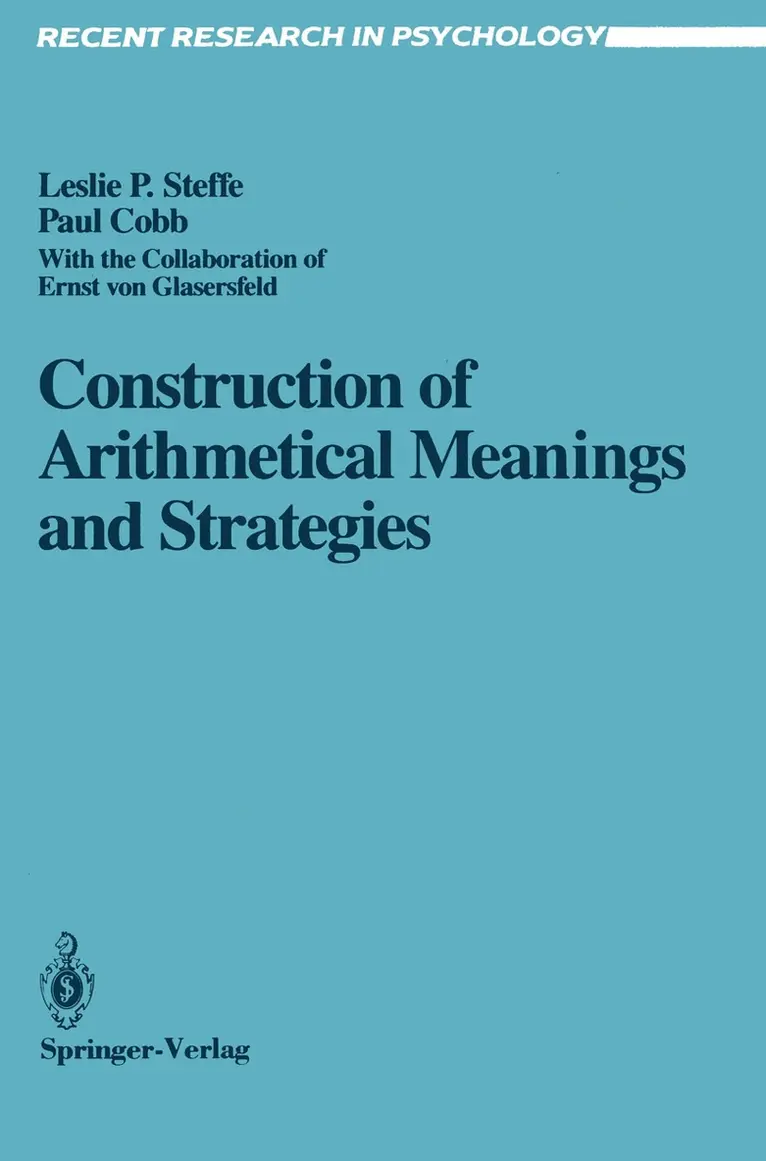
    Construction of Arithmetical Meanings and Strategies

    AvLeslie P. Steffe,Paul Cobb

    Häftad, Engelska, 1987

    Del i serien Recent Research in Psychology

    1 160 kr

    Beställningsvara. Skickas inom 10-15 vardagar. Fri frakt över 249 kr.

    Beskrivning

    The studies presented in this book should be of interest to anybody concerned with the teaching of arithmetic to young children or with cognitive development in general. The 'eaching experiment· was carried out with half a dozen children entering first grade over two years in biweekly sessions. Methodologically the authors' research is original. It is a longitudinal but not a naturalistic study, since the experimenter-teachers directed their interaction with each individual child with a view to his or her possible progress. It is experimental in the sense that two groups of subjects were selected according to criteria derived from an earlier study (Steffe, von Glasersfeld, Richards & Cobb, 1983) and that the problems proposed were comparable, though far from identical across the subjects; but unlike more rigid and shorter "learning" or ''training" studies it does not include pre-and posttests, or predetermined procedures. Theoretically, the authors subscribe to Piagefs constructivism: numbers are made by children, not found (as they may find some pretty rocks, for example) or accepted from adults (as they may accept and use a toy). The authors interpret changes in the children's counting behaviors in terms of constructivist concepts such as assimilation, accommodation, and reflective abstraction, and certain excerpts from protocols provide on-line examples of such processes at work. They also subscribe to Vygotsky's proposal for teachers '0 utilize the zone of proximal development and to lead the child to what he (can) not yet do· (1965, p. 104).

    Produktinformation

    • Utgivningsdatum:1987-12-18
    • Mått:155 x 235 x 20 mm
    • Vikt:552 g
    • Format:Häftad
    • Språk:Engelska
    • Serie:Recent Research in Psychology
    • Antal sidor:343
    • Förlag:Springer-Verlag New York Inc.
    • Medarbetare:Hermine Sinclair
    • ISBN:9780387966885

    Utforska kategorier

    • Psykologi inom Psykologi och pedagogik

    Innehållsförteckning

    • I: On the Construction of the Counting Scheme.- Children’s Counting.- Other Sources of Numerosity.- Meaning Theory.- II: The Construction of Motor Unit Items: Brenda, Tarus, and James.- 1. Brenda.- 2. Tarus.- 3. James.- Perspectives on the Three Case Studies.- III: The Construction of Verbal Unit Items: Brenda, Tarus, and James.- 1. Brenda.- 2. Tarus.- 3. James.- Perspectives on the Case Studies.- IV: The Construction of Abstract Unit Items: Tyrone, Scenetra, and Jason.- 4. Tyrone.- 5. Scenetra.- 6. Jason.- Perspectives on the Case Studies.- V: Lexical and Syntactical Meanings: Brenda, Tarus, and James.- 1. Brenda.- 2. Tarus.- 3. James.- Perspectives on the Case Studies.- VI: Lexical and Syntactical Meanings: Tyrone, Scenetra, and Jason.- Systems of Integration.- 4. Tyrone.- 5. Scenetra.- 6. Jason.- Perspectives on the Case Studies.- VII: Strategies for Finding Sums and Differences: Brenda, Tarus, and James.- Brenda.- Tarus.- James.- Perspectives on the Case Studies.- VIII: Strategies for Finding Sums and Differences: Tyrone, Scenetra, and Jason.- Sequential Integration Operations.- Progressive Integration Operations.- Part-Whole Operations.- Perspective on the Case Studies.- IX: Modifications of the Counting Scheme.- Predicting Modifications of the Counting Scheme.- Mathematical Learning.- Stages in the Construction of Part-Whole Operations.- References.