• Fri frakt över 249 kr
  • •
  • Snabba leveranser
  • •
  • Billiga böcker
Kundservice

Du är på sajten för privatpersoner.

Företag, bibliotek eller offentlig verksamhet?

Du handlar på classic.bokus.com, där alla dina funktioner finns intakta.
Till classic.bokus.com
Bokus logotyp. Gå till startsidan.
  • Erbjudanden
  • Nyheter
  • Student
  • Topplistor
  • Barn & ungdom
  • Bokus Play
  • E-böcker
  • Pocketböcker
  • Spel & pussel

10% rabatt på allt med kod: NYSTART10 →

Sidfot

Mina sidor

    Hjälp

    • Kundservice
    • Vanliga frågor och svar
    • Frakt och leverans
    • Retur vid ångerrätt
    • Reklamera vara
    • Betalning
    • Köpvillkor
    • Allmänna villkor
    • Information om webbplatsens tillgänglighet

    Om Bokus

    • Om oss
    • Pressrum
    • För studenter
    • För företag
    • För bibliotek och offentlig verksamhet
    • För leverantörer
    • Hållbarhet

    Populärt

    • Aktuella erbjudanden
    • Presentkort
    • Studentlitteratur
    • Nya böcker
    • Topplistor
    • Signerade böcker
    • Engelska böcker

    Inspiration

    • Boktips
    • BookTok
    • Populära bokserier
    • Barnbokskaraktärer
    • Populära författare
    Logotyp för Bokus
    Följ oss på Facebook (extern länk)Följ oss på Instagram (extern länk)Följ oss på YouTube (extern länk)Följ oss på TikTok (extern länk)
    bokus @ CookiesAnpassa cookiesIntegritetspolicyKöpvillkor
    Till Citymail hemsida (extern länk)Till Budbee hemsida (extern länk)Till Postnord hemsida (extern länk)Till Schenker hemsida (extern länk)Till Early Bird hemsida (extern länk)Till Walleys hemsida (extern länk)
    1. Naturvetenskap och teknik
    2. Matematik och naturvetenskap
    3. Matematik
    4. Matematisk statistik

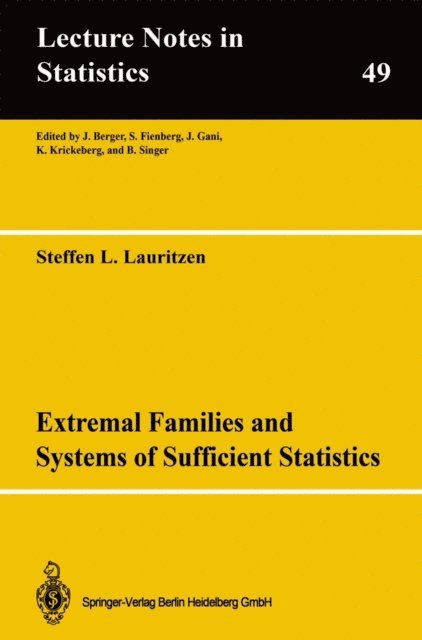
    Extremal Families and Systems of Sufficient Statistics

    AvSteffen L. Lauritzen

    Häftad, Engelska, 1988

    Del 49 i serien Lecture Notes in Statistics

    1 302 kr

    Beställningsvara. Skickas inom 10-15 vardagar. Fri frakt över 249 kr.

    Fler format och utgåvor

    E-bok

    1 665 kr

    Beskrivning

    The pOint of view behind the present work is that the connection between a statistical model and a statistical analysis-is a dua­ lity (in a vague sense). In usual textbooks on mathematical statistics it is often so that the statistical model is given in advance and then various in­ ference principles are applied to deduce the statistical ana­ lysis to be performed. It is however possible to reverse the above procedure: given that one wants to perform a certain statistical analysis, how can this be expressed in terms of a statistical model? In that sense we think of the statistical analysis and the stati­ stical model as two ways of expressing the same phenomenon, rather than thinking of the model as representing an idealisation of "truth" and the statistical analysis as a method of revealing that truth to the scientist. It is not the aim of the present work to solve the problem of giving the correct-anq final mathematical description of the quite complicated relation between model andanalysis. We have rather restricted ourselves to describe a particular aspect of this, formulate it in mathematical terms, and then tried to make a rigorous and consequent investigation of that mathematical struc­ ture.

    Produktinformation

    • Utgivningsdatum:1988-11-28
    • Mått:155 x 235 x 16 mm
    • Vikt:441 g
    • Format:Häftad
    • Språk:Engelska
    • Serie:Lecture Notes in Statistics
    • Antal sidor:268
    • Upplaga:1988
    • Förlag:Springer-Verlag New York Inc.
    • ISBN:9780387968728

    Utforska kategorier

    • Matematisk statistik inom Naturvetenskap och teknik

    Innehållsförteckning

    • I The Case of a Single Experiment and Finite Sample Space.- 1. Basic facts. Maximal and extremal families.- 2. Induced maximal and extremal families.- 3. Convexity, maximal and extremal families.- 4. Some examples.- II Simple Repetitive Structures of Product Type. Discrete Sample Spaces.- 0. Conditional independence.- 1. Preliminaries. Notation.- 2. Notions of sufficiency.- 3. Maximal and extremal families.- 4. Limit theorems for maximal and extremal families.- 5. The topology of$$\left( {\mathop{ {\dot{U}}}\limits_{n} { {y}_{n}}} \right)UM.$$Boltzmann laws.- 6. Integral representation of M.- 7. Construction of maximal and extremal families.- 8. On the triviality of the tail ?-algebra of a Markov chain.- 9. Examples of extremal families.- 10. Bibliographical notes.- III Repetitive Structures of Power Type. Discrete Sample Spaces.- 0. Basic facts about Abelian semigroups.- 1. Extremal families for semigroup statistics.- 2. General exponential families.- 3. The classical case.zd-valuedstatistics.- 4. Maximum likelihood estimation in general exponential families.- 5. Examples of general exponential families.- 6. Bibliographical notes.- IV General Repetitive Structures of Polish Spaces. Projective Statistical Fields.- 0. Probability measures on Polish spaces.- 1. Projective systems of Polish spaces and Markov kernels.- 2. Projective statistical fields.- 3. Canonical projective statistical fields on repetitive structures.- 4. Limit theorems for maximal and extremal families on repetitive structures.- 5. Poisson Models.- 6. Exponential Families.- 7. Examples from continuous time stochastic processes.- 8. Linear normal models.- 9. The Rasch model for item analysis.- 10. Bibliographical notes.- Literature.