• Fri frakt över 249 kr
  • •
  • Snabba leveranser
  • •
  • Billiga böcker
Kundservice

Du är på sajten för privatpersoner.

Företag, bibliotek eller offentlig verksamhet?

Du handlar på classic.bokus.com, där alla dina funktioner finns intakta.
Till classic.bokus.com
Bokus logotyp. Gå till startsidan.
  • Erbjudanden
  • Student
  • Topplistor
  • Barn & ungdom
  • Bokus Play
  • E-böcker
  • Ljudböcker
  • Pocketböcker
  • Spel & pussel

Upp till 25% på utvalda nyheter →

Sidfot

Mina sidor

    Hjälp

    • Kundservice
    • Vanliga frågor och svar
    • Frakt och leverans
    • Retur vid ångerrätt
    • Reklamera vara
    • Betalning
    • Köpvillkor
    • Allmänna villkor
    • Information om webbplatsens tillgänglighet

    Om Bokus

    • Om oss
    • Pressrum
    • För studenter
    • För företag
    • För bibliotek och offentlig verksamhet
    • För leverantörer
    • Hållbarhet

    Populärt

    • Aktuella erbjudanden
    • Presentkort
    • Studentlitteratur
    • Nya böcker
    • Topplistor
    • Signerade böcker
    • Engelska böcker

    Inspiration

    • Boktips
    • BookTok
    • Populära bokserier
    • Barnbokskaraktärer
    • Populära författare
    Logotyp för Bokus
    Följ oss på Facebook (extern länk)Följ oss på Instagram (extern länk)Följ oss på YouTube (extern länk)Följ oss på TikTok (extern länk)
    bokus @ CookiesAnpassa cookiesIntegritetspolicyKöpvillkor
    Till Citymail hemsida (extern länk)Till Budbee hemsida (extern länk)Till Postnord hemsida (extern länk)Till Schenker hemsida (extern länk)Till Early Bird hemsida (extern länk)Till Walleys hemsida (extern länk)
    1. Data och IT
    2. Systemvetenskap och AI

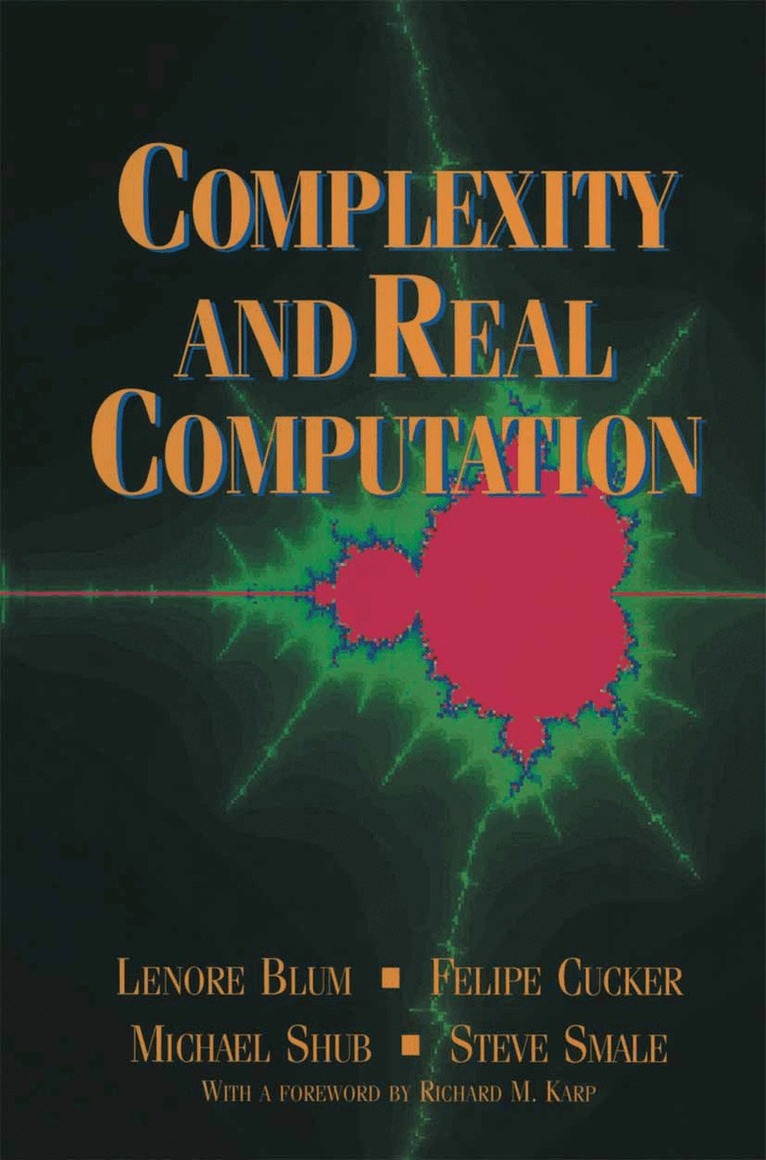
    Complexity and Real Computation

    AvLenore Blum,Felipe Cucker

    Inbunden, Engelska, 1997

    870 kr

    Beställningsvara. Skickas inom 10-15 vardagar. Fri frakt över 249 kr.

    Fler format och utgåvor

    Häftad

    547 kr

    Beskrivning

    Computational complexity theory provides a framework for understanding the cost of solving computational problems, as measured by the requirement for resources such as time and space. The objects of study are algorithms defined within a formal model of computation. Upper bounds on the computational complexity of a problem are usually derived by constructing and analyzing specific algorithms. Meaningful lower bounds on computational complexity are harder to come by, and are not available for most problems of interest. The dominant approach in complexity theory is to consider algorithms as oper­ ating on finite strings of symbols from a finite alphabet. Such strings may represent various discrete objects such as integers or algebraic expressions, but cannot rep­ resent real or complex numbers, unless the numbers are rounded to approximate values from a discrete set. A major concern of the theory is the number of com­ putation steps required to solve a problem, as a function of the length of the input string.

    Produktinformation

    • Utgivningsdatum:1997-10-30
    • Mått:155 x 235 x 34 mm
    • Vikt:956 g
    • Format:Inbunden
    • Språk:Engelska
    • Antal sidor:453
    • Upplaga:1998
    • Förlag:Springer-Verlag New York Inc.
    • ISBN:9780387982816

    Utforska kategorier

    • Systemvetenskap och AI inom Data och IT
    • Matematikens grunder inom Naturvetenskap och teknik

    Innehållsförteckning

    • 1 Introduction.- 2 Definitions and First Properties of Computation.- 3 Computation over a Ring.- 4 Decision Problems and Complexity over a Ring.- 5 The Class NP and NP-Complete Problems.- 6 Integer Machines.- 7 Algebraic Settings for the Problem “P ? NP?”.- 8 Newton’s Method.- 9 Fundamental Theorem of Algebra: Complexity Aspects.- 10 Bézout’s Theorem.- 11 Condition Numbers and the Loss of Precision of Linear Equations.- 12 The Condition Number for Nonlinear Problems.- 13 The Condition Number in ?(H(d).- 14 Complexity and the Condition Number.- 15 Linear Programming.- 16 Deterministic Lower Bounds.- 17 Probabilistic Machines.- 18 Parallel Computations.- 19 Some Separations of Complexity Classes.- 20 Weak Machines.- 21 Additive Machines.- 22 Nonuniform Complexity Classes.- 23 Descriptive Complexity.- References.