• Fri frakt över 249 kr
  • •
  • Snabba leveranser
  • •
  • Billiga böcker
Kundservice

Du är på sajten för privatpersoner.

Företag, bibliotek eller offentlig verksamhet?

Du handlar på classic.bokus.com, där alla dina funktioner finns intakta.
Till classic.bokus.com
Bokus logotyp. Gå till startsidan.
  • Erbjudanden
  • Student
  • Topplistor
  • Barn & ungdom
  • Bokus Play
  • E-böcker
  • Ljudböcker
  • Pocketböcker
  • Spel & pussel

Upp till 25% på utvalda nyheter →

Sidfot

Mina sidor

    Hjälp

    • Kundservice
    • Vanliga frågor och svar
    • Frakt och leverans
    • Retur vid ångerrätt
    • Reklamera vara
    • Betalning
    • Köpvillkor
    • Allmänna villkor
    • Information om webbplatsens tillgänglighet

    Om Bokus

    • Om oss
    • Pressrum
    • För studenter
    • För företag
    • För bibliotek och offentlig verksamhet
    • För leverantörer
    • Hållbarhet

    Populärt

    • Aktuella erbjudanden
    • Presentkort
    • Studentlitteratur
    • Nya böcker
    • Topplistor
    • Signerade böcker
    • Engelska böcker

    Inspiration

    • Boktips
    • BookTok
    • Populära bokserier
    • Barnbokskaraktärer
    • Populära författare
    Logotyp för Bokus
    Följ oss på Facebook (extern länk)Följ oss på Instagram (extern länk)Följ oss på YouTube (extern länk)Följ oss på TikTok (extern länk)
    bokus @ CookiesAnpassa cookiesIntegritetspolicyKöpvillkor
    Till Citymail hemsida (extern länk)Till Budbee hemsida (extern länk)Till Postnord hemsida (extern länk)Till Schenker hemsida (extern länk)Till Early Bird hemsida (extern länk)Till Walleys hemsida (extern länk)
    1. Samhälle och politik
    2. Sociologi och antropologi
    3. Antropologi

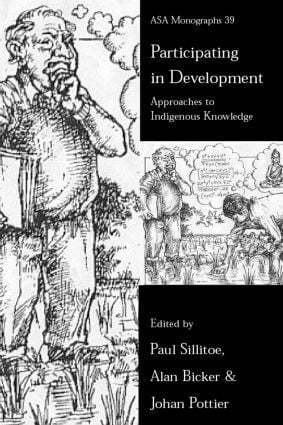
    Participating in Development

    Approaches to Indigenous Knowledge

    AvAlan Bicker,Johan Pottier

    Häftad, Engelska, 2002

    Del i serien ASA Monographs

    709 kr

    Beställningsvara. Skickas inom 10-15 vardagar. Fri frakt över 249 kr.

    Beskrivning

    Development has too often failed to deliver on its promises to poor nations. The policies imposed from above by international agencies and state bodies have frequently not met the needs and aspirations of ordinary people. Development agencies have been searching for sometime for alternative approaches. One of those being pioneered is 'indigenous knowledge', which aims to make local voices heard more effectively. However while it is increasingly acknowledged in development contexts, it is yet to be validated and accepted by anthropologists. It is self-evident to any anthropologist that effective development assistance will benefit from some understanding of local knowledge and practices. This therefore puts anthropology and anthropologists at the centre of development. This volume focuses on two major issues that anthropology might profitably address. First of all how to define indigenous knowledge and who should define it as it currently lacks disciplinary coherence. Secondly once this definition is achieved what methodologies should be used in such an interdisciplinary research endeavour when it must meet the demands of development (cost- and time-effective, intelligible to non-experts) while not compromising anthropological expectations. The new opportunities and their methodological implications are addressed in the chapters of this book in a range of ethnographic and institutional contexts and demonstrate how wide-reaching and how crucially important this debate has become. Participating in Development is a thought provoking and challenge collection. Its authors both define and validate the role of the anthropologist in development as well of development in anthropology.

    Produktinformation

    • Utgivningsdatum:2002-07-04
    • Mått:156 x 234 x 16 mm
    • Vikt:530 g
    • Format:Häftad
    • Språk:Engelska
    • Serie:ASA Monographs
    • Antal sidor:286
    • Förlag:Taylor & Francis Ltd
    • ISBN:9780415258692

    Utforska kategorier

    • Antropologi inom Samhälle och politik

    Mer om författaren

    Paul Sillitoe is Professor of Anthropology at the University of Durham. Alan Bicker is a research fellow at the University of Kent. Johan Pottier is a Professor of African Anthropology and Head of Department at the School of Oriental and Asian Studies, University of London.

    Innehållsförteckning

    • 1. Participant observation to participatory development: making anthropology work Paul Sillitoe 2. Upsetting the sacred balance: can the study of indigenous knowledge reflect cosmic connectedness? Darrell Posey 3. Beyond the cognitive paradigm: majority knowledges and local discourses in a non-Western donor society John Clammer 4. Ethnotheory, ethnopraxis: ethnodevelopment in the Oromia regional state of Ethiopia Aneesa Kassam 5. Canadian First Nations' experiences with international development Peter Croal and Wes Darou 6. Globalizing indigenous knowledge Paul Sillitoe 7. Negotiating with knowledge at development interfaces: anthropology and the quest for participation Michael Schonhuth 8. Indigenous knowledge, power and parity: models of knowledge integration Trevor Purcell and Elizabeth Akinyi Onjoro 9. Interdisciplinary research and GIS: why local and indigenous knowledge is discounted John Campbell 10. Indigenous and scientific knowledge of plant breeding: similarities, differences and implications for collaboration David Cleveland and Daniela Soleri 11. 'Deja vu, all over again', again: reinvention and progress in applying local knowledge to development Roy Ellen