• Fri frakt över 249 kr
  • •
  • Snabba leveranser
  • •
  • Billiga böcker
Kundservice

Du är på sajten för privatpersoner.

Företag, bibliotek eller offentlig verksamhet?

Du handlar på classic.bokus.com, där alla dina funktioner finns intakta.
Till classic.bokus.com
Bokus logotyp. Gå till startsidan.
  • Erbjudanden
  • Nyheter
  • Student
  • Topplistor
  • Barn & ungdom
  • Bokus Play
  • E-böcker
  • Pocketböcker
  • Spel & pussel

Upp till 20% på populära nyheter →

Sidfot

Mina sidor

    Hjälp

    • Kundservice
    • Vanliga frågor och svar
    • Frakt och leverans
    • Retur vid ångerrätt
    • Reklamera vara
    • Betalning
    • Köpvillkor
    • Allmänna villkor
    • Information om webbplatsens tillgänglighet

    Om Bokus

    • Om oss
    • Pressrum
    • För studenter
    • För företag
    • För bibliotek och offentlig verksamhet
    • För leverantörer
    • Hållbarhet

    Populärt

    • Aktuella erbjudanden
    • Presentkort
    • Studentlitteratur
    • Nya böcker
    • Topplistor
    • Signerade böcker
    • Engelska böcker

    Inspiration

    • Boktips
    • BookTok
    • Populära bokserier
    • Barnbokskaraktärer
    • Populära författare

    Mina sidor

      Hjälp

      • Kundservice
      • Vanliga frågor och svar
      • Frakt och leverans
      • Retur vid ångerrätt
      • Reklamera vara
      • Betalning
      • Köpvillkor
      • Allmänna villkor
      • Information om webbplatsens tillgänglighet

      Om Bokus

      • Om oss
      • Pressrum
      • För studenter
      • För företag
      • För bibliotek och offentlig verksamhet
      • För leverantörer
      • Hållbarhet

      Populärt

      • Aktuella erbjudanden
      • Presentkort
      • Studentlitteratur
      • Nya böcker
      • Topplistor
      • Signerade böcker
      • Engelska böcker

      Inspiration

      • Boktips
      • BookTok
      • Populära bokserier
      • Barnbokskaraktärer
      • Populära författare
      Logotyp för Bokus
      Följ oss på Facebook (extern länk)Följ oss på Instagram (extern länk)Följ oss på YouTube (extern länk)Följ oss på TikTok (extern länk)
      bokus @ CookiesIntegritetspolicyKöpvillkor
      Till Citymail hemsida (extern länk)Till Budbee hemsida (extern länk)Till Postnord hemsida (extern länk)Till Schenker hemsida (extern länk)Till Early Bird hemsida (extern länk)Till Walleys hemsida (extern länk)
      1. Historia och arkeologi
      2. Arkeologi
      3. Arkeologiska perioder och områden

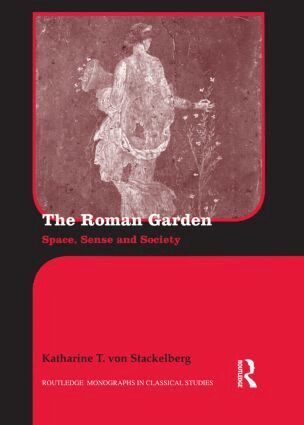
      Roman Garden

      Space, Sense, and Society

      AvKatharine T. von Stackelberg

      Inbunden, Engelska, 2009

      Del i serien Routledge Monographs in Classical Studies

      2 544 kr

      Beställningsvara. Skickas inom 10-15 vardagar. Fri frakt över 249 kr.

      Fler format och utgåvor

      E-bok

      1 064 kr

      E-bok

      1 064 kr

      Häftad

      907 kr

      Beskrivning

      This innovative book is the first comprehensive study of ancient Roman gardens to combine literary and archaeological evidence with contemporary space theory. It applies a variety of interdisciplinary methods including access analysis, literary and gender theory to offer a critical framework for interpreting Roman gardens as physical sites and representations. The Roman Garden: Space, Sense, and Society examines how the garden functioned as a conceptual, sensual and physical space in Roman society, and its use as a vehicle of cultural communication. Readers will learn not only about the content and development of the Roman garden, but also how they promoted memories and experiences. It includes a detailed original analysis of garden terminology and concludes with three case studies on the House of Octavius Quartio and the House of the Menander in Pompeii, Pliny’s Tuscan garden, and Caligula’s Horti Lamiani in Rome. Providing both an introduction and an advanced analysis, this is a valuable and original addition to the growing scholarship in ancient gardens and will complement courses on Roman history, landscape archaeology and environmental history.

      Produktinformation

      • Utgivningsdatum:2009-06-19
      • Mått:156 x 234 x 16 mm
      • Vikt:520 g
      • Format:Inbunden
      • Språk:Engelska
      • Serie:Routledge Monographs in Classical Studies
      • Antal sidor:182
      • Förlag:Taylor & Francis Ltd
      • ISBN:9780415438230

      Utforska kategorier

      • Arkeologiska perioder och områden inom Historia och arkeologi
      • Romarna inom Historia och arkeologi
      • Socialhistoria och kulturhistoria inom Historia och arkeologi

      Mer om författaren

      Brock University, Canada

      Recensioner i media

      Katharine von Stackelberg’s book on Roman gardens offers an engaging and welcome contribution to an emerging interest in cultivated ancient landscapes. Gardens have tended to be overlooked, but recent publications by Patrick Bowe, Victoria Pagán, and now Katharine von Stackelberg have shown that such spaces are in fact worth our attention, particularly for the cultural information they convey.1 While Bowe emphasized the history and visual aspects of gardens, and Pagán the literature, Stackelberg engages both the material and literary records, as well as contemporary space theory in an attempt to approach the challenging task of discovering the Roman experience of gardens.In the first two chapters, Stackelberg explores the ways to recover experience: in chapter 1, she presents the conceptual and physical terminology of gardens. In 2, the author sets up a theoretical framework, using Hillier and Hansons’ access analysis theory, as well as theories of LeFebvre, Foucault, and Soja so as to investigate the social and spatial logic of gardens. Chapters 3 and 4 are concerned with experiential perspectives; in 3, Stackelberg explores the experiences generated by and occurring in gardens. In the final full chapter, Stackelberg applies the theory from 2 and the experiences from 3 to three case studies, and looks at the receptions to the garden spaces by viewers and readers. Stackelberg synthesizes everything in a concise conclusion. In chapter 1, Stackelberg presents the representational and physical "spatial categories" of the garden. She first examines the evolution of hortus as its own concept, and then reads it in terms of its relation to other spaces. In Latin literature, whether the hortus demarcated inherited legitimacy (heredium), or signified social prestige, whether it was for productivity or display, was idyllic and nostalgic or for isolation and degeneracy, Stackelberg shows that hortus signified multivalent space and had a complex conceptual evolution. Add to this the various relational terminology which, Stackelberg argues, falls into one of two groups: one for nouns that signify cultivation of plants, and one for the "cognitive features" embedded in garden descriptions. Architectural features and context are important. The most common architectural contexts were the villa and the urban house, but others included shops and inns, planted porticos, planted temple enclosures, and tombs. In terms of the garden’s architectural features, Stackelberg identifies three degrees of "architectural structuration": macro, median, and micro. The macro entailed freestanding architectural structures. The median architecture directed the focus of viewers to the garden. At the micro level, sculpture, carvings, paintings and mosaics "set an associative mood" for the garden (27) whereby viewers realized the interplay between interior and exterior space. All levels of structuration as well as the modification of soil, water, light, air, and horticultural design should not be overlooked; the overall effect would have an impact on the viewer.Registering the impact on an occupant is a process which Stackelberg investigates in chapter 2, but the process is difficult because of evidence (lacking or incongruent), and because there was such variety in Roman gardens. Accordingly Stackelberg turns to space theory as a conceptual framework that has spatial logic. Stackelberg starts with "territory theory" which argues that lying behind the production, utilization and experience of space are the rules of society, but which cannot alone suffice since it rests upon a firm boundary between urban and rural spaces that does not work for the Roman garden and its "dual spatiality" (50). Cognitive theory posits a "fluid perception of space" (51); it recasts space as subjective and lived experience, and is thus appropriate for analyzing gardens since gardens make "synaesthetic demands on the body" (51) while being steeped also in a temporally specific context. This aspect of a historically-situated space is key also to Foucauldian theories of space, particularly to heterotopias since they are real spaces that have also a mythic element to them, and as such, they can include Roman gardens. In addition, Stackelberg turns to Soja’s concept of "thirdspace," which considers "reality as it is lived and practiced" (52). Here, space is perceived as a dialectic wherein space and society interact. In addition, following Hillier and Hanson, Stackelberg presents spatial syntax analysis which recognizes spatial division and enables analysis of how each space and the lived experiences in them worked within the architectural context. Stackelberg’s original contribution here is to apply this analysis to garden spaces. From a smattering of examples, the author shows that garden spaces have certain shared structural features, yet they vary greatly in terms of size, accessibility, composition, and decoration. These differences are tied inextricably to social status. And since social rank changed, access to all spaces was likewise mutable. Gardens and their continuous de- and re-construction mirrored the fluid relationships between space and social status. Roman political self-fashioning and presentation required much face-time: the aspiring politician had to be greatly visible as did his house. The permeability of the domus was key in the presentation and preservation of rank. Stackelberg turns to gardens within domestic space to see if they too were permeable, and in what way they affected social exchanges between inhabitants and visitors. From a swath of examples, and astute consideration of a Vitruvian passage, Stackelberg suggests that the garden’s "dual spatiality" permitted it to be both a private garden and a public space. Gardens, then, like houses, were (re)producers of social status and of gender. For instance, slaves occupied gardens, but invisibly, and for upkeep; conversely, free men were likely to occupy the garden around dining hours, visibly, and for leisure. In terms of gender, gardens were perceived generally as "a woman’s space" (71). Having established that gardens were places of social encounter, Stackelberg turns in the third chapter to the lived experience of the Roman garden. Here, the author argues that garden experiences can be "categorized as power, awe and pleasure" (73), each of which categories is addressed in turn in this chapter. In the late republic, gardens were used increasingly to evidence social power. The land crises of the 2nd century contributed to this by enabling the wealthy elite to invest in large-scale estates on which they built villas and cultivated gardens. The aesthetic appeal of such cultivation found replication in the city in the form of vast horti. Horti, then, constituted a show of power, as Stackelberg demonstrates via the horti of Pompey, Caesar, Lucullus, and Augustus.Gardens also presented the opportunity for their owners to construct and share an image of awe. Stackelberg illustrates the relationship between gardens and awe by way of Pompey’s Porticus Pompeiana as well as by Agrippa’s buildings in the Campus Martius. As performative spaces, gardens could also be transformative where transgressive activities such as "murders, marriages, plots, poison, war, riots, fire, madness, and incest" could find a setting (84). Nero, of course, occupies center stage in this part of Stackelberg’s discussion. ‘Performance’ often also conjures up Roman religion. Literary evidence points to the practice of augury in urban gardens, though more common was the practice of making offerings to the lares, penates, and sometimes to the Olympic pantheon. Statuary, shrines, sacral objects and decoration were part of a "staged representation of sanctuary," and the gardens can be seen again as a liminal space, between hortus and temenos (87). This relation between religio and garden spaces is evident also in public contexts: Pompey, Caesar, and Augustus all capitalized on this politico-religious aspect of garden spaces. Yet there appears to have been a sort of barometer of appropriate cultivation in Rome: while some manipulation of nature and some artifice were acceptable, excessive manipulation was regarded as morally abhorrent. It was too unnatural. Per Stackelberg, pleasure, when achieved by transgressive manipulation of nature, marks a switch from healthful otium to self-indulgent luxuria. Amongst such activities was, perhaps unsurprisingly, sex. Stackelberg argues that the common inclusion of a nude Venus or a Priapus in garden spaces may have contributed to the eroticization of such spaces. By my lights this claim has little purchase; however, that the garden was perceived as an erotic space more generally is supported by plenty of references in extant literature. Other transgressive experiences represented include rape, executions, crucifixions, violence, Bacchic celebrations, conspiracies, and the use of magic. Stackelberg states, "As heterotopias of crisis and deviation, gardens were accepted as spaces of transition or subversion as long as exterior social controls were strong and active" (100). Stackelberg’s final chapter involves the application of what has preceded to three case studies. The first involves the Pompeian Houses of Octavius Quartio, and of the Menander, both with an archaeological but no literary record. Stackelberg applies access analysis to the gardens so as to offer a "better understanding of their spatial and experiential impact" (101). These houses have been studied, and yet there remains no comprehensive analysis of the gardens and what their social function and experiential potential were. This is where Stackelberg makes her contribution. She first presents the history and appearance of each house before exploring the spatial logic and social value of both. The analysis reveals that despite the fact that in both houses garden space was of high social value, the experiences in each must have been different: property size, tree size, visibility, access to water, as well as décor all demonstrate the degree of social complexity, intentionality of design, and extent of control of the viewer by the owner. In Case Study 2, Stackelberg provides a perceptive reading of Pliny’s Epistula 5.6 describing his Tuscan property. Though no material evidence of the villa remains, the letter is nonetheless valuable. Stackelberg applies Soja’s thirdspace framework to the letter, turning first to Pliny’s presentation of garden space, then considering how this presentation influenced a reader’s perception, before exploring the issue of practice. Stackelberg shows that while it is possible to identify three distinct garden spaces in the letter, the specifics in terms of location and of relation to architectural spaces cannot be determined: via notable ellipses as well as what Stackelberg calls a "diffusion of perspective", Stackelberg argues that Pliny deliberately manipulates the reader in such a way that "rhetoric and reality converge" in the garden. Furthermore, Pliny replaces the apparent subject of his letter (the villa) with the "true subject," himself (132). Stackelberg argues that it is in the garden that this transubstantiation occurs: the garden, like the villa, is art. And Pliny is the artist. This is the garden’s thirdspace of practice: "By losing the reader in the garden, by its mise-en-âbime from a letter about a garden to a garden of letters, only the figure of Pliny is left" (134). In her final case study, Stackelberg shows that ‘place’ in the presentation of history can carry significant social, political and religious weight. Emplacement) is not vague but specific. With this in mind, Stackelberg examines Philo’s narrative on the Alexandrian embassy to Caligula which ends in the Horti Lamiani. Having presented the Horti’s topography and history, and having contextualized the history behind Philo’s narrative as well as why the specific locus of these Horti was chosen, Stackelberg shows that Philo’s account evidences an imperial garden that "becomes the medium for a contentious encounter between imperial persona and resistant subject" (134). Consideration of Caligula’s use of the gardens and of Philo’s presentation is, then, a must. This is an engaging and stimulating book, incorporating a broad (if not occasionally overwhelming) spectrum of approaches. I would posit first that the book is not intended for a general audience, and second that any classicist studying gardens, landscapes, and even the Roman domus will find Stackelberg’s contribution a must-read, even if the reader is not (yet) versed in cognitive or space theory. Stackelberg well demonstrates the multivalency, complexity, and critical social role of Roman garden spaces and the experience of them. In a sense, then, and in so doing, Stackelberg brings Roman gardens back to life. --Bryn Mawr Classical Review

      Innehållsförteckning

      • Imago Hortorum: Introducing the Roman Garden Part 1: Entering Roman Garden Space Part 2: The Logic of Roman Garden Space Part 3: Experiencing the Roman Garden Part 4: Space, Sense and Society: Three Case Studies Conclusion: Gardens Bound and Unbound.
      Hoppa över listan

      Mer från samma författare

      Katharine T. von Stackelberg, Elizabeth Macaulay-Lewis - Housing the New Romans, Inbunden

      Housing the New Romans

      Katharine T. von Stackelberg, Elizabeth Macaulay-Lewis

      Inbunden, 2017

      1 343 kr

      Elizabeth Macaulay-Lewis, Katharine T. von Stackelberg - Housing the New Romans, E-bok

      Housing the New Romans

      Elizabeth Macaulay-Lewis, Katharine T. von Stackelberg

      E-bok
      2017

      1 016 kr

      Elizabeth Macaulay-Lewis, Katharine T. von Stackelberg - Housing the New Romans, E-bok

      Housing the New Romans

      Elizabeth Macaulay-Lewis, Katharine T. von Stackelberg

      E-bok
      2017

      1 006 kr

      Hoppa över listan

      Mer från samma serie

      Eleonora Zampieri - Politics in the Monuments of Pompey the Great and Julius Caesar, Häftad

      Politics in the Monuments of Pompey the Great and Julius Caesar

      Eleonora Zampieri

      Häftad, 2024

      656 kr

      Tatiana Ivleva, Rob Collins - Un-Roman Sex, Häftad

      Un-Roman Sex

      Tatiana Ivleva, Rob Collins

      Häftad, 2022

      694 kr

      John Heath - Bible, Homer, and the Search for Meaning in Ancient Myths, Inbunden

      Bible, Homer, and the Search for Meaning in Ancient Myths

      John Heath

      Inbunden, 2019

      2 470 kr

      Jonathan J. Price, Rachel Zelnick-Abramovitz - Text and Intertext in Greek Epic and Drama, Inbunden

      Text and Intertext in Greek Epic and Drama

      Jonathan J. Price, Rachel Zelnick-Abramovitz

      Inbunden, 2020

      2 841 kr

      Chrysanthos S. Chrysanthou, Timothy E. Duff - Generic Enrichment in Plutarch’s Lives, Inbunden

      Generic Enrichment in Plutarch’s Lives

      Chrysanthos S. Chrysanthou, Timothy E. Duff

      Inbunden, 2024

      2 841 kr

      Christine Plastow - Homicide in the Attic Orators, Inbunden

      Homicide in the Attic Orators

      Christine Plastow

      Inbunden, 2020

      2 544 kr

      Graham Anderson - Fantasy in Greek and Roman Literature, Inbunden

      Fantasy in Greek and Roman Literature

      Graham Anderson

      Inbunden, 2019

      3 104 kr

      Emilio Zucchetti, Anna Maria Cimino - Antonio Gramsci and the Ancient World, Inbunden

      Antonio Gramsci and the Ancient World

      Emilio Zucchetti, Anna Maria Cimino

      Inbunden, 2021

      2 470 kr

      Carol Atack - Discourse of Kingship in Classical Greece, Inbunden

      Discourse of Kingship in Classical Greece

      Carol Atack

      Inbunden, 2019

      2 470 kr

      Filippo Carlà-Uhink, Lucia Cecchet, Carlos Machado - Poverty in Ancient Greece and Rome, Inbunden

      Poverty in Ancient Greece and Rome

      Filippo Carlà-Uhink, Lucia Cecchet, Carlos Machado

      Inbunden, 2022

      2 544 kr

      Hoppa över listan

      Du kanske också är intresserad av

      Katharine T. von Stackelberg - Roman Garden, E-bok

      Roman Garden

      Katharine T. von Stackelberg

      E-bok
      2009

      1 064 kr

      Katharine T. von Stackelberg - Roman Garden, Häftad

      Roman Garden

      Katharine T. von Stackelberg

      Häftad, 2017

      907 kr

      Katharine T. von Stackelberg - Roman Garden, E-bok

      Roman Garden

      Katharine T. von Stackelberg

      E-bok
      2009

      1 064 kr

      Katharine T. von Stackelberg, Elizabeth Macaulay-Lewis - Housing the New Romans, Inbunden

      Housing the New Romans

      Katharine T. von Stackelberg, Elizabeth Macaulay-Lewis

      Inbunden, 2017

      1 343 kr

      Elizabeth Macaulay-Lewis, Katharine T. von Stackelberg - Housing the New Romans, E-bok

      Housing the New Romans

      Elizabeth Macaulay-Lewis, Katharine T. von Stackelberg

      E-bok
      2017

      1 006 kr

      Elizabeth Macaulay-Lewis, Katharine T. von Stackelberg - Housing the New Romans, E-bok

      Housing the New Romans

      Elizabeth Macaulay-Lewis, Katharine T. von Stackelberg

      E-bok
      2017

      1 016 kr

      Klara Peters Bastin - SIGNERAD - Om julens wälgång, Inbunden
      • Signerad!

      SIGNERAD - Om julens wälgång

      Klara Peters Bastin

      Inbunden, 2026

      249 kr

      Harlan Coben - Se dig inte om, Pocket
      • -30%

      Se dig inte om

      Harlan Coben

      Pocket, 2026

      69 kr99 kr

      Lars Kepler - Medusa, Inbunden
      • Nyhet
      Del 11

      Medusa

      Lars Kepler

      Inbunden, 2026

      269 kr

      Caroline Ringskog Ferrada-Noli - Sex in the City, Inbunden
      • -19%

      Sex in the City

      Caroline Ringskog Ferrada-Noli

      Inbunden, 2026

      209 kr259 kr