• Fri frakt över 249 kr
  • •
  • Snabba leveranser
  • •
  • Billiga böcker
Kundservice

Du är på sajten för privatpersoner.

Företag, bibliotek eller offentlig verksamhet?

Du handlar på classic.bokus.com, där alla dina funktioner finns intakta.
Till classic.bokus.com
Bokus logotyp. Gå till startsidan.
  • Erbjudanden
  • Student
  • Topplistor
  • Barn & ungdom
  • Bokus Play
  • E-böcker
  • Ljudböcker
  • Pocketböcker
  • Spel & pussel

10% rabatt på allt med kod NYSTART10 →

Sidfot

Mina sidor

    Hjälp

    • Kundservice
    • Vanliga frågor och svar
    • Frakt och leverans
    • Retur vid ångerrätt
    • Reklamera vara
    • Betalning
    • Köpvillkor
    • Allmänna villkor
    • Information om webbplatsens tillgänglighet

    Om Bokus

    • Om oss
    • Pressrum
    • För studenter
    • För företag
    • För bibliotek och offentlig verksamhet
    • För leverantörer
    • Hållbarhet

    Populärt

    • Aktuella erbjudanden
    • Presentkort
    • Studentlitteratur
    • Nya böcker
    • Topplistor
    • Signerade böcker
    • Engelska böcker

    Inspiration

    • Boktips
    • BookTok
    • Populära bokserier
    • Barnbokskaraktärer
    • Populära författare
    Logotyp för Bokus
    Följ oss på Facebook (extern länk)Följ oss på Instagram (extern länk)Följ oss på YouTube (extern länk)Följ oss på TikTok (extern länk)
    bokus @ CookiesAnpassa cookiesIntegritetspolicyKöpvillkor
    Till Citymail hemsida (extern länk)Till Budbee hemsida (extern länk)Till Postnord hemsida (extern länk)Till Schenker hemsida (extern länk)Till Early Bird hemsida (extern länk)Till Walleys hemsida (extern länk)
    1. Data och IT
    2. Informationsteknik: allmänt

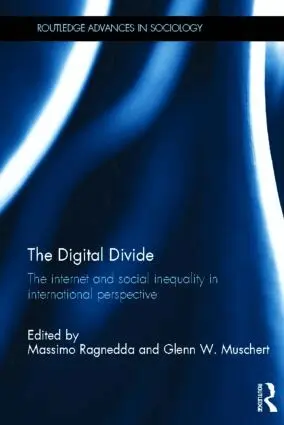
    Digital Divide

    The Internet and Social Inequality in International Perspective

    AvMassimo Ragnedda,Glenn W. Muschert

    Inbunden, Engelska, 2013

    Del i serien Routledge Advances in Sociology

    2 418 kr

    Beställningsvara. Skickas inom 10-15 vardagar. Fri frakt över 249 kr.

    Beskrivning

    This book provides an in-depth comparative analysis of inequality and the stratification of the digital sphere. Grounded in classical sociological theories of inequality, as well as empirical evidence, this book defines ‘the digital divide’ as the unequal access and utility of internet communications technologies and explores how it has the potential to replicate existing social inequalities, as well as create new forms of stratification. The Digital Divide examines how various demographic and socio-economic factors including income, education, age and gender, as well as infrastructure, products and services affect how the internet is used and accessed. Comprised of six parts, the first section examines theories of the digital divide, and then looks in turn at: Highly developed nations and regions (including the USA, the EU and Japan); Emerging large powers (Brazil, China, India, Russia); Eastern European countries (Estonia, Romania, Serbia); Arab and Middle Eastern nations (Egypt, Iran, Israel); Under-studied areas (East and Central Asia, Latin America, and sub-Saharan Africa). Providing an interwoven analysis of the international inequalities in internet usage and access, this important work offers a comprehensive approach to studying the digital divide around the globe. It is an important resource for academic and students in sociology, social policy, communication studies, media studies and all those interested in the questions and issues around social inequality.

    Produktinformation

    • Utgivningsdatum:2013-06-05
    • Mått:156 x 234 x 25 mm
    • Vikt:800 g
    • Format:Inbunden
    • Språk:Engelska
    • Serie:Routledge Advances in Sociology
    • Antal sidor:344
    • Förlag:Taylor & Francis Ltd
    • ISBN:9780415525442

    Utforska kategorier

    • Informationsteknik: allmänt inom Data och IT
    • Medievetenskap inom Samhälle och politik
    • Sociala och etiska frågor inom Samhälle och politik

    Mer om författaren

    Massimo Ragnedda teaches Mass Communications at Northumbria University, UK. Previously he was an affiliated visitor at the Department of Sociology, University of Cambridge, UK and in 2011 he was Academic Visiting at the Oxford Internet Institute, University of Oxford, UK. Glenn W. Muschert is Associate Professor in the Sociology, Criminology, and Social Justice Studies Programs at Miami University, USA.

    Recensioner i media

    "Extremely valuable..." - J.L. Croissant, University of Arizona, Choice

    Innehållsförteckning

    • Introduction Massimo Ragnedda and Glenn W. Muschert Section 1: Theories of the Digital Divide 1. The Reproduction and Reconfiguration of Inequality: Differentiation and Class, Status, and Power in the Dynamics of Digital Divides Bridgette Wessels 2. A Theory of the Digital Divide Jan A.G.M. van Dijk Section 2: Highly Developed Nations and Regions 3. The Digital Divide in Europe Nicole Zillien and Mirko Marr 4. The Internet and Social Inequalities in the U.S. James Witte, Marissa Kiss, and Randy Lynn 5. Missing In the Midst of Abundance: The Case of Broadband Adoption in Japan Mito Akiyoshi, Motohiro Tsuchiya, and Takako Sano Section 3: Rapidly Developing Large Nations – the BRIC Nations 6. The Digital Divide in Brazil: Conceptual, Research and Policy Challenges Bernardo Sorj 7. Digitizing Russia: Uneven Pace of Progress toward Internet Access Equality Inna F. Deviatko 8. Digital Divide in India: Inferences from the Information and Communication Technology Workforce P. Vigneswara Ilavarasan 9. China Digital Divide in China, Hong Kong, and Taiwan: The Barriers of First Order and Second Order Digital Divide Shu-Fen Tseng and Yu-Ching You Section 4: Eastern Europe 10. The Internet and Digital Divide in SEE: Connectivity Does Not End the Digital Divide, Skills Do Danica Radovanovic 11. Closing the Gap, Are We There Yet? Reflections on the Persistence of Second-Level Digital Divide Among Adolescents in Central and Eastern Europe Monica Barbovschi and Bianca Fizeşan 12. Behind the Slogan of "e-State:" Digital Stratification in Estonia Veronika Kalmus, Kairi Talves and Pille Pruulmann-Vengerfeldt Section 5: The Middle East Region 13. Digitally Divided We Stand: The Contribution of Digital Media to the Arab Spring David M. Faris 14. Explaining Digital Inequalities in Israel: Juxtaposing the Conflict and Cultural Perspectives Gustavo Mesch, Ilan Talmud and Tanya Kolovov 15. An Analysis of the Second-Level Digital Divide in Iran: A Case Study of University of Tehran's Undergraduate Students Hamid Abdollahyan, Mehdi Semati and Mohammad Ahmadi Section 6: Under-Studied Countries and Regions 16. The Digital Divide in the Latin American Context Daniela Trucco Horwitz 17. The Central Asian Digital Divide Barney Warf 18. The Double Digital Divide and Social Inequality in Asia: Comparative Research on Internet Cafes in Taiwan, Singapore, Thailand, and the Philippines Tomohisa Hirata 19. Dimensions of the Mobile Divide in Niger Gado Alzouma Afterword Internet Freedom, Nuanced Digital Divides, and the Internet Craftsman Sascha D. Meinrath, James Losey and Benjamin Lennett