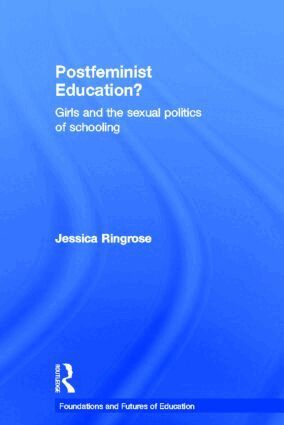
Inbunden, Engelska, 2012
Postfeminist Education?
2433 kr
Beställningsvara. Skickas inom 10-15 vardagar. Fri frakt över 249 kr.
Beskrivning
This book challenges a contemporary postfeminist sensibility grounded not only in assumptions that gender and sexual equality has been achieved in many Western contexts, but that feminism has gone ‘too far’ with women and girls now overtaking men and boys - positioned as the new victims of gender transformations. The book is the first to outline and critique how educational discourses have directly fed into postfeminist anxieties, exploring three postfeminist panics over girls and girlhood that circulate widely in the international media and popular culture. First it explores how a masculinity crisis over failing boys in school has spawned a backlash discourse about overly successful girls; second it looks at how widespread anxieties over girls becoming excessively mean and/or violent have positioned female aggression as pathological; third it examines how incessant concerns over controlling risky female sexuality underpin recent sexualisation of girls' moral panics. The book outlines how these postfeminist panics over girlhood have influenced educational policies and practices in areas such as academic achievement, anti-bullying strategies and sex-education curriculum, making visible the new postfeminist, sexual politics of schooling.Moving beyond media or policy critique, however, this book offers new theoretical and methodological tools for researching postfeminism, girlhood and education. It engages with current theoretical debates over possibilities for girls’ agency and empowerment in postfeminist, neo-liberal contexts of sexual regulation. It also elaborates new psychosocial and feminist Deleuzian methodological approaches for mapping subjectivity, affectivity and social change. Drawing on two UK empirical research projects exploring teen-aged girls’ own perspectives and responses to postfeminist panics, the book shows how real girls are actually negotiating notions of girls as overly successful, mean, violent, aggressive and sexual. The data offers rich insight into girls’ gendered, raced and classed experiences at school and beyond, exploring teen peer cultures, friendship, offline and online sexual identities, and bullying and cyberbullying. The analysis illuminates how and when girls take up and identify with postfeminist trends, but also at times attempt to re-work, challenge and critique the contradictory discourses of girlhood and femininity. In this sense the book offers an opportunity for girls to ‘talk back’ to the often simplistic either wildly celebratory or crisis-based sensationalism of postfeminist panics over girlhood.This book will be essential reading for those interested in feminism, girlhood, media studies, gender and education.
Produktinformation
- Utgivningsdatum: 2012-07-09
- Mått: 156 x 234 x undefined mm
- Vikt: 530 g
- Format: Inbunden
- Språk: Engelska
- Serie: Foundations and Futures of Education
- Antal sidor: 200
- Förlag: Taylor & Francis Ltd
- ISBN: 9780415557481
Utforska kategorier
Betyg & recensioner
0 recensioner
Inga recensioner tillgängliga.