• Fri frakt över 249 kr
  • •
  • Snabba leveranser
  • •
  • Billiga böcker
Kundservice

Du är på sajten för privatpersoner.

Företag, bibliotek eller offentlig verksamhet?

Du handlar på classic.bokus.com, där alla dina funktioner finns intakta.
Till classic.bokus.com
Bokus logotyp. Gå till startsidan.
  • Erbjudanden
  • Student
  • Topplistor
  • Barn & ungdom
  • Bokus Play
  • E-böcker
  • Ljudböcker
  • Pocketböcker
  • Spel och pussel

Pocketfynda! Hundratals böcker för 49 kr/st →

Sidfot

Mina sidor

    Hjälp

    • Kundservice
    • Vanliga frågor och svar
    • Frakt och leverans
    • Retur vid ångerrätt
    • Reklamera vara
    • Betalning
    • Köpvillkor
    • Allmänna villkor
    • Information om webbplatsens tillgänglighet

    Om Bokus

    • Om oss
    • Pressrum
    • För studenter
    • För företag
    • För bibliotek och offentlig verksamhet
    • För leverantörer
    • Hållbarhet

    Populärt

    • Aktuella erbjudanden
    • Presentkort
    • Studentlitteratur
    • Nya böcker
    • Topplistor
    • Signerade böcker
    • Engelska böcker

    Inspiration

    • Boktips
    • BookTok
    • Barnbokskaraktärer
    • Populära författare
    Logotyp för Bokus
    Följ oss på Facebook (extern länk)Följ oss på Instagram (extern länk)Följ oss på YouTube (extern länk)Följ oss på TikTok (extern länk)
    bokus @ CookiesAnpassa cookiesIntegritetspolicyKöpvillkor
    Till Citymail hemsida (extern länk)Till Budbee hemsida (extern länk)Till Postnord hemsida (extern länk)Till Schenker hemsida (extern länk)Till Early Bird hemsida (extern länk)Till Walleys hemsida (extern länk)
    1. Ekonomi och Ledarskap
    2. Nationalekonomi

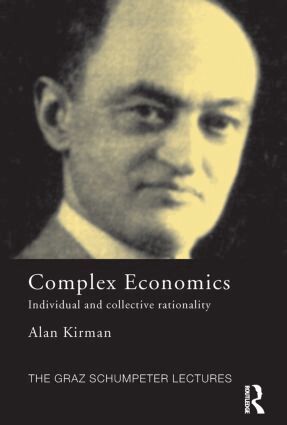
    Complex Economics

    Individual and Collective Rationality

    AvAlan Kirman

    Häftad, Engelska, 2011

    Del i serien Graz Schumpeter Lectures

    741 kr

    Beställningsvara. Skickas inom 10-15 vardagar. Fri frakt över 249 kr.

    Fler format och utgåvor

    Inbunden

    2 713 kr

    E-bok

    883 kr

    E-bok

    881 kr

    Beskrivning

    The economic crisis is also a crisis for economic theory. Most analyses of the evolution of the crisis invoke three themes, contagion, networks and trust, yet none of these play a major role in standard macroeconomic models. What is needed is a theory in which these aspects are central. The direct interaction between individuals, firms and banks does not simply produce imperfections in the functioning of the economy but is the very basis of the functioning of a modern economy. This book suggests a way of analysing the economy which takes this point of view.The economy should be considered as a complex adaptive system in which the agents constantly react to, influence and are influenced by, the other individuals in the economy. In such systems which are familiar from statistical physics and biology for example, the behaviour of the aggregate cannot be deduced from the behaviour of the average, or "representative" individual. Just as the organised activity of an ants’ nest cannot be understood from the behaviour of a "representative ant" so macroeconomic phenomena should not be assimilated to those associated with the "representative agent". This book provides examples where this can clearly be seen. The examples range from Schelling’s model of segregation, to contributions to public goods, the evolution of buyer seller relations in fish markets, to financial models based on the foraging behaviour of ants. The message of the book is that coordination rather than efficiency is the central problem in economics. How do the myriads of individual choices and decisions come to be coordinated? How does the economy or a market, "self organise" and how does this sometimes result in major upheavals, or to use the phrase from physics, "phase transitions"? The sort of system described in this book is not in equilibrium in the standard sense, it is constantly changing and moving from state to state and its very structure is always being modified. The economy is not a ship sailing on a well-defined trajectory which occasionally gets knocked off course. It is more like the slime described in the book "emergence", constantly reorganising itself so as to slide collectively in directions which are neither understood nor necessarily desired by its components.

    Produktinformation

    • Utgivningsdatum:2011-01-16
    • Mått:156 x 234 x 14 mm
    • Vikt:500 g
    • Format:Häftad
    • Språk:Engelska
    • Serie:Graz Schumpeter Lectures
    • Antal sidor:272
    • Förlag:Taylor & Francis Ltd
    • ISBN:9780415594240

    Utforska kategorier

    • Nationalekonomi inom Ekonomi och Ledarskap
    • Ekonomiska system inom Ekonomi och Ledarskap

    Mer om författaren

    Alan Kirman is Professor Emeritus at l’Université d’Aix-Marseille lll and l’Ecole des Hautes Etudes en Sciences Sociales, France.

    Recensioner i media

    ‘What a refreshing read! Alan Kirman draws on his immense experience of how real people trade, from the Marseille and Ancona fish markets to experiments on public goods games, to propose an approach to economics centred on interaction between individuals and its consequences for aggregate behaviour. This book is essential reading in the quest for new economic thinking’.- Prof. Robert MacKay, University of Warwick, UK

    Innehållsförteckning

    • 1. Introduction 2. The Structure of Interaction 3. Fish Markets: An Example of the Emergence of Aggregate Coordination 4. Financial Markets: Bubbles, Herds and Crashes 5. Public Goods: A coordination problem 6. Segregation: Schelling’s Model 7. Conclusion