Alan Kirman - Böcker
Visar alla böcker från författaren Alan Kirman. Handla med fri frakt och snabb leverans.
10 produkter
10 produkter
610 kr
Skickas
2 358 kr
Skickas inom 10-15 vardagar
The economic crisis is also a crisis for economic theory. Most analyses of the evolution of the crisis invoke three themes, contagion, networks and trust, yet none of these play a major role in standard macroeconomic models. What is needed is a theory in which these aspects are central. The direct interaction between individuals, firms and banks does not simply produce imperfections in the functioning of the economy but is the very basis of the functioning of a modern economy. This book suggests a way of analysing the economy which takes this point of view.The economy should be considered as a complex adaptive system in which the agents constantly react to, influence and are influenced by, the other individuals in the economy. In such systems which are familiar from statistical physics and biology for example, the behaviour of the aggregate cannot be deduced from the behaviour of the average, or "representative" individual. Just as the organised activity of an ants’ nest cannot be understood from the behaviour of a "representative ant" so macroeconomic phenomena should not be assimilated to those associated with the "representative agent". This book provides examples where this can clearly be seen. The examples range from Schelling’s model of segregation, to contributions to public goods, the evolution of buyer seller relations in fish markets, to financial models based on the foraging behaviour of ants. The message of the book is that coordination rather than efficiency is the central problem in economics. How do the myriads of individual choices and decisions come to be coordinated? How does the economy or a market, "self organise" and how does this sometimes result in major upheavals, or to use the phrase from physics, "phase transitions"? The sort of system described in this book is not in equilibrium in the standard sense, it is constantly changing and moving from state to state and its very structure is always being modified. The economy is not a ship sailing on a well-defined trajectory which occasionally gets knocked off course. It is more like the slime described in the book "emergence", constantly reorganising itself so as to slide collectively in directions which are neither understood nor necessarily desired by its components.
691 kr
Skickas inom 10-15 vardagar
The economic crisis is also a crisis for economic theory. Most analyses of the evolution of the crisis invoke three themes, contagion, networks and trust, yet none of these play a major role in standard macroeconomic models. What is needed is a theory in which these aspects are central. The direct interaction between individuals, firms and banks does not simply produce imperfections in the functioning of the economy but is the very basis of the functioning of a modern economy. This book suggests a way of analysing the economy which takes this point of view.The economy should be considered as a complex adaptive system in which the agents constantly react to, influence and are influenced by, the other individuals in the economy. In such systems which are familiar from statistical physics and biology for example, the behaviour of the aggregate cannot be deduced from the behaviour of the average, or "representative" individual. Just as the organised activity of an ants’ nest cannot be understood from the behaviour of a "representative ant" so macroeconomic phenomena should not be assimilated to those associated with the "representative agent". This book provides examples where this can clearly be seen. The examples range from Schelling’s model of segregation, to contributions to public goods, the evolution of buyer seller relations in fish markets, to financial models based on the foraging behaviour of ants. The message of the book is that coordination rather than efficiency is the central problem in economics. How do the myriads of individual choices and decisions come to be coordinated? How does the economy or a market, "self organise" and how does this sometimes result in major upheavals, or to use the phrase from physics, "phase transitions"? The sort of system described in this book is not in equilibrium in the standard sense, it is constantly changing and moving from state to state and its very structure is always being modified. The economy is not a ship sailing on a well-defined trajectory which occasionally gets knocked off course. It is more like the slime described in the book "emergence", constantly reorganising itself so as to slide collectively in directions which are neither understood nor necessarily desired by its components.
Del 10 - International Symposia in Economic Theory and Econometrics
Nonlinear Dynamics and Economics
Proceedings of the Tenth International Symposium in Economic Theory and Econometrics
Inbunden, Engelska, 1996
1 173 kr
Skickas inom 7-10 vardagar
Nonlinear Dynamics and Economics, first published in 1997, presents developments in nonlinear economic dynamics along with related research from associated fields, including mathematics, statistics, biology, and physics. Specific areas covered include instability in economic theory, nonlinearity in financial markets, tests for nonlinearity and chaos, frequency domain methods, nonlinear business cycles, and nonlinear prediction and forecasting. This volume comprises the tenth in the International Symposia in Economic Theory and Econometrics series under the general editorship of William Barnett. This proceedings volume includes revisions of the most important papers presented at a conference held at the European University Institute in Florence on July 6-17, 1992, along with revisions of the related, invited papers presented at the annual meetings of the American Statistical Association held in San Francisco on August 8-12, 1993.
2 236 kr
Skickas inom 7-10 vardagar
This challenging book extends standard economic theory to take into account the presence of heterogeneity among economic agents. It argues for an approach to economic analysis which regards the economy as an interactive system with heterogeneous agents and not simply a system which treats aggregates as some 'representative' individual.The authors consider that no sector of the economy can be treated as behaving like a single individual and each sector should be modelled as a complex interactive system. They apply this approach to many macro- and micro- analyses including monetary policy and firms, technological innovation and the insider-outsider model. In conclusion the authors find that this approach proves much more fruitful in explaining empirical phenomena than much of the existing theory. The result of this approach to economic theory which encompasses many realistic features, provides a vision of the economy which is not at odds with common sense, but which does not abandon rigorous analysis.This important book will be welcomed by those interested in both macro and micro economic theory.
551 kr
Skickas inom 10-15 vardagar
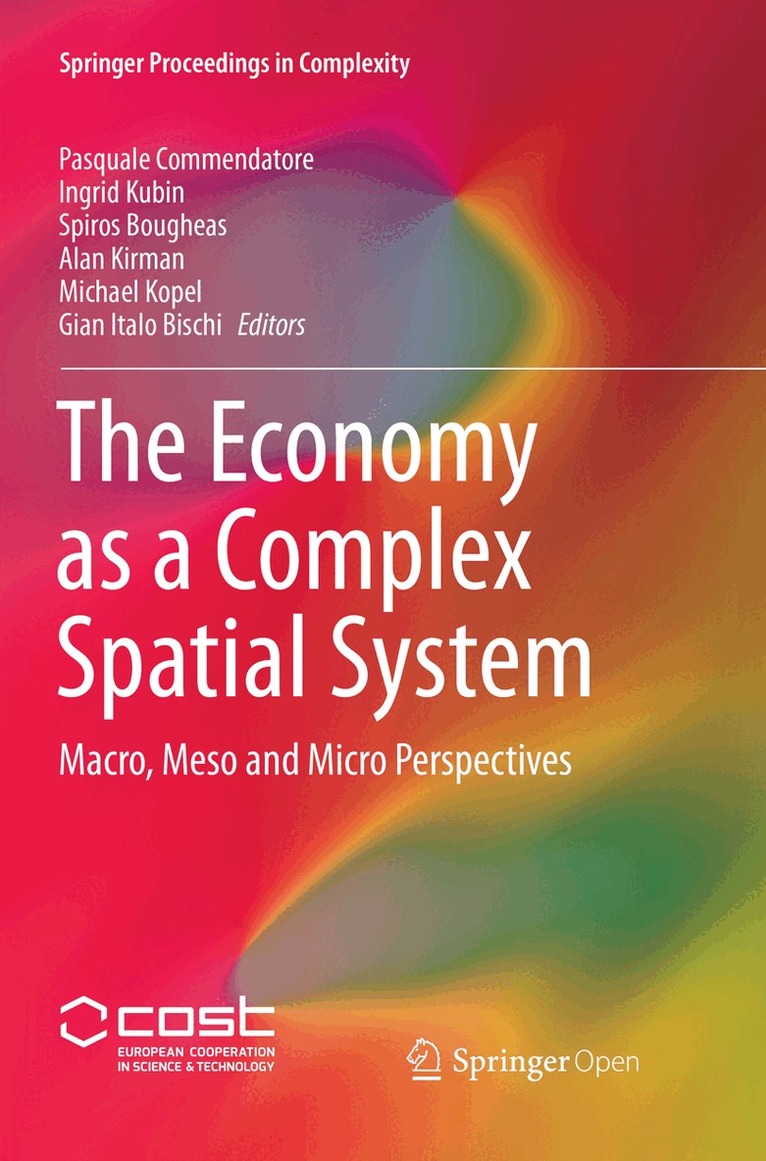
This book is open access under a CC BY-NC 4.0 license.This collected volume represents the final outcome of the COST Action IS1104 “The EU in the new complex geography of economic systems: models, tools and policy evaluation”.Visualizing the EU as a complex and multi-layered network, the book is organized in three parts, each of them dealing with a different level of analysis: At the macro-level, Part I considers the interactions within large economic systems (regions or countries) involving trade, workers migration, and other factor movements. At the meso-level, Part II discusses interactions within specific but wide-ranging markets, with a focus on financial markets and banking systems. Lastly, at the micro-level, Part III explores the decision-making of single firms, especially in the context of location decisions.
551 kr
Skickas inom 10-15 vardagar
This book is open access under a CC BY-NC 4.0 license.This collected volume represents the final outcome of the COST Action IS1104 “The EU in the new complex geography of economic systems: models, tools and policy evaluation”.Visualizing the EU as a complex and multi-layered network, the book is organized in three parts, each of them dealing with a different level of analysis: At the macro-level, Part I considers the interactions within large economic systems (regions or countries) involving trade, workers migration, and other factor movements. At the meso-level, Part II discusses interactions within specific but wide-ranging markets, with a focus on financial markets and banking systems. Lastly, at the micro-level, Part III explores the decision-making of single firms, especially in the context of location decisions.
Del 503 - Lecture Notes in Economics and Mathematical Systems
Economics with Heterogeneous Interacting Agents
Häftad, Engelska, 2001
1 095 kr
Skickas inom 10-15 vardagar
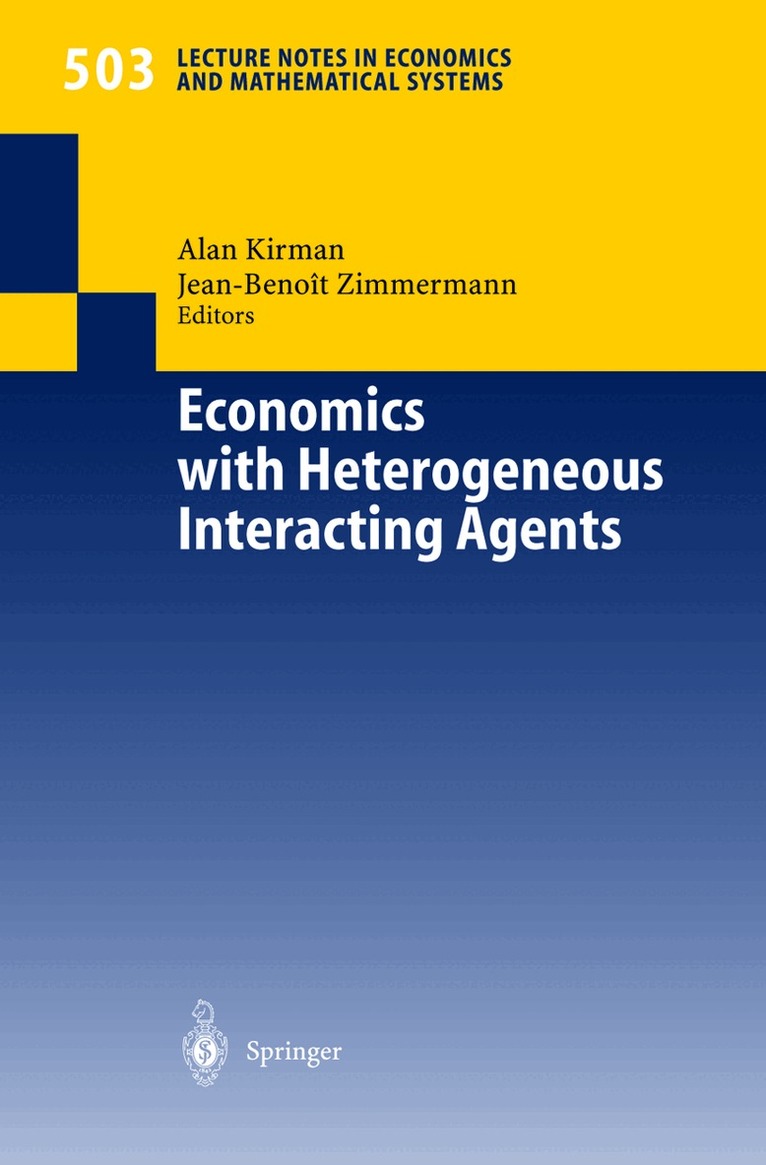
Alan Kirman* and Jean-Benoit Zimmermann** *GREQAM -Universite d'Aix-Marseille, Ecole des Hautes Etudes en Sciences Sociales, Marseille **CNRS -GREQAM, Marseille This book continues in a tradition which has developed in the annual Workshops on Economics with Heterogeneous Interacting Agents, (WEHIA). The purpose of that workshop was to analyse situations in which individual agents, who might be different from each other, interact and produce behaviour on the aggregate level which does not correspond to that of the average actor. This rupture with the well- established tradition of the "representative individual" is far from having established a central position in economics. That the relaxation of that assumption and the introduction of heterogeneous individuals might change the relationship between micro behaviour and macro phenomena is clearly spelled out by Forni and Lippi (1997). The modelling of the actual interaction between these individuals has been and remains a challenge.Early analytical attempts to introduce direct and local interaction between agents such as in the pioneering work of Follmer (1974) met with little response and the recent wave of interest associated with the names of Aoki (1996), Durlauf (1997) and Blume (1993) amongst others was twenty years in the making. Yet, the influence of other disciplines such as physics and biology in which complex interactive systems and their analysis play a central role is now making itself felt in economics and the papers in this volume reflect that fact.
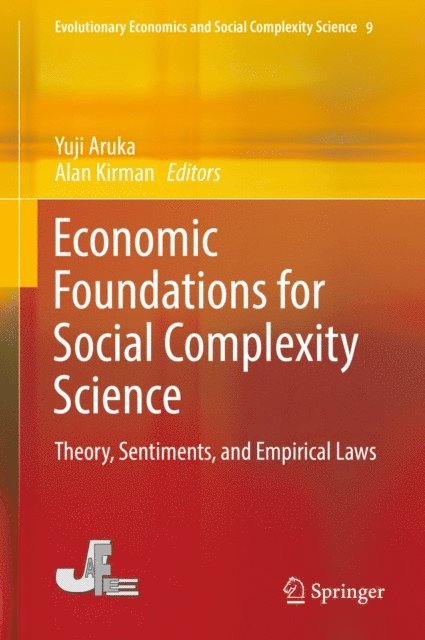
Del 9 - Evolutionary Economics and Social Complexity Science
Economic Foundations for Social Complexity Science
Theory, Sentiments, and Empirical Laws
Inbunden, Engelska, 2017
1 275 kr
Skickas inom 10-15 vardagar
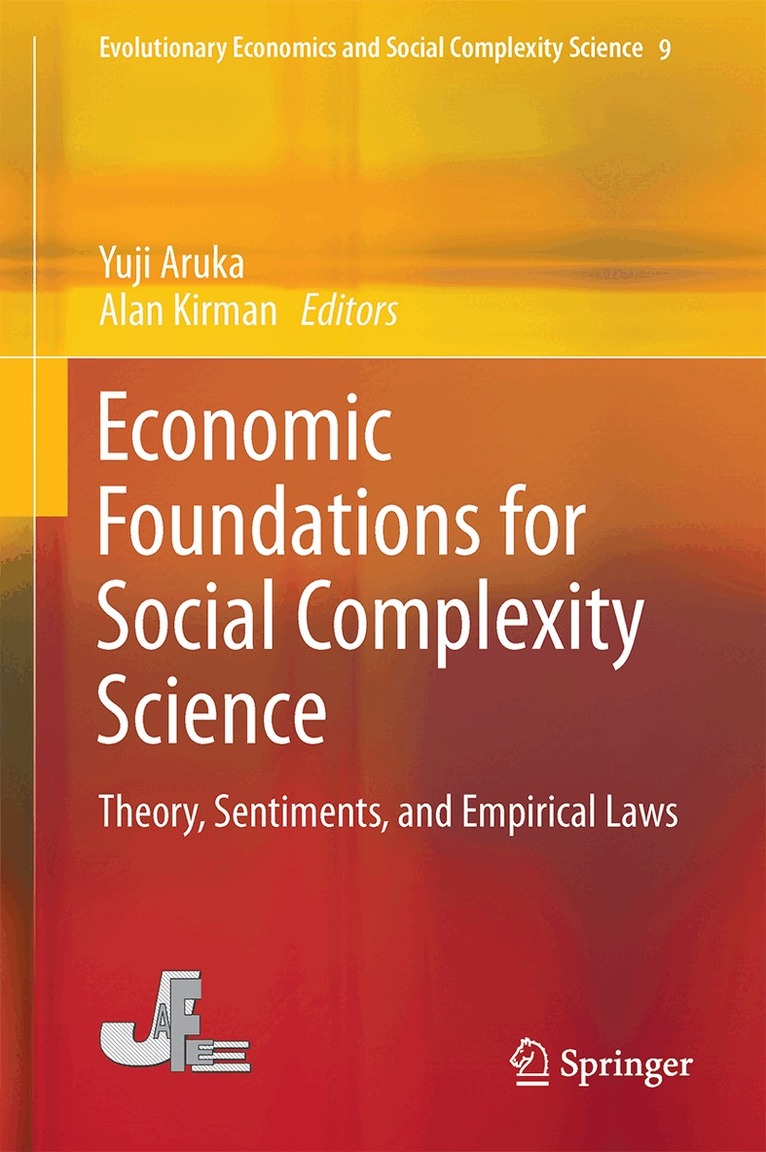
This book focuses on how important massive information is and how sensitive outcomes are to information. In this century humans now are coming up against the massive utilization of information in various contexts. The advent of super intelligence is drastically accelerating the evolution of the socio-economic system. Our traditional analytic approach must therefore be radically reformed in order to adapt to an information-sensitive framework, which means giving up myopic purification and the elimination of all considerations of massive information. In this book, authors who have shared and exchanged their ideas over the last 20 years, offer thorough examinations of the theoretical–ontological basis of complex economic interaction, econophysics, and agent-based modeling during the last several decades.This book thus provides the indispensable philosophical-scientific foundations for this new approach, and then moves on to empirical–epistemological studies concerning changes insentiments and other movements in financial markets.
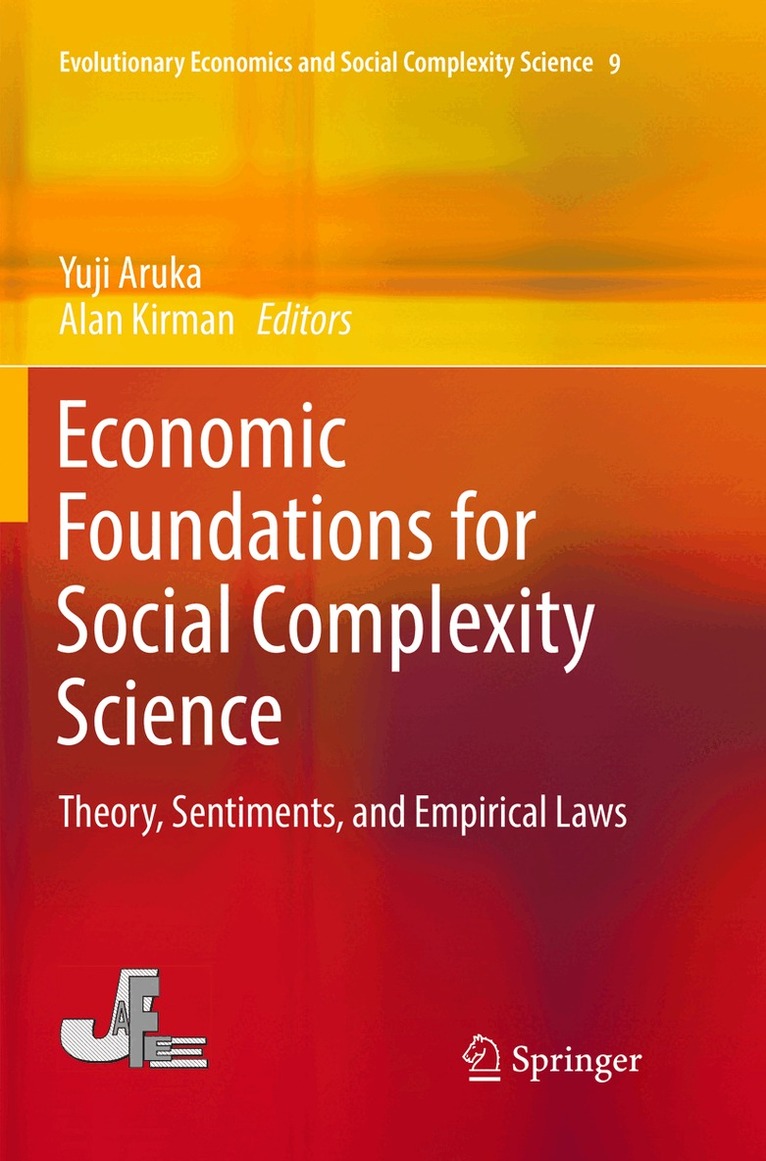
Del 9 - Evolutionary Economics and Social Complexity Science
Economic Foundations for Social Complexity Science
Theory, Sentiments, and Empirical Laws
Häftad, Engelska, 2018
1 275 kr
Skickas inom 10-15 vardagar
This book focuses on how important massive information is and how sensitive outcomes are to information.