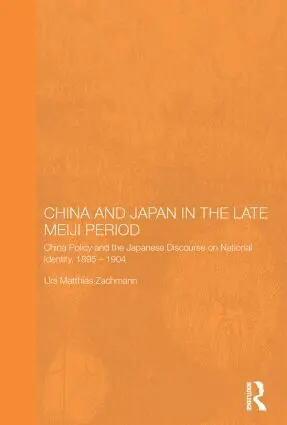
Häftad, Engelska, 2011
China and Japan in the Late Meiji Period
China Policy and the Japanese Discourse on National Identity, 1895-1904
Del i serien Routledge/Leiden Series in Modern East Asian Politics, History and Media
929 kr
Beställningsvara. Skickas inom 10-15 vardagar. Fri frakt över 249 kr.
Beskrivning
Produktinformation
- Utgivningsdatum: 2011-02-07
- Mått: 156 x 234 x 14 mm
- Vikt: 470 g
- Format: Häftad
- Språk: Engelska
- Serie: Routledge/Leiden Series in Modern East Asian Politics, History and Media
- Antal sidor: 256
- Förlag: Taylor & Francis Ltd
- ISBN: 9780415608398
Utforska kategorier
Mer om författaren
Urs Matthias Zachmann is Assistant Professor at the Japan Centre of the University of Munich (LMU)
Recensioner i media
Winner of the JaDe Prize 2010 awarded by the German Foundation for the Promotion of Japanese-German Culture and Science Relations"Between Japan's victory over China in the first Sino-Japanese war and its victory over Russia ten years later fundamental changes took place in the East Asian realm—changes in the Japanese public's image of itself and its position in the world and in its stance toward a weakened and increasingly marginalized China, changes in how the Western powers viewed China and Japan and how China and Japan in turn viewed the West. Building his narrative around key events from the troubled interwar decade, Matthias Zachmann presents a revealing picture of how these changes evolved, the inner tension among Japanese motives at different junctures, and such inherently slippery notions as "pan-Asianism," what it meant to be "civilized," to engage in "war," or for a stronger country to adopt a stance of "friendship" toward a weaker one. The perspectives developed in this book, often psychologically informed, deepen our understanding of Sino-Japanese relations leading up to the Pacific War; they also shed light on the far less unequal relationship that has emerged between China and Japan in more recent years." - Paul A. Cohen Fairbank Center for Chinese Studies Harvard University, USA "A hundred years ago, Japan emerged as a major power. Today China is fast asserting its influence in the world arena. How a non-Western nation defines its identity and destiny is a question that has serious implications for the West as well as for other countries. The ways in which Japan’s political and intellectual elites argued about the nature and direction of national policy at the turn of the twentieth century and the choices they made, as Matthias Zachmann skillfully traces them, were to have fateful consequences for East Asia and the wider world. The book will not only serve as an excellent introduction to that story but also offer clues to understanding contemporary Chinese domestic and foreign affairs." - Akira Iriye, Harvard University, USA "Urs Matthias Zachmann has produced a work that is fresh and much needed…a strength that sets the study apart because of rich materials carefully mined around this topic for the first time…Students of modern China need…to read this book…" - Douglas Reynolds, The China Quarterly, 201, March 2010, pp. 223-225"...Zachmann has undoubtedly made a most important contribution to Meiji era history and the history of Sino-Japanese relations, which should have both an immediate impact as well as lasting significance for generations of researchers and general interested readers to come. I recommend it highly." - Richard John Lynn, Journal of the Royal Asiatic Society of Great Britain and Ireland (2010) 20, pp. 393-395"...meticulously researched...what Zachmann captures superbly is the intensity and fluidity of debate..." - Thomas David DuBois, Japanese Studies 30.1 (May 2010), pp. 147-149
Betyg & recensioner
0 recensioner
Inga recensioner tillgängliga.