• Fri frakt över 249 kr
  • •
  • Snabba leveranser
  • •
  • Billiga böcker
Kundservice

Du är på sajten för privatpersoner.

Företag, bibliotek eller offentlig verksamhet?

Du handlar på classic.bokus.com, där alla dina funktioner finns intakta.
Till classic.bokus.com
Bokus logotyp. Gå till startsidan.
  • Erbjudanden
  • Nyheter
  • Student
  • Topplistor
  • Barn & ungdom
  • Bokus Play
  • E-böcker
  • Pocketböcker
  • Spel & pussel

10% rabatt på allt med kod: NYSTART10 →

Sidfot

Mina sidor

    Hjälp

    • Kundservice
    • Vanliga frågor och svar
    • Frakt och leverans
    • Retur vid ångerrätt
    • Reklamera vara
    • Betalning
    • Köpvillkor
    • Allmänna villkor
    • Information om webbplatsens tillgänglighet

    Om Bokus

    • Om oss
    • Pressrum
    • För studenter
    • För företag
    • För bibliotek och offentlig verksamhet
    • För leverantörer
    • Hållbarhet

    Populärt

    • Aktuella erbjudanden
    • Presentkort
    • Studentlitteratur
    • Nya böcker
    • Topplistor
    • Signerade böcker
    • Engelska böcker

    Inspiration

    • Boktips
    • BookTok
    • Populära bokserier
    • Barnbokskaraktärer
    • Populära författare
    Logotyp för Bokus
    Följ oss på Facebook (extern länk)Följ oss på Instagram (extern länk)Följ oss på YouTube (extern länk)Följ oss på TikTok (extern länk)
    bokus @ CookiesAnpassa cookiesIntegritetspolicyKöpvillkor
    Till Citymail hemsida (extern länk)Till Budbee hemsida (extern länk)Till Postnord hemsida (extern länk)Till Schenker hemsida (extern länk)Till Early Bird hemsida (extern länk)Till Walleys hemsida (extern länk)
    1. Ekonomi och Ledarskap
    2. Företagsekonomi
    3. Entreprenörskap

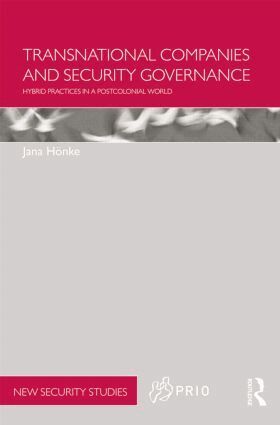
    Transnational Companies and Security Governance

    Hybrid Practices in a Postcolonial World

    AvJana Hönke

    Inbunden, Engelska, 2013

    Del i serien PRIO New Security Studies

    2 421 kr

    Beställningsvara. Skickas inom 10-15 vardagar. Fri frakt över 249 kr.

    Fler format och utgåvor

    Häftad

    877 kr

    Beskrivning

    This book investigates governance practiced by non-state actors. It analyses how multinational mining companies protect their sites in fragile contexts and what that tells us about political ordering 'beyond' the state. Based on extensive primary research in the Democratic Republic of Congo, South Africa, Europe and North America, the book compares companies' political role in the 19th and 21st centuries. It demonstrates that despite a number of disturbing parallels, many contemporary practices are not a reversion to the past but unique to the present. The book discloses hybrid security practices with highly ambiguous effects around the sites of contemporary companies that have committed to norms of corporate social and security responsibility. Companies invest in local communities, and offer human rights training to security forces alongside coercive techniques of fortress protection, and stability-oriented clientele practice and arrangements of indirect rule. The book traces this hybridity back to contradictory collective meaning systems that cross borders and structure the perceptions and choices of company managers, private security officers, NGO collaborators and others practitioners. The book argues that hybrid security practices are not the result of an encounter between a supposed ‘local’ with the liberal ‘global’. Instead, this hybridity is inherent in the transnational and part and parcel of liberal transnational governance. Therefore, more critical reflection of global governance in practice is required. These issues are sharply pertinent to liberal peacebuilding as well as global governance more broadly. The book will be of interest to anyone interested in business, politics and human rights; critical security studies; peacebuilding and statebuilding; African politics; and ethnographic and sociological approaches to global governance and international relations more generally.

    Produktinformation

    • Utgivningsdatum:2013-05-09
    • Mått:156 x 234 x 19 mm
    • Vikt:620 g
    • Format:Inbunden
    • Språk:Engelska
    • Serie:PRIO New Security Studies
    • Antal sidor:248
    • Förlag:Taylor & Francis Ltd
    • ISBN:9780415622066

    Utforska kategorier

    • Entreprenörskap inom Ekonomi och Ledarskap
    • Politiskt förtryck inom Samhälle och politik
    • Internationella relationer inom Samhälle och politik

    Mer om författaren

    Jana Hönke is a Lecturer in International Relations at the University of Edinburgh. She is also a senior research associate with the Collaborative Research Centre SFB 700 at Freie Universität Berlin.

    Recensioner i media

    "The unique strength of Hönke’s argument lies, perhaps paradoxically, in refusing to attribute to multinational corporations a straightforward role in local security governance in contexts of weak statehood. Showing how local security managers combine different globally circulating security discourses and translate them into hybrid local security strategies renders corporations more ‘real’ (one could say more ‘human’) than studies that grant seemingly unified global discourses unlimited power over local practices. This means that her nuanced analysis of the security practices of mining companies helps to dispel many prevailing myths, and is therefore a must-read for scholars who wish to understand the complexity of the role of multinational corporations in contemporary sub-Saharan Africa. Furthermore, the careful interdisciplinary heuristic analytical framework that Hönke applies to her case studies makes this book more generally of interest to anyone concerned with studying contemporary governance beyond the state in terms of the interrelations between global discourses and local practices." - Peer Schouten. School of Global Studies, University of Gothenburg

    Innehållsförteckning

    • 1. Introduction 2. Engaging Hybrid Security Governance 3. Transnationalised Business Spaces in a Postcolonial World 4. Practicing Hybrid Security: Multinational Companies and Hybrid Security Practices, post-1995 5. Understanding Hybrid Security Practices: Transnational Meaning Systems, post-1995 6. Companies, Security Governance and Change: Practicing Transnational Meaning Systems, 1890s-1920s 7. Conclusion