• Fri frakt över 249 kr
  • •
  • Snabba leveranser
  • •
  • Billiga böcker
Kundservice

Du är på sajten för privatpersoner.

Företag, bibliotek eller offentlig verksamhet?

Du handlar på classic.bokus.com, där alla dina funktioner finns intakta.
Till classic.bokus.com
Bokus logotyp. Gå till startsidan.
  • Erbjudanden
  • Student
  • Topplistor
  • Barn & ungdom
  • Bokus Play
  • E-böcker
  • Ljudböcker
  • Pocketböcker
  • Spel & pussel

Upp till 25% på utvalda nyheter →

Sidfot

Mina sidor

    Hjälp

    • Kundservice
    • Vanliga frågor och svar
    • Frakt och leverans
    • Retur vid ångerrätt
    • Reklamera vara
    • Betalning
    • Köpvillkor
    • Allmänna villkor
    • Information om webbplatsens tillgänglighet

    Om Bokus

    • Om oss
    • Pressrum
    • För studenter
    • För företag
    • För bibliotek och offentlig verksamhet
    • För leverantörer
    • Hållbarhet

    Populärt

    • Aktuella erbjudanden
    • Presentkort
    • Studentlitteratur
    • Nya böcker
    • Topplistor
    • Signerade böcker
    • Engelska böcker

    Inspiration

    • Boktips
    • BookTok
    • Populära bokserier
    • Barnbokskaraktärer
    • Populära författare
    Logotyp för Bokus
    Följ oss på Facebook (extern länk)Följ oss på Instagram (extern länk)Följ oss på YouTube (extern länk)Följ oss på TikTok (extern länk)
    bokus @ CookiesAnpassa cookiesIntegritetspolicyKöpvillkor
    Till Citymail hemsida (extern länk)Till Budbee hemsida (extern länk)Till Postnord hemsida (extern länk)Till Schenker hemsida (extern länk)Till Early Bird hemsida (extern länk)Till Walleys hemsida (extern länk)
    1. Kultur
    2. Arkitektur

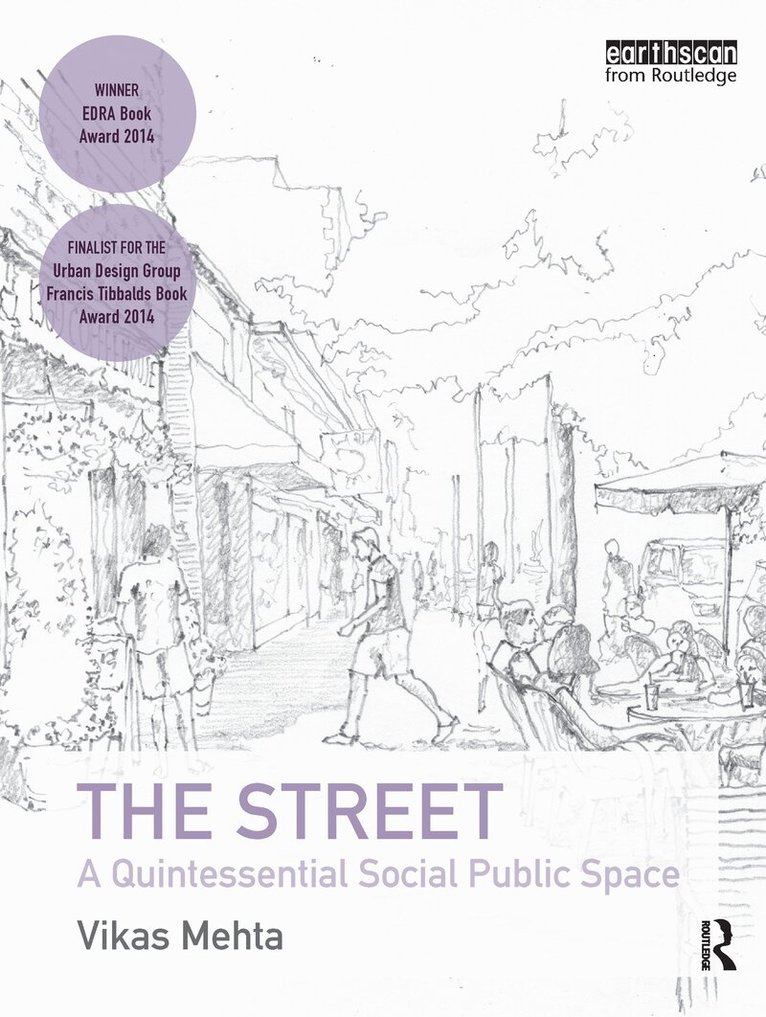
    Street

    A Quintessential Social Public Space

    AvVikas Mehta

    Häftad, Engelska, 2014

    1 034 kr

    Beställningsvara. Skickas inom 10-15 vardagar. Fri frakt över 249 kr.

    Fler format och utgåvor

    Inbunden

    2 726 kr

    E-bok

    1 226 kr

    E-bok

    1 226 kr

    Beskrivning

    Received the Environmental Design Research Association's 2014 Place Book AwardShortlisted for the UDG Francis Tibbalds Book Award 2014Good cities are places of social encounter. Creating public spaces that encourage social behavior in our cities and neighborhoods is an important goal of city design. How do we make sociable streets? This book shows us how these ordinary public spaces can be planned and designed to become settings that support an array of social behaviors. Through carefully crafted research, The Street systematically examines people's actions and perceptions, develops a comprehensive typology of social behaviors on the neighborhood commercial street and provides a thorough inquiry into the social dimensions of streets.Vikas Mehta shows that sociability is not a result of the physical environment alone, but is achieved by the relationships between the physical environment, the land uses, their management, and the places to which people assign special meanings.Scholars and students of urban design, planning, architecture, geography and sociology will find the book a stimulating resource. The material is also directly applicable to practice and should be widely read by professional urban designers, planners, architects, and others involved in the design, planning, and implementation of commercial streets.

    Produktinformation

    • Utgivningsdatum:2014-02-25
    • Mått:189 x 246 x 16 mm
    • Vikt:580 g
    • Format:Häftad
    • Språk:Engelska
    • Antal sidor:256
    • Förlag:Taylor & Francis Ltd
    • ISBN:9780415737296

    Utforska kategorier

    • Arkitektur inom Kultur
    • Regional planering inom Naturvetenskap och teknik
    • Sociologi inom Samhälle och politik

    Mer om författaren

    Vikas Mehta, PhD, is the Fruth/Gemini Chair, the Ohio Eminent Scholar of Environment/Urban Design and Associate Professor at the School of Planning, College of Design, Architecture, Art and Planning at the University of Cincinnati.

    Recensioner i media

    Mehta’s description of the street as social space is a welcome reminder to those who see it simply as pattern or movement channel. The book is required reading for all who want more livable cities. — Sidney Brower, Professor Emeritus, School of Architecture, Planning & Preservation, University of Maryland A readable and engaging people-focused book about high streets — Marc Furnival, Urban Design, Issue 128, Autumn 2013With his fine-grained analysis of the design and use of three Massachusetts streets, Vikas Mehta reveals the particular qualities of road way, sidewalk and building frontage that together create vibrant public spaces – for people and for businesses. — Karen A. Franck, Professor, School of Architecture and Department of Humanities, New Jersey Institute of TechnologyThis important book returns designers' and policy-makers' attention back to the street as a place of social, economic, and cultural exchange. Using empirical observation and survey methods in the tradition of Lynch, Whyte, and Gehl, urban designer Vikas Mehta defines factors associated with socially successful, multi-use streets. They range from seating and shade (crucial) to economic policy to support the critical ingredient of independent, speciality businesses that add cultural and visual interest. Required reading for anyone concerned with re-animating the public realm of the city. — Robin C. Moore, Professor of Landscape Architecture, College of Design, North Carolina State UniversityA fresh take… [Mehta] conducted user interviews and performed multiple regression analysis on his frontage variables to determine the relative contribution of each to social activity. I cannot do justice to this full-length book in a short column, but I can say from experience that the book goes well with a glass of merlot while seated at an outdoor cafe. — Reid Ewing, Journal of the American Planning Association

    Innehållsförteckning

    • Introduction 1. A Ubiquitous Urban Space for People 2. The Street Evolving: A Brief Social History 3. Everyday Social Behavior as a Basis for Design 4. Three Streets 5. Sociable Streets: A Typology of Social Behaviors 6. Needs for Social Behavior on Streets 7. Making Sociable Streets: Guidelines and Application Appendices