• Fri frakt över 249 kr
  • •
  • Snabba leveranser
  • •
  • Billiga böcker
Kundservice

Du är på sajten för privatpersoner.

Företag, bibliotek eller offentlig verksamhet?

Du handlar på classic.bokus.com, där alla dina funktioner finns intakta.
Till classic.bokus.com
Bokus logotyp. Gå till startsidan.
  • Erbjudanden
  • Nyheter
  • Student
  • Topplistor
  • Barn & ungdom
  • Bokus Play
  • E-böcker
  • Pocketböcker
  • Spel & pussel

Må bättre, för mindre! Upp till 50% rabatt på hälsoböcker

Sidfot

Mina sidor

    Hjälp

    • Kundservice
    • Vanliga frågor och svar
    • Frakt och leverans
    • Retur vid ångerrätt
    • Reklamera vara
    • Betalning
    • Köpvillkor
    • Allmänna villkor
    • Information om webbplatsens tillgänglighet

    Om Bokus

    • Om oss
    • Pressrum
    • För studenter
    • För företag
    • För bibliotek och offentlig verksamhet
    • För leverantörer
    • Hållbarhet

    Populärt

    • Aktuella erbjudanden
    • Presentkort
    • Studentlitteratur
    • Nya böcker
    • Topplistor
    • Signerade böcker
    • Engelska böcker

    Inspiration

    • Boktips
    • BookTok
    • Populära bokserier
    • Barnbokskaraktärer
    • Populära författare
    Logotyp för Bokus
    Följ oss på Facebook (extern länk)Följ oss på Instagram (extern länk)Följ oss på YouTube (extern länk)Följ oss på TikTok (extern länk)
    bokus @ CookiesAnpassa cookiesIntegritetspolicyKöpvillkor
    Till Citymail hemsida (extern länk)Till Budbee hemsida (extern länk)Till Postnord hemsida (extern länk)Till Schenker hemsida (extern länk)Till Early Bird hemsida (extern länk)Till Walleys hemsida (extern länk)
    1. Naturvetenskap och teknik
    2. Matematik och naturvetenskap
    3. Matematik

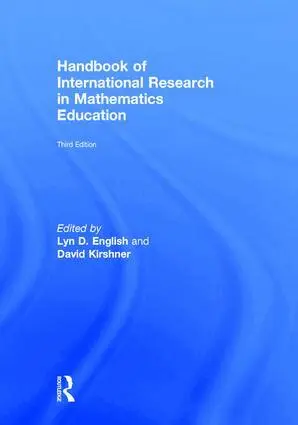
    Handbook of International Research in Mathematics Education

    AvLyn D. English,David Kirshner

    Inbunden, Engelska, 2015

    7 304 kr

    Beställningsvara. Skickas inom 10-15 vardagar. Fri frakt över 249 kr.

    Beskrivning

    This third edition of the Handbook of International Research in Mathematics Education provides a comprehensive overview of the most recent theoretical and practical developments in the field of mathematics education. Authored by an array of internationally recognized scholars and edited by Lyn English and David Kirshner, this collection brings together overviews and advances in mathematics education research spanning established and emerging topics, diverse workplace and school environments, and globally representative research priorities. New perspectives are presented on a range of critical topics including embodied learning, the theory-practice divide, new developments in the early years, educating future mathematics education professors, problem solving in a 21st century curriculum, culture and mathematics learning, complex systems, critical analysis of design-based research, multimodal technologies, and e-textbooks. Comprised of 12 revised and 17 new chapters, this edition extends the Handbook’s original themes for international research in mathematics education and remains in the process a definitive resource for the field.

    Produktinformation

    • Utgivningsdatum:2015-09-11
    • Mått:178 x 254 x 44 mm
    • Vikt:1 540 g
    • Format:Inbunden
    • Språk:Engelska
    • Antal sidor:738
    • Upplaga:3
    • Förlag:Taylor & Francis Ltd
    • ISBN:9780415832038

    Utforska kategorier

    • Matematik inom Naturvetenskap och teknik
    • Undervisning i specifika ämnen inom Psykologi och pedagogik

    Mer om författaren

    Lyn D. English is a professor of STEM in education within the Faculty of Education at Queensland University of Technology, Australia. She is a fellow of the Academy of the Social Sciences in Australia and the founding editor of the international journal Mathematical Thinking and Learning.David Kirshner is a professor in the School of Education at Louisiana State University, USA, and co-director of the Gordon A. Cain Center for Scientific, Mathematical, Engineering, and Technological Literacy at that institution.

    Recensioner i media

    "This state of the art handbook reflects a truly international authorship, with comparable scope in topic coverage - with a focus on democratic access, learning contexts, research methods, and the changing technological world. If you want up-to-date scholarship in these areas, this is the source." --Alan Schoenfeld, University of California, Berkeley"This handbook provides a comprehensive and topical map of research in mathematics education. It is not only an indispensable resource for those interested in a broad overview of the priorities of the research field, but also provides penetrating analyses of the major developments within those priority issues. The volume brilliantly reflects the dynamics of research topics in mathematics education; change, advance, and transformation constitute the organising principles of the book. Without doubt, the third edition of this handbook is essential reading and a cutting edge reference in the field." --Uwe Gellert, Professor of Mathematics Education, Freie Universität Berlin, Germany

    Innehållsförteckning

    • Section 1. Priorities in International Mathematics Education Research. Chapter 01. Changing Agendas in International Research in Mathematics Education. Lyn D. English and David Kirshner. Chapter 02. Perspectives on Priority Mathematics Education: Unpacking and Understanding a Complex Relationship Linking Teacher Knowledge, Teaching, and Learning. Charalambos Y. Charalambous and Demetra Pitta-Pantazi. Chapter 03. Approaches to Embodied Learning in Mathematics. Susan Gerofsky. Chapter 04. Configuring Learning Theory in Support of Teaching. David Kirshner. Section 2. Democratic Access to Mathematics Learning. Chapter 05. Young Children’s Access to Powerful Mathematics Ideas: A Review of Current Challenges and New Developments in the Early Years. Joan Moss, Catherine D. Bruce, and Janette Bobis. Chapter 06. Powerful Ideas in Elementary School Mathematics. David W. Carraher and Analúcia D. Schliemann. Chapter 07. Students’ Access to Mathematics Learning in the Middle and Junior Secondary Schools. Teresa Rojano. Chapter 08. Mathematical Structure, Proof and Definition in Advanced Mathematical Thinking. Joanna Mamona-Downs and Martin L. N. Downs. Chapter 09. Reform as an Issue for Mathematics Education Research: Thinking about Change, Communication, and Cooperation. Michael N. Fried and Miriam Amit. Chapter 10. Prospective Mathematics Teachers’ Learning and Knowledge for Teaching. Joao Pedro Da Ponte and Olive Chapman. Chapter 11. Educating Future Mathematics Education Professors. Jeremy Kilpatrick and Denise Spangler. Section 3. Transformations in Learning Contexts. Chapter 12. Problem Solving in a 21st Century Mathematics Curriculum. Lyn D. English and Julie Gainsburg. Chapter 13. Critical Issues in Culture and Mathematics Learning. Peter Appelbaum and Charoula Stathopoulou. Chapter 14. Mathematics Education and Democracy: An Open Landscape of Tensions, Uncertainties, and Challenges. Ole Skovsmose and Miriam Godoy Penteado.Chapter 15. Toward a Sociology of Mathematics Education: Examining Democratic Access in U.S. Schools. Celia Rousseau Anderson and William F. Tate. Chapter 16. Mathematics Learning In and Out of School: Towards Continuity or Discontinuity? Guida de Abreu and Sarah Crafter. Chapter 17. Perspectives on Complex Systems in Mathematics Learning. Brent Davis and Elaine Simmt. Section 4. Advances in Research Methodologies. Chapter 18. Researching Mathematical Meanings for Teaching. Patrick W. Thompson. Chapter 19. Measurement Challenges in Mathematics Education Research. Rosemary Callingham. Chapter 20. Design Research: An Analysis and Critique. Paul Cobb, Kara Jackson, and Charlotte Dunlap. Chapter 21. The Intertwining of Theory and Practice: Influences on Ways of Teaching and Teachers’ Education. Annalisa Cusi and Nicolina A. Malara. Chapter 22. Knowledge creation through dialogic interaction between the practices of teaching and researching. Kenneth Ruthven and Simon Goodchild. Section 5. Influences of Advanced Technologies. Chapter 23. Foundations For The Future: The Potential of Multimodal Technologies for Learning Mathematics. Stephen Hegedus and David O. Tall. Chapter 24. Statistical Software and Mathematics Education: Affordances for Learning. Jane Watson and Noleine Fitzallen. Chapter 25. The Use of Digital Technology in Mathematical Practices: Reconciling Traditional and Emerging Approaches. Luis Moreno-Armella and Manuel Santos-Trigo. Chapter 26. Computerized Environments in Mathematics Classrooms: A Research-Design View. Rina Hershkowitz, Michal Tabach, and Tommy Dreyfus. Chapter 27. E-textbooks in/for Teaching and Learning Mathematics: A Potentially Transformative Educational Technology. Birgit Pepin, Ghislaine Gueudet, Michal Yerushalmy, Luc Trouche, and Daniel I. Chazan. Chapter 28. Digital Technologies in the Early Primary School Classroom. Nathalie Sinclair and Anna Baccaglini-Frank. Final Comment. Chapter 29. Mathematics Education Research: a strategic view. Hugh Burkhardt.