• Fri frakt över 249 kr
  • •
  • Snabba leveranser
  • •
  • Billiga böcker
Kundservice

Du är på sajten för privatpersoner.

Företag, bibliotek eller offentlig verksamhet?

Du handlar på classic.bokus.com, där alla dina funktioner finns intakta.
Till classic.bokus.com
Bokus logotyp. Gå till startsidan.
  • Erbjudanden
  • Nyheter
  • Student
  • Topplistor
  • Barn & ungdom
  • Bokus Play
  • E-böcker
  • Pocketböcker
  • Spel & pussel

10% rabatt på allt med kod NYSTART10 →

Sidfot

Mina sidor

    Hjälp

    • Kundservice
    • Vanliga frågor och svar
    • Frakt och leverans
    • Retur vid ångerrätt
    • Reklamera vara
    • Betalning
    • Köpvillkor
    • Allmänna villkor
    • Information om webbplatsens tillgänglighet

    Om Bokus

    • Om oss
    • Pressrum
    • För studenter
    • För företag
    • För bibliotek och offentlig verksamhet
    • För leverantörer
    • Hållbarhet

    Populärt

    • Aktuella erbjudanden
    • Presentkort
    • Studentlitteratur
    • Nya böcker
    • Topplistor
    • Signerade böcker
    • Engelska böcker

    Inspiration

    • Boktips
    • BookTok
    • Populära bokserier
    • Barnbokskaraktärer
    • Populära författare
    Logotyp för Bokus
    Följ oss på Facebook (extern länk)Följ oss på Instagram (extern länk)Följ oss på YouTube (extern länk)Följ oss på TikTok (extern länk)
    bokus @ CookiesAnpassa cookiesIntegritetspolicyKöpvillkor
    Till Citymail hemsida (extern länk)Till Budbee hemsida (extern länk)Till Postnord hemsida (extern länk)Till Schenker hemsida (extern länk)Till Early Bird hemsida (extern länk)Till Walleys hemsida (extern länk)
    1. Psykologi och pedagogik
    2. Psykologi
    3. Arbetspsykologi

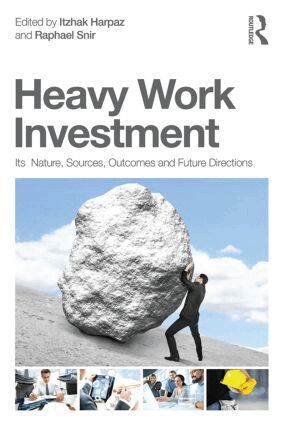
    Heavy Work Investment

    Its Nature, Sources, Outcomes, and Future Directions

    AvItzhak Harpaz,Raphael Snir

    Häftad, Engelska, 2014

    Del i serien Applied Psychology Series

    948 kr

    Beställningsvara. Skickas inom 10-15 vardagar. Fri frakt över 249 kr.

    Beskrivning

    The book deals with the concept of Heavy Work Investment (HWI) recently initiated by Snir and Harpaz. Since its introduction the interest in the general HWI model has increased considerably. The book illustrates the development of HWI conceptualization, theory, and research. It deals with the foremost HWI subtype of workaholism. However, it also compares workaholism as a "negative" HWI subtype with work devotion/passion/engagement, as a "positive" HWI subtype. Most importantly, it addresses HWI in general, including its possible situational subtypes. In view of Snir and Harpaz's claim that the study of situational heavy work investors is relatively scarce, this certainly constitutes a promising step in the right direction. Finally, it deals with timely and important topics examined by prominent international researchers on Heavy Work Investment and such issues as: personality factors of workaholism, work-life balance, cross-cultural similarities and differences in HWI, work addiction and technology, HWI and retirement, and intergenerational similarity in work investment.

    Produktinformation

    • Utgivningsdatum:2014-08-01
    • Mått:152 x 229 x 24 mm
    • Vikt:614 g
    • Format:Häftad
    • Språk:Engelska
    • Serie:Applied Psychology Series
    • Antal sidor:388
    • Förlag:Taylor & Francis Ltd
    • ISBN:9780415835060

    Utforska kategorier

    • Arbetspsykologi inom Psykologi och pedagogik

    Mer om författaren

    Itzhak Harpaz, PhD, is Professor of Management, Dean of Graduate Studies, and director of the Center for the Study of Organizations and Human Resource Management at the University of Haifa, Israel. He is also a Research Fellow at the Center for Human Resources and Labor Studies at the University of Minnesota.Raphael Snir, PhD, is Senior Lecturer at the School of Management and Economics and at the School of Behavioral Sciences at the Academic College of Tel Aviv-Yaffo, Israel. He is also a research fellow at the Center for the Study of Organizations and Human Resource Management at the University of Haifa, Israel.

    Recensioner i media

    "This book focusses on one of the critical productivity and quality-of-working-life issues we face: workaholism. ‘Heavy work’ signifies a culture where people feel they have to work excessively long hours, and with excessively heavy effort. This is a must read for HR professionals and those who study or suffer from workaholism—it describes research findings that will make a difference to your workplace and life."—Cary L. Cooper, CBE, Distinguished Professor of Organizational Psychology and Health at Lancaster University Management School, UK"It is common now around the world to see people whose lives are completely dedicated to their work. Why this has happened and what it means both for them and the people around them is an important question. This book provides compelling answers."—Peter Cappelli, George W. Taylor Professor of Management and Director, Center for Human Resources at the Wharton School of the University of Pennsylvania, USA

    Innehållsförteckning

    • Series Foreword. Introduction: Workaholism, HWI subtypes and beyond – Towards a general model of work investment. Part 1: Nature, Sources, and Measurement of Heavy Work Investment (HWI) 1. A General Model of Heavy Work Investment 2. Personality Factors, Workaholism, and Heavy Work Investment 3. Heavy Work Investment: The Role of Passion 4. Workaholism: The Concept and Its Assessment 5. Dispositional Heavy Work Investment: A Review of Assessments Designed to Measure Addiction to and Passion for Work Part 2: HWI Subtypes and Outcomes 6. The beauty versus the beast: On the motives of engaged and workaholic employees 7. Distinctions between Overemployment, Overwork, Workaholism, and Heavy Investments in Work Time 8. How Workaholism Affects Employees and their Families. 9. Affective Reactions and Subsequent Consequences of Heavy Work Investments 10. The Relationship between Heavy Work Investment and Employee’s Happiness Part 3: Special Issues in the Study of HWI 11. Work-family Balance in the Era of Intensive Work 12. Workaholism in a Dynamic Workforce 13. Heavy Work Investment, Bridge Employment, and the Transition to Retirement 14. Work Addicts’ Attributions about Company-supplied Smartphones Part 4: Future Directions in Conceptualization and Research of HWI 15. Is Work Addiction a Proper Label for High Work Investment Habits? 16. Applying the Biosocial Model to Examine Cross-Cultural Similarities and Differences 17. Bring Your Parents to the Job Interview – Intergenerational Similarity in (Heavy) Work Investment Epilogue: The Current State of Heavy Work Investment and Future Developments