• Fri frakt över 249 kr
  • •
  • Snabba leveranser
  • •
  • Billiga böcker
Kundservice

Du är på sajten för privatpersoner.

Företag, bibliotek eller offentlig verksamhet?

Du handlar på classic.bokus.com, där alla dina funktioner finns intakta.
Till classic.bokus.com
Bokus logotyp. Gå till startsidan.
  • Erbjudanden
  • Student
  • Topplistor
  • Barn & ungdom
  • Bokus Play
  • E-böcker
  • Ljudböcker
  • Pocketböcker
  • Spel och pussel

Upp till 25% på utvalda nyheter →

Sidfot

Mina sidor

    Hjälp

    • Kundservice
    • Vanliga frågor och svar
    • Frakt och leverans
    • Retur vid ångerrätt
    • Reklamera vara
    • Betalning
    • Köpvillkor
    • Allmänna villkor
    • Information om webbplatsens tillgänglighet

    Om Bokus

    • Om oss
    • Pressrum
    • För studenter
    • För företag
    • För bibliotek och offentlig verksamhet
    • För leverantörer
    • Hållbarhet

    Populärt

    • Aktuella erbjudanden
    • Presentkort
    • Studentlitteratur
    • Nya böcker
    • Topplistor
    • Signerade böcker
    • Engelska böcker

    Inspiration

    • Boktips
    • BookTok
    • Barnbokskaraktärer
    • Populära författare
    Logotyp för Bokus
    Följ oss på Facebook (extern länk)Följ oss på Instagram (extern länk)Följ oss på YouTube (extern länk)Följ oss på TikTok (extern länk)
    bokus @ CookiesAnpassa cookiesIntegritetspolicyKöpvillkor
    Till Citymail hemsida (extern länk)Till Budbee hemsida (extern länk)Till Postnord hemsida (extern länk)Till Schenker hemsida (extern länk)Till Early Bird hemsida (extern länk)Till Walleys hemsida (extern länk)
    1. Psykologi och pedagogik
    2. Pedagogik
    3. Skolväsen och utbildningssystem
    4. Examination och betygsättning

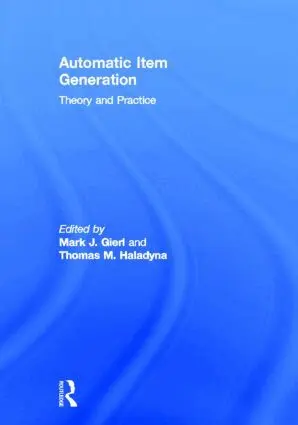
    Automatic Item Generation

    Theory and Practice

    AvMark J Gierl,Thomas M. Haladyna

    Inbunden, Engelska, 2012

    2 864 kr

    Beställningsvara. Skickas inom 10-15 vardagar. Fri frakt över 249 kr.

    Beskrivning

    Automatic item generation (AIG) represents a relatively new and unique research area where specific cognitive and psychometric theories are applied to test construction practices for the purpose of producing test items using technology. The purpose of this book is to bring researchers and practitioners up-to-date on the growing body of research on AIG by organizing in one volume what is currently known about this research area. Part I begins with an overview of the concepts and topics necessary for understanding AIG by focusing on both its history and current applications. Part II presents two theoretical frameworks and practical applications of these frameworks in the production of item generation. Part III summarizes the psychological and substantive characteristics of generated items . Part IV concludes with a discussion of the statistical models that can be used to estimate the item characteristics of generated items, features one future application of AIG, describes the current technologies used for AIG, and also highlights the unresolved issues that must be addressed as AIG continues to mature as a research area. Comprehensive – The book provides a comprehensive analysis of both the theoretical concepts that define automatic item generation and the practical considerations required to implement these concepts.Varied Applications – Readers are provided with novel applications in diverse content areas (e.g., science and reading comprehension) that range across all educational levels – elementary through university.

    Produktinformation

    • Utgivningsdatum:2012-08-07
    • Mått:178 x 254 x 19 mm
    • Vikt:630 g
    • Format:Inbunden
    • Språk:Engelska
    • Antal sidor:256
    • Förlag:Taylor & Francis Ltd
    • ISBN:9780415897501

    Utforska kategorier

    • Examination och betygsättning inom Psykologi och pedagogik

    Mer om författaren

    Mark J. Gierl is Professor of Educational Psychology and Director of the Centre for Research in Applied Measurement and Evaluation in the Department of Educational Psychology, Faculty of Education, at the University of Alberta. He holds the Canada Research Chair in Educational Measurement.Thomas M. Haladyna is Professor Emeritus, Arizona State University. He is the author of numerous books in the field of educational assessment and test item development, including the much praised Handbook of Test Development.

    Innehållsförteckning

    • Part I. Initial Considerations for Automatic Item Generation 1. Automatic Item Generation: An Introduction Mark J. Gierl and Thomas M. Haladyna 2. Automatic Item Generation: A Historical Perspective Thomas M. Haladyna 3. Using Weak and Strong Theory to Create Item Models for Automatic Item Generation: Some Practical Guidelines with Examples Mark J. Gierl and Hollis Lai 4. Item generation: Implications for a validity argument Isaac I. Bejar Part II. Connecting Theory and Practice in Automatic Item Generation 5. An Introduction to Assessment Engineering for Automatic Item Generation Richard M. Luecht 6. Generating Items under the Assessment Engineering Framework Hollis Lai and Mark J. Gierl 7. Using Evidence-Centered Design Task Models In Automatic Item Generation Kristen Huff, Cecilia B. Alves, James Pellegrino and Pamela Kaliski Part III. Psychological Foundations for Automatic Item Generation 8. Learning Sciences, Cognitive Models, and Automatic Item Generation Jacqueline P. Leighton 9. Using Cognitive Psychology to Generate Items and Predict Item Characteristics Joanna S. Gorin 10. Difficulty Modeling and Automatic Generation of Quantitative Items: Recent Advances and Possible Next Steps Edith Aurora Graf and James H. Fife Part IV. Technical Developments in Automatic Item Generation 11. Statistical Modeling of Automatically Generated Items Sandip Sinharay and Matthew S. Johnson 12. Automatic Item Generation for Computerized Adaptive Testing Richard M. Luecht 13.IGOR: a Web-Based Automatic Item Generation Tool Todd Mortimer, Eleni Stroulia, and Meisam Vosoughpour Yazdchi 14. Obstacles for Automatic Item Generation Thomas M. Haladyna and Mark J. Gierl