• Fri frakt över 249 kr
  • •
  • Snabba leveranser
  • •
  • Billiga böcker
Kundservice

Du är på sajten för privatpersoner.

Företag, bibliotek eller offentlig verksamhet?

Du handlar på classic.bokus.com, där alla dina funktioner finns intakta.
Till classic.bokus.com
Bokus logotyp. Gå till startsidan.
  • Erbjudanden
  • Nyheter
  • Student
  • Topplistor
  • Barn & ungdom
  • Bokus Play
  • E-böcker
  • Pocketböcker
  • Spel & pussel

10% rabatt på allt med kod: NYSTART10 →

Sidfot

Mina sidor

    Hjälp

    • Kundservice
    • Vanliga frågor och svar
    • Frakt och leverans
    • Retur vid ångerrätt
    • Reklamera vara
    • Betalning
    • Köpvillkor
    • Allmänna villkor
    • Information om webbplatsens tillgänglighet

    Om Bokus

    • Om oss
    • Pressrum
    • För studenter
    • För företag
    • För bibliotek och offentlig verksamhet
    • För leverantörer
    • Hållbarhet

    Populärt

    • Aktuella erbjudanden
    • Presentkort
    • Studentlitteratur
    • Nya böcker
    • Topplistor
    • Signerade böcker
    • Engelska böcker

    Inspiration

    • Boktips
    • BookTok
    • Populära bokserier
    • Barnbokskaraktärer
    • Populära författare
    Logotyp för Bokus
    Följ oss på Facebook (extern länk)Följ oss på Instagram (extern länk)Följ oss på YouTube (extern länk)Följ oss på TikTok (extern länk)
    bokus @ CookiesAnpassa cookiesIntegritetspolicyKöpvillkor
    Till Citymail hemsida (extern länk)Till Budbee hemsida (extern länk)Till Postnord hemsida (extern länk)Till Schenker hemsida (extern länk)Till Early Bird hemsida (extern länk)Till Walleys hemsida (extern länk)
    1. Naturvetenskap och teknik
    2. Teknik och industri
    3. Transportteknik
    4. Motorfordon

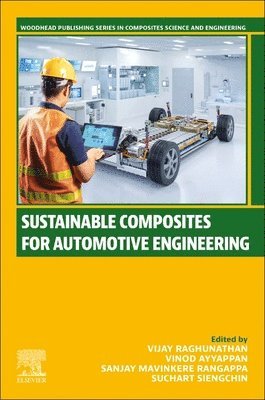
    Sustainable Composites for Automotive Engineering

    AvVijay Raghunathan,Sanjay Mavinkere Rangappa

    Häftad, Engelska, 2025

    Del i serien Woodhead Publishing Series in Composites Science and Engineering

    3 496 kr

    Beställningsvara. Skickas inom 10-15 vardagar. Fri frakt över 249 kr.

    Beskrivning

    Sustainable Composites for Automotive Engineering presents recent trends in this important research field. Emphasis is placed on the development, characterization, and application of lightweight composites in various automobile components. The types of materials covered include polymer composites, metal matrix and ceramic matrix composites. The book takes a 360-degree approach and covers all aspects of the product development cycle including materials selection, as well as design and development processes, testing, characterization, modelling and simulation, and applications. The book will be a valuable reference resource for academic and industrial researchers, materials scientists and engineers, industrial R&D, automotive engineers, and manufacturers working in the design and development of composite materials for applications in automotive components.

    • Provides in-depth knowledge about the materials, their properties and performance, and applications in automotive components
    • Covers polymer matrix composites, ceramic-matrix and metal-based composites
    • Discusses traditional manufacturing methods and recent developments in sustainable ‘green’ manufacturing and testing of automobile parts with various industrial case studies
    • Includes brake friction materials, as well as natural and rubber-based composites
    • Covers OEM regulations, environmental aspects, economic analysis, and life cycle assessment of composite-based products

    Produktinformation

    • Utgivningsdatum:2025-09-16
    • Mått:152 x 229 x 39 mm
    • Vikt:1 000 g
    • Format:Häftad
    • Språk:Engelska
    • Serie:Woodhead Publishing Series in Composites Science and Engineering
    • Antal sidor:802
    • Förlag:Elsevier Science
    • ISBN:9780443236693

    Utforska kategorier

    • Motorfordon inom Naturvetenskap och teknik
    • Maskinteknik och material inom Naturvetenskap och teknik

    Mer om författaren

    Dr. Vijay Raghunathan is Scientific Researcher at the Department of Materials and Production Engineering (MPE), The Sirindhorn International Thai–German Graduate School of Engineering (TGGS), King Mongkut's University of Technology North Bangkok, Thailand. He received his Bachelor of Engineering in Mechanical Engineering and Master of Engineering in Computer Integrated Manufacturing from Anna University, Chennai, India, in 2012 and 2014, respectively, with university rank. He completed his Doctor of Philosophy in Production Engineering from National Institute of Technology Tiruchirappalli, India, in 2020. His research focused on developing and characterizing automotive brake friction composites in collaboration with academia and industry worldwide. He completed his postdoctoral research on the tribological behavior of natural fiber-based composites at TGGS, KMUTNB, Thailand, from 2022 to 2023. He was awarded the Budding Researcher Award of the Production Engineering Department in 2020 by National Institute of Technology Tiruchirappalli, India. He has published over 83+ articles in various SCI and Scopus-indexed journals. He has published six book chapters, 1 book and 2 Indian patents in his field of research. He has published one book and editing several books for reputed international publishers. He is also Associate Editor for Proceedings of the Institution of Mechanical Engineers, Part J: Journal of Engineering Tribology (SAGE Publishers, SCI-E), Frontiers in Materials (Polymeric and Composite Materials Section- SCI-E), Frontiers in Mechanical Engineering (Tribology Section- ESCI, Scopus), and International Research Journal of Multidisciplinary Technovation (Scopus). He is an academic editor for Advances in Polymer Technology (Hindawi- Wiley, SCI-E) and PLOS One (Engineering) (SCI-E). He is also an editorial board member for Discover Applied Sciences (Springer, Scopus), Scientific Reports(Springer, SCI-E), Advanced Manufacturing: Polymer & Composites Science (Taylor and Francis, Scopus), and Journal of Fibers and Polymer Composites (Indexed by Copernicus). He is also the guest editor for various special issues in SCI-E and Scopus journals. He has reviewed many regular and special issue articles. Based on Google Scholar, his citations are 6310+, his H-index is 46, and his i10-Index is 78. His articles received the Best Research Paper Award 2020 from Friction Journal, Springer, and the Top Cited Article award from India in the Materials field by Material Research Express, IOP publishing. Also, many of his other articles are top-cited in various journals. He is recognized by Stanford University, USA, and Elsevier as one of the world’s top 2% of the most cited scientists in single-year citation impact for 2021, 2022, 2023, 2024. His research areas include Brake Friction Composites, Natural Fiber and its Composites, and Additive Manufacturing.Dr. Sanjay Mavinkere Rangappa is a Principal Research Scientist and Associate Professor at King Mongkut 's University of Technology North Bangkok, Thailand. He also serves as an Advisor within the President' s Office for University Promotion and Development towards International goals. Dr. Rangappa is the Executive Editor of Book Cluster: Fiber Science and Fibrous Composite Materials ( Elsevier), a former Associate Editor of Heliyon (Materials Science), and an Associate Editor of Frontier Materials Journals. He acts as a Board Member and Editor for various international journals in materials science and composites. He has reviewed over 250 international journals, including for Nature, Elsevier, Springer, and Wiley, as well as book proposals and conference submissions. He has published more than 425 articles in top- tier peer- reviewed journals indexed by SCI/Scopus, 13 editorial issues, 100 book chapters, and 70 books as an Editor with leading publishers such as Elsevier, Springer, Taylor & Francis, and Wiley. Additionally, he authored 3 books published by Elsevier and has presented research at numerous national and international conferences. Over 25 of his articles are highly cited in journals like the Journal of Cleaner Production and Carbohydrate Polymers. Dr. Rangappa is the lead editor for several special issues and has a Google Scholar citation count exceeding 39, 000, with an H- index of 100 and An i 100- Index of 475. He holds 1 US Patent, 11 UK Design Patents, 1 Thailand Patent, and 5 Indian patents. He has delivered keynote and invited talks globally, including Russia, South Africa, Malaysia, and India. Currently, he is an Academic Visitor at The University of Portsmouth, UK (2024), with upcoming visiting positions at various Malaysian and Indonesian universities from 2024 to 2027. His research focuses on Natural fiber composites, Polymer Composites, and Advanced Material Technology. He received the ‘Top Peer Reviewer 2019’ award from Publons, and the KMUTNB ‘Outstanding Young Researcher’ (2020) and' Outstanding Researcher’ (2021) awards. Recognized as one of the top 1% most- cited scientists by Stanford University (2019-2025), he ranks 5th in Thailand overall and 2nd In the Polymers category for 2023. He is also listed among the ‘Top 100 Scientists’ in Thailand by AD Scientific Index. Dr. Vinod Ayyappan is an Assistant Professor (SG) of Mechanical Engineering at Saveetha School of Engineering, Saveetha Institute of Medical and Technical Sciences (SIMATS), Chennai, India. Previously, he was a Research Scientist at King Mongkut’s University of Technology North Bangkok, Thailand, where he completed his Post-doctorate from 2022 to 2023. He earned his Doctor of Engineering from TGGS, KMUTNB, Thailand, in October 2022. His key research interests include additive manufacturing and hybrid composite development using advanced technology, leading to collaborations with academic and industry partners worldwide. Besides his research, he holds life memberships in the Indian Society for Technical Education (ISTE) and the International Association of Engineers (IAENG). He serves as Associate Editor and Editorial Board Member in various SCI and WOS indexed journals. He also serves as reviewer for over 70 international journals and conferences, also guest-editing special issues. With more than 70 articles and chapters in SCI, WOS, and Scopus-indexed journals from reputable publishers, he has accumulated over 5,000 citations, an H-index of 37, and an i10-Index of 51, according to Google Scholar. He has edited four books and contributed to others for international publishers, broadening his influence. His research excellence is recognized globally, including being listed among Stanford University’s top 2% of Most-Cited Scientists for 2022–2025. He ranks 10th among polymers in Thailand and is included in the AD Scientific Index for scientist ranking. He received the KMUTNB ‘Outstanding Young Researcher Award’ in 2025. His current researchareas include Additive Manufacturing, Advanced Material Technology, Natural Fiber Composites, and Polymer Composites.Prof. Dr.-Ing. habil. Suchart Siengchin is a former President of King Mongkut’s University of Technology North Bangkok and currently serves as the Director of TechnoPark at the same university. He earned his Dipl.-Ing. in Mechanical Engineering from the University of Applied Sciences Giessen/Friedberg, Germany in 1999, followed by an M.Sc. in Polymer Technology from the University of Applied Sciences Aalen in 2002, and another M.Sc. in Material Science from Erlangen-Nürnberg University in 2004. He obtained his Doctor of Philosophy in Engineering (Dr.-Ing.) from the Institute for Composite Materials at the University of Kaiserslautern in 2008, including postdoctoral research at Kaiserslautern University and Purdue University's School of Materials Engineering. In 2016, he received his habilitation from Chemnitz University in Saxony, Germany. In 2024, he was honored as an Honorary Fellow by RWTH Aachen University. He has also served as a Lecturer in Production and Material Engineering at the Sirindhorn International Thai-German Graduate School of Engineering, KMUTNB, and has been a full Professor and President of KMUTNB. He received the Outstanding Researcher Award in 2010, 2012, and 2013 at KMUTNB. His research focuses on Polymer Processing and Composite Materials. He is the Editor-in-Chief of the journal Applied Science and Engineering Progress, a Q1 indexed journal on Scopus, and has authored over 600 peer-reviewed journal articles, 15 editorial contributions, more than 100 book chapters, one authored book, and over 50 edited books. He has presented at more than 70 international and national conferences related to Materials Science and Engineering. Recognized as one of the world’s top 2% scientists by Stanford University for 2021- 2022, he received the National Excellence Researcher Award (Engineering and Research Industry) from Thailand's National Research Council in 2021, and has been listed as a Highly Cited Researcher in 2025 by Clarivate.

    Innehållsförteckning

    • Section-A: Materials1. The role of lightweight composites in the automotive industry- An overview2. Natural fibers and their composites in automotive applications- An exploration of different fibers with industrial cases studies3. The role of nanomaterials on the strength behavior of automobile composites4. Recycled industrial waste-based composites for automobiles towards a green environment5. The role of the matrix in automobile composites- Studies on recent advancements6. Nanocomposites as a potential corrosion inhibitor7. Studies on novel filler-modified GLARE laminates for lightweight applications8. Metal filler-based additive manufacturing for automotive structures9. The role of ceramic matrix composites for automobile applications: A case study on Industrial Methods10. The sustainability of composites for automobiles11. The effect of textile advancements on composite performance in automobilesSection-B: Manufacturing Methods12. Surface coating influence on the fiber reinforcement for automobile composites13. 3D printing technologies for soft robotics – an overview14. 3D printing in automotive component development15. Laser Surface Texturing on the tribological behavior of metal matrix composites for passenger car component applications- A case study16. Additive manufacturing techniques in automotive component development: Fabrication methods and applications17. The influence of mixing process parameters and its related effects on performance characteristics of Non-Asbestos Organic brake friction compositesSection-C: Testing18. Studies on the weathering of composites for automobile applications- Mechanical and Visco-elastic characteristics19. The influence of dynamic loading on composites for automobile applications20. The tribological behavior of polymeric composites for automobile applications21. Durability and Flammability studies of composites for automotive applications22. The design, production, and characterization of copper-free automobile brake friction composites23. A crashworthiness study of composites for automobiles24. Lifecycle assessment of composites in automobile productsSection-D: Case studies and Applications25. The role of fiber-based composites for dashboard applications- A case study on the experimental process26. Performance of hybrid composites in automotives- Case studies on side intrusion beams and other automobile components27. Exploration of recycled material-filled automobile brake friction composites – an overview28. Rubber-based composites in the automotive field: Case studies on vibration dampers, and Engine mounts29. Composite joints and connections for automobile applications30. The impact of composites on Ecology: A study on the carbon footprint from an Industrial aspect31. The performance of existing materials in automobiles, their limitations, and future opportunities in automotive composites32 – Additive manufacturing in the automotive component development