• Fri frakt över 249 kr
  • •
  • Snabba leveranser
  • •
  • Billiga böcker
Kundservice

Du är på sajten för privatpersoner.

Företag, bibliotek eller offentlig verksamhet?

Du handlar på classic.bokus.com, där alla dina funktioner finns intakta.
Till classic.bokus.com
Bokus logotyp. Gå till startsidan.
  • Erbjudanden
  • Nyheter
  • Student
  • Topplistor
  • Barn & ungdom
  • Bokus Play
  • E-böcker
  • Pocketböcker
  • Spel & pussel

10% rabatt på allt med kod NYSTART10 →

Sidfot

Mina sidor

    Hjälp

    • Kundservice
    • Vanliga frågor och svar
    • Frakt och leverans
    • Retur vid ångerrätt
    • Reklamera vara
    • Betalning
    • Köpvillkor
    • Allmänna villkor
    • Information om webbplatsens tillgänglighet

    Om Bokus

    • Om oss
    • Pressrum
    • För studenter
    • För företag
    • För bibliotek och offentlig verksamhet
    • För leverantörer
    • Hållbarhet

    Populärt

    • Aktuella erbjudanden
    • Presentkort
    • Studentlitteratur
    • Nya böcker
    • Topplistor
    • Signerade böcker
    • Engelska böcker

    Inspiration

    • Boktips
    • BookTok
    • Populära bokserier
    • Barnbokskaraktärer
    • Populära författare
    Logotyp för Bokus
    Följ oss på Facebook (extern länk)Följ oss på Instagram (extern länk)Följ oss på YouTube (extern länk)Följ oss på TikTok (extern länk)
    bokus @ CookiesAnpassa cookiesIntegritetspolicyKöpvillkor
    Till Citymail hemsida (extern länk)Till Budbee hemsida (extern länk)Till Postnord hemsida (extern länk)Till Schenker hemsida (extern länk)Till Early Bird hemsida (extern länk)Till Walleys hemsida (extern länk)
    1. Naturvetenskap och teknik
    2. Geovetenskap
    3. Geovetenskap

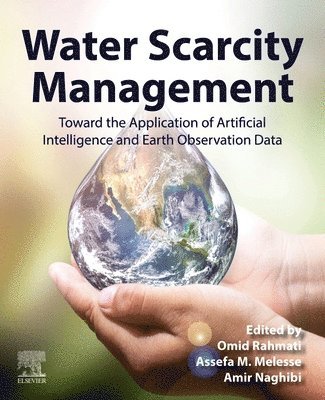
    Water Scarcity Management

    Towards the Application of Artificial Intelligence and Earth Observation Data

    AvOmid Rahmati,Assefa M. Melesse

    Häftad, Engelska, 2025

    1 871 kr

    Beställningsvara. Skickas inom 10-15 vardagar. Fri frakt över 249 kr.

    Beskrivning

    Drought and the condition of water scarcity lead to several socio-economic, social and environmental impacts. Whatever the approaches of drought management, policymakers and planners require novel methods to analyze data and model drought processes and its connection with water scarcity. In recent years, artificial intelligence-based and earth observation approaches have been progressively developed and applied in domain of water-related disasters. The target of this book is to present new advances and achievements in the fields of drought monitoring, analyzing, and modeling using artificial intelligence algorithms (e.g., machine learning, deep learning, etc.), statistical indices, and a diverse range of satellite remote sensing and geo-spatial data sets. Water Scarcity Management: Towards the Application of Artificial Intelligence and Earth Observation Data will help students gain knowledge on drought prediction using new free-access earth observation data and machine learning models. It will also guide scientists, researchers, and urban planners with the monitoring of water resources and key elements of hydrological cycle.

    • Covers application of a range of diverse artificial intelligence algorithms for spatial modeling of drought susceptibility
    • Includes real case studies from large geographical areas
    • Offers earth observation satellite data for spatio-temporal analysis of drought and water scarcity
    • Combines geo-environmental and topo-hydrological factors with drought and water scarcity issues

    Produktinformation

    • Utgivningsdatum:2025-11-27
    • Mått:216 x 276 x undefined mm
    • Vikt:450 g
    • Format:Häftad
    • Språk:Engelska
    • Antal sidor:404
    • Förlag:Elsevier Science
    • ISBN:9780443267222

    Utforska kategorier

    • Geovetenskap inom Naturvetenskap och teknik
    • Geografi inom Naturvetenskap och teknik
    • Miljövetenskap och miljöpolitik inom Naturvetenskap och teknik

    Mer om författaren

    Dr. Omid Rahmati is a geo-environmental researcher and Assistant Professor at the Agricultural Research, Education, and Extension Organization (AREEO) in Iran. His research focuses on applying machine learning models to natural hazard mitigation and watershed management. He has authored and co-authored over 70 articles in international peer-reviewed journals, as well as several books and book chapters. Dr. Rahmati’s publications have been cited more than 12,500 times (H-index: 56), and he has been recognized as a Highly Cited Researcher. He is ranked among the World’s Top 1% of Scientists by Web of Science (Clarivate, 2021–2022) and listed in Stanford University’s “World’s Top 2% Scientists” from 2021 to 2025. His publications over the past decade reflect a broad and significant influence in his field. Dr. Assefa M. Melesse is a Distinguished University Professor of Water Resources Engineering at Florida International University. He earned his ME (2000) and PhD (2002) from the University of Florida in Agricultural Engineering. His areas of research and experience include climate change impact modeling, watershed modeling, ecohydrology, sediment transport, surface and groundwater interactions modeling, water–energy–carbon fluxes coupling and simulations, remote sensing hydrology, river basin management, and land cover change detection and scaling. Dr. Melesse is a registered Professional Engineer (PE), Board Certified Enviromental Engineer (BCEE) and also a Board Certified Water Resources Engineer (BC.WRE) with over 30 years of teaching and research experience, and has authored/edited 11 books, over 230 journal articles, and over 100 book chapters. Dr. Amir Naghibi is an Assistant Professor in the Division of Water Resources Engineering and the Center for Advanced Middle Eastern Studies at Lund University, Lund, Sweden. His work sits at the intersection of artificial intelligence (AI), computer science, remote sensing, and environmental systems modeling, addressing the water-climate-food-energy nexus. He develops advanced AI-driven decision support systems to address complex challenges in water resources, agriculture, climate adaptation, and natural hazard management. He has published more than 50 papers in peer-reviewed journals with over 6,000 citations and has been listed in Stanford University’s World’s Top 2% Scientists from 2020 to 2025, demonstrating his broad and significant scientific influence.

    Innehållsförteckning

    • 1. Water scarcity crisis: overview of challenges and solutions2. Assessing Dust Storm Risks in Water-Scarce Regions: A Machine Learning Approach3. An Integrated Machine Learning Framework for Flood Susceptibility Assessment4. Application of GRACE satellite data to monitor groundwater storage and scarcity5. Discover the world of drought and water scarcity indices: insights for a sustainable future6. Exploring the Interplay of Water Scarcity and Dust Emissions7. Groundwater potential mapping: a way for mitigating water scarcity8. The role of climatic and anthropogenic factors in drying up of lakes9. Integrated assessment of the vulnerability of socio-ecological coupled systems of coastal areas to drought10. The effect of climatic and human factors on hydrological drought11. Machine Learning-Driven Land Subsidence Prediction Using Radar Imagery12. Remote Sensing for Assessing Ecosystem Drought Impact13. Ground Subsidence and Groundwater Dynamics: the Role of InSAR Analysis in Confined Aquifer Systems14. Drought mitigation and management measures15. Technological Innovations in Water Conservation: Navigating Drought and Water Scarcity16. Vegetation dynamics as a response to meteorological drought17. Machine Learning in Groundwater Drought Forecasting: A Bibliometric Perspective18. Decoding the Water Crisis in Iran: Policy Challenges and Resource Constraints19. Human effects of dam construction on the downstream ecosystem20. Climatic influences on vegetation degradation and soil moisture21. Holistic Water Resource Management in Scarcity: Policy Frameworks and Practical Solutions