• Fri frakt över 249 kr
  • •
  • Snabba leveranser
  • •
  • Billiga böcker
Kundservice

Du är på sajten för privatpersoner.

Företag, bibliotek eller offentlig verksamhet?

Du handlar på classic.bokus.com, där alla dina funktioner finns intakta.
Till classic.bokus.com
Bokus logotyp. Gå till startsidan.
  • Erbjudanden
  • Nyheter
  • Student
  • Topplistor
  • Barn & ungdom
  • Bokus Play
  • E-böcker
  • Pocketböcker
  • Spel & pussel

Må bättre, för mindre! Upp till 50% rabatt på hälsoböcker

Sidfot

Mina sidor

    Hjälp

    • Kundservice
    • Vanliga frågor och svar
    • Frakt och leverans
    • Retur vid ångerrätt
    • Reklamera vara
    • Betalning
    • Köpvillkor
    • Allmänna villkor
    • Information om webbplatsens tillgänglighet

    Om Bokus

    • Om oss
    • Pressrum
    • För studenter
    • För företag
    • För bibliotek och offentlig verksamhet
    • För leverantörer
    • Hållbarhet

    Populärt

    • Aktuella erbjudanden
    • Presentkort
    • Studentlitteratur
    • Nya böcker
    • Topplistor
    • Signerade böcker
    • Engelska böcker

    Inspiration

    • Boktips
    • BookTok
    • Populära bokserier
    • Barnbokskaraktärer
    • Populära författare
    Logotyp för Bokus
    Följ oss på Facebook (extern länk)Följ oss på Instagram (extern länk)Följ oss på YouTube (extern länk)Följ oss på TikTok (extern länk)
    bokus @ CookiesAnpassa cookiesIntegritetspolicyKöpvillkor
    Till Citymail hemsida (extern länk)Till Budbee hemsida (extern länk)Till Postnord hemsida (extern länk)Till Schenker hemsida (extern länk)Till Early Bird hemsida (extern länk)Till Walleys hemsida (extern länk)
    1. Naturvetenskap och teknik
    2. Teknik och industri
    3. Miljöteknik

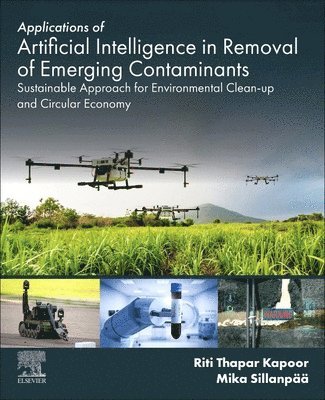
    Applications of Artificial Intelligence in Removal of Emerging Contaminants

    Sustainable Approach for Environmental Clean-up and Circular Economy

    AvMika Sillanp��,Riti Thapar Kapoor

    Häftad, Engelska, 2025

    1 523 kr

    Beställningsvara. Skickas inom 10-15 vardagar. Fri frakt över 249 kr.

    Beskrivning

    Applications of Artificial Intelligence in Removal of Emerging Contaminants: Sustainable Approach for Environmental Clean-up and Circular Economy focuses on the exploitation of various Artificial Intelligence (AI) tools to treat emerging contaminants and the restoration of contaminated sites. The book addresses critical environmental issues and challenges faced by society to meet such challenges. It highlights artificial intelligence and machine learning tools in the removal of environmental contaminants, such as industrial effluents, air, and to overcome limitations of conventional methods, predict water quality parameters and decrease the chances of error.

    Advanced tools, updated information, and future directions for researchers and scientists working in the bioremediation of emerging contaminants, bioenergy and reutilization of waste biomass in the production of value-added products for environmental safety are also thoroughly discussed.

    • Provides knowledge on various emerging pollutants which are hazardous to the environment, human health, and the applications of different artificial intelligence (AI) tools for the bioremediation of contaminant removal
    • Explores different aspects of biological methods using AI tools, including solutions for recycling and reuse
    • Highlights ways AI can assist scientists to make smart and effective decisions on the identification of suitable sorbents to enhance the performance of the sorption process and protect our environment

    Produktinformation

    • Utgivningsdatum:2025-12-05
    • Mått:191 x 235 x undefined mm
    • Vikt:450 g
    • Format:Häftad
    • Språk:Engelska
    • Antal sidor:382
    • Förlag:Elsevier Science
    • ISBN:9780443267796

    Utforska kategorier

    • Miljöteknik inom Naturvetenskap och teknik
    • Miljövetenskap och miljöpolitik inom Naturvetenskap och teknik
    • Artificiell intelligens inom Data och IT

    Mer om författaren

    Mika Sillanpää is a professor at the University of Johannesburg, South Africa. His research centers on chemical treatment in environmental engineering, environmental monitoring, and resource recovery from waste streams.Sillanpää received his M.Sc. (Eng.) and D.Sc. (Eng.) degrees from the Aalto University where he also completed an MBA degree in 2013. Since 2000, he has been a full professor/adjunct professor at the University of Oulu, the University of Eastern Finland, the LUT University, the University of Eastern Finland and the University of Johannesburg.He has received numerous awards for research and innovation. He is the first Laureate of Scientific Committee on the Problems of the Environment (SCOPE)’s Young Investigator Award, which was delivered at the UNESCO Conference in Shanghai 2010 for his “significant contributions, outstanding achievements and research leadership in Environmental Technological Innovations to address present water pollution problems worldwide, especially with regard to wastewater treatment and reuse”. In 2011, he was invited to act as a Principal Scientific Reviewer in the GEO-5 report of the United Nations Environmental Programme (UNEP). In 2012, he received Tapani Järvinen Environmental Technology Award and Publication Award of the Lappeenranta University of Technology. In 2014, he received the Science Award of the Lappeenranta University of Technology and Pro Mikkeli Award. In 2018, he was invited as a Member of the Finnish Academy of Sciences and Letters and Technology Academy of Finland. He also received Literature award from the Water Association of Finland in 2018. Riti Thapar Kapoor is Professor in Amity Institute of Biotechnology, Amity University Uttar Pradesh, Noida, India. She received her Ph.D from University of Allahabad and worked as post - doctoral fellow at Banaras Hindu University, Varanasi, India. She has fourteen years of teaching and research experience and her area of specialization is environmental biotechnology, bioremediation, wastewater treatment and abiotic stresses. She has received prestigious travel award from Bill & Melinda Gates Research Foundation under CGIAR project for participation in International training programme held at International Rice Research Institute (IRRI), Manila, Philippines in 2010. She is also recipient of DST travel grant for participation in International Conference held at Sri Lanka in 2013. She has been awarded with Teacher’s Research Fellowship from Indian Academy of Sciences, Bengaluru in 2019. ALong with this, she has supervised and mentored a number of research projects sanctioned by different government funding agencies such as DAE, DST and UPCST etc.

    Innehållsförteckning

    • 1. Artificial intelligence: Introduction of technology, tools and need and significance for environmental sustainability2. Artificial intelligence: historical background, types of tool and application for sustainable future3. Artificial intelligence in pollution control and management: status and future prospects4. Recent advances in use of artificial intelligence for optimization and automation of adsorption processes for wastewater treatment5. Artificial intelligence and machine learning-based monitoring and design of biological wastewater treatment system6. Applications of artificial intelligence tools for the adsorption of dyes from industrial effluent7. Application of AI tools and smart technology in adsorption of heavy metals by using biochar8. Current applications and future impacts of artificial intelligence and machine learning tools in removal of emerging contaminants9. Applications of AI for the adsorption of pharmaceutical compounds from wastewater10. Use of AI tools for the adsorption of organic pollutants from wastewater11. Use of machine learning methods for dye adsorption prediction onto agricultural waste /biochar/ activated carbon12. Comparison between conventional methods and artificial intelligence tools for wastewater treatment13. Artificial neural networks (ANN) for the prediction of biochar yield and its application in bioremediation14. Application of different AI models like fuzzy logic, genetic programming, model tree for prediction and removal of contaminants from wastewater treatment plants15. Challenges with artificial intelligence and machine learning methods for implementation in water treatment and monitoring16. Artificial intelligence technologies for forecasting air pollution and human health17. Applications of artificial intelligence-based modeling for bioenergy system18. Use of artificial intelligence tools in agro-waste management19. Application of artificial intelligence and machine learning technologies for development of circular economy20. Artificial intelligence: economical approaches for waste management and disposal21. Artificial intelligence and machine learning tools: Patents and technologies transferred to the industries22. Case studies from developed and developing nations: economic evaluation of contaminants removal/ waste recycling by AI tools23. Case study on the use of artificial intelligence tools to reduce pesticides/synthetic fertilizers application in agricultural fields24. Role of AI tools in a future bioeconomy for environmental clean-up: regulations and policy framework