• Fri frakt över 249 kr
  • •
  • Snabba leveranser
  • •
  • Billiga böcker
Kundservice

Du är på sajten för privatpersoner.

Företag, bibliotek eller offentlig verksamhet?

Du handlar på classic.bokus.com, där alla dina funktioner finns intakta.
Till classic.bokus.com
Bokus logotyp. Gå till startsidan.
  • Erbjudanden
  • Nyheter
  • Student
  • Topplistor
  • Barn & ungdom
  • Bokus Play
  • E-böcker
  • Pocketböcker
  • Spel & pussel

10% rabatt på allt med kod NYSTART10 →

Sidfot

Mina sidor

    Hjälp

    • Kundservice
    • Vanliga frågor och svar
    • Frakt och leverans
    • Retur vid ångerrätt
    • Reklamera vara
    • Betalning
    • Köpvillkor
    • Allmänna villkor
    • Information om webbplatsens tillgänglighet

    Om Bokus

    • Om oss
    • Pressrum
    • För studenter
    • För företag
    • För bibliotek och offentlig verksamhet
    • För leverantörer
    • Hållbarhet

    Populärt

    • Aktuella erbjudanden
    • Presentkort
    • Studentlitteratur
    • Nya böcker
    • Topplistor
    • Signerade böcker
    • Engelska böcker

    Inspiration

    • Boktips
    • BookTok
    • Populära bokserier
    • Barnbokskaraktärer
    • Populära författare
    Logotyp för Bokus
    Följ oss på Facebook (extern länk)Följ oss på Instagram (extern länk)Följ oss på YouTube (extern länk)Följ oss på TikTok (extern länk)
    bokus @ CookiesAnpassa cookiesIntegritetspolicyKöpvillkor
    Till Citymail hemsida (extern länk)Till Budbee hemsida (extern länk)Till Postnord hemsida (extern länk)Till Schenker hemsida (extern länk)Till Early Bird hemsida (extern länk)Till Walleys hemsida (extern länk)
    1. Naturvetenskap och teknik
    2. Teknik och industri
    3. Miljöteknik

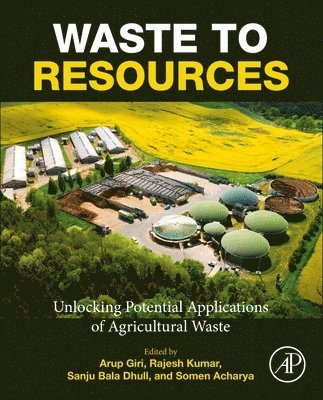
    Waste to Resources

    Unlocking Potential Applications of Agricultural Waste

    AvArup Giri,Rajesh Kumar

    Häftad, Engelska, 2025

    1 370 kr

    Beställningsvara. Skickas inom 5-8 vardagar. Fri frakt över 249 kr.

    Beskrivning

    Waste to Resources: Unlocking Potential Applications of Agricultural Waste is a comprehensive textbook that explores various types of agricultural waste, their sources, and composition. Growing environmental concerns create a need to deploy sustainable processes within agriculture. This book sheds light on waste management techniques, covering both theory and practice, and advocates for re-framing agricultural waste as a valuable resource. It takes into account the latest research and regulatory considerations to give a well-rounded understanding of the subject. This textbook is an essential resource for upper-level undergraduate students, researchers, and professionals in environmental science and agricultural biology.

    The introductory chapters provide an overview of agricultural waste, including crop residues, livestock waste, pesticides, and chemical waste, and describe the environmental implications of these categories. The subsequent chapters delve into waste management techniques such as biogas production, nutrient recovery, recycling, and composting. The final chapter explores the regulatory and policy issues related to sustainable agricultural waste management.

    • Provides a timely exploration of agricultural waste and how it can be utilized as a valuable resource
    • Delves into key concepts related to agricultural waste, waste management techniques, and their environmental impact
    • Gives an overview of the regulatory and policy issues surrounding waste management in agriculture
    • Offers future directions to overcome barriers and expand opportunities for a sustainable and resilient agricultural sector
    • Offers online support, including PowerPoint slides for instructors and case studies for students

    Produktinformation

    • Utgivningsdatum:2025-11-07
    • Mått:191 x 235 x 28 mm
    • Vikt:1 410 g
    • Format:Häftad
    • Språk:Engelska
    • Antal sidor:536
    • Förlag:Elsevier Science
    • ISBN:9780443302466

    Utforska kategorier

    • Miljöteknik inom Naturvetenskap och teknik
    • Agronomi inom Naturvetenskap och teknik

    Mer om författaren

    Dr. Arup Giri, M.Sc., Ph.D. is working as an Associate Professor in the Department of Zoology, Baba Mastnath University, India. He is also serving as the Director of Internal Quality Assurance Cell (IQAC) of Baba Mastnath University, India. Dr. Giri has completed M.Sc. in Zoology from Maulana Azad College, Kolkata, University of Calcutta. For his doctoral research, he has joined DRDO-Defence Institute of High Altitude Research (DIHAR), Leh, Ladakh UT, India, and received a Ph.D. from Bharathiar University, Coimbatore, TN, India in Life Sciences. Dr. Giri has later joined as a postdoctoral ICMR-SRF fellow at DIHAR, Chandigarh, India. He has also worked as an Assistant Professor in the Department of Life Science, Arni University, Kangra, Himachal Pradesh, India. His main research interest is on ‘Animal Physiology and Environmental Toxicology.’ A prolific author with 76 articles published in peer-reviewed journals, Dr. Giri's impact factor of 93.53 underscores the significance of his contributions (Google Scholar citation: 1023; H-index: 19; i10-index: 29). A mentor par excellence, Dr. Giri has guided numerous students in their academic pursuits. With six completed Ph.D. thesis, on-going mentorship for four more, and guided 85 post-graduate students. His supervision has been instrumental in earning accolades, such as the 'Best M.Sc. Dissertation Work' at Sri Sai University, Himachal Pradesh, India. Dr. Giri's influence extends beyond borders, with memberships in esteemed international societies and collaborations. He serves as a reviewer for prestigious journals (Poultry Science Journal, Biological Trace Element Research Journal, Euro-Mediterranean Journal for Environmental Integration, RevistaAmbiente&Água, Hygiene and Environmental Health Advances, Frontiers in Analytical Science, Italian Journal of Animal Science, Journal of Applied Biology & Biotechnology, Biological Rhythm Research, Biomarkers, Science of the Total Environment, Applied Water Science Journal, etc.), enriching the scientific discourse on subjects ranging from trace elements to environmental integration. Beyond academia, Dr. Giri is an ardent advocate for environmental stewardship. His research spanning five published book by Springer and ELSEVIER, 37 book chapters, two training manuals, and two technical bulletins. He received the ‘Best Academician Award’, 'Young Scientist Award,' 'Young Researcher Award,' and 'Best Oral Presentation Award" two times by different prestigious institutes of India. Dr Rajesh Kumar born and grown in Himachal Pradesh, did his Masters and PhD in Zoology from Jiwaji University, Gwalior (M.P.) India. He is currently working as Assistant Professor in Department of Biosciences, Himachal Pradesh University, Shimla (Himachal Pradesh) India. He has about 10 years of experience in teaching and research. His thrust areas of research are Animal Physiology and Applied Zoology. Dr Kumar has published about 102 Research Articles including 35 Book Chapters in indexed journals/publishers such as Elsevier, Springer, Scopus, WoS, CRC Press, AAP etc, 10 Research Papers in Full Length Proceedings, 05 Books (CRC Press, Springer), 04 Monographs, 95 Abstracts by participating in more than 75 national/international conferences. He has earned 12 awards for his excellent research till date. Dr Kumar has successfully completed 02 Major Research Projects and 02 Startup Projects sponsored by Government agencies. He has successfully supervised 03 PhD, 01 MPhil, 43 MSc students for their research work and currently, 02 PhD candidates are working under his supervision. Dr Kumar has successfully organized about 20 seminars/conferences and delivered more than 25 invited talks/extension lectures in different institutions. He is life/fellow member of various prestigious scientific agencies like ISC, HBSRA, STRA, ISZS etc and also reviewer of several journals of national and international repute. Dr Kumar has h-index – 11, i10 index - 13, Vidwan score 9.7/10. Dr. Sanju Bala Dhull is presently working as Associate Professor in the Department of Food Science and Technology, Chaudhary Devi Lal University, Sirsa, having more than 15 years of teaching and research experience. Her area of interests includes characterization and modification of biomolecules such as starch and gums, preparation and application of edible films, hydrogels, nanoparticles, nanoemulsions and new product development. She has published 5 books (4 CRC, 1 Springer), more than 50 research papers in different journals and 25 chapters in books of national and international repute. She presented more than 25 research papers in various national and international conferences. She is life member of the Association of Food Scientists and Technologists (India) and the Association of Microbiologists of India. She is Associate editor, Journal of Food Processing and Preservation (Hindawi) and Member, Editorial board, Legume Science (Wiley). She is a reviewer of several national and international journals Dr. Somen Acharya is currently working as Scientist ‘E’ at Defence Research Laboratory (DRL), DRDO, Assam, India. His present research works involves biodegradation technology for waste management; tertiary treatment systems for managing effluent water quality and biodigester technology for managing human waste for high altitude cold areas.Earlier, Dr. Acharya has joined at Defence Institute of High Altitude Research (DIHAR), DRDO Leh Ladakh, India where he has vast work experience on agronomic biofortification and crop productivity enhancement; demonstration of agro-technologies for high altitude cold desert regions of India; Hydroponic technology for growing vegetables at high altitude Ladakh region; designing and evaluation of cost effective net-energy based storage structure for vegetables during winters for round the year availability of fresh vegetables. He has obtained his MSc and PhD degree in Environmental Sciences from Indian Agricultural Research Institute (IARI), New Delhi, India. Dr. Acharya has published about 35 research articles in peer-reviewed journals; 07 book chapters; 10 popular articles. He is reviewer in various National and International referred journals.

    Innehållsförteckning

    • Part 1: Understanding Agricultural and Food Wastes1. Beyond the harvest: The origins and diversity of crop residues and byproducts2. Livestock waste: Sources, types and composition3. Pesticide and chemical waste: Exploring the sources, composition, and characteristics4. Nutrient, fertilizer, and plastic waste in agriculture sector5. Food processing waste: understanding the sources, composition, and characteristics6. Water footprints of global agriculture sectorPart 2: Environmental Impact and Ecological Considerations7. The ecological footprint of agricultural waste: Pollution and greenhouse gas8. Emissions from fertile to fragile: Understanding soil degradation and erosion due to agricultural waste9. Pyrethroids contamination: Understanding the impacts on freshwater invertebrates and fish10. The ecological toll: Biodiversity loss and habitat degradation caused by agricultural waste11. The hidden dangers: Agricultural waste and its impact on human healthPart 3: Waste management technologies for waste mitigation12. Traditional and modern waste management technologies: Challenges and limitations13. Integrated Waste Management Systems: Holistic Approaches to Waste Management in Agriculture14. Anaerobic Digestion of Waste for Sustainable Energy Production: Principles, applications, and sustainable challenges15. Waste-to-energy technologies: Harnessing biogas from agricultural waste16. Industrial applications of agricultural waste for value added products17. Nanotechnology and agro-industrial wastes as a sustainable and future approach in agricultural applicationsPart 4: Waste valorisation and resource utilisation18. Nutrient recovery and recycling: Extracting and reusing nutrients from agricultural waste19. Transforming waste into worth: Exploring Value-added products from Agricultural waste20. Agricultural waste as a renewable resource: Biomass and biofuel production21. Vermicomposting for waste decomposition and soil health improvement: Risk and challenges22. Residue to rations: Enhancing livestock nutrition with agricultural byproducts23. Biochar production: Utilizing waste for carbon sequestration and soil improvement24. Sustainable solutions: Utilizing agricultural waste for bioplastics and biofibers25. Waste not, mushroom lots: Innovative cultivation methods with agricultural residuesPart 5: Regulatory and Policy Frameworks for Sustainable Waste Management26. Policies and strategies to promote sustainable agricultural waste management practices27. Emerging Trends and Future Prospects in Agricultural Waste Management28. Potential agricultural waste management practices to contribute to a sustainable and circular agricultural system