• Fri frakt över 249 kr
  • •
  • Snabba leveranser
  • •
  • Billiga böcker
Kundservice

Du är på sajten för privatpersoner.

Företag, bibliotek eller offentlig verksamhet?

Du handlar på classic.bokus.com, där alla dina funktioner finns intakta.
Till classic.bokus.com
Bokus logotyp. Gå till startsidan.
  • Erbjudanden
  • Nyheter
  • Student
  • Topplistor
  • Barn & ungdom
  • Bokus Play
  • E-böcker
  • Pocketböcker
  • Spel & pussel

10% rabatt på allt med kod NYSTART10 →

Sidfot

Mina sidor

    Hjälp

    • Kundservice
    • Vanliga frågor och svar
    • Frakt och leverans
    • Retur vid ångerrätt
    • Reklamera vara
    • Betalning
    • Köpvillkor
    • Allmänna villkor
    • Information om webbplatsens tillgänglighet

    Om Bokus

    • Om oss
    • Pressrum
    • För studenter
    • För företag
    • För bibliotek och offentlig verksamhet
    • För leverantörer
    • Hållbarhet

    Populärt

    • Aktuella erbjudanden
    • Presentkort
    • Studentlitteratur
    • Nya böcker
    • Topplistor
    • Signerade böcker
    • Engelska böcker

    Inspiration

    • Boktips
    • BookTok
    • Populära bokserier
    • Barnbokskaraktärer
    • Populära författare
    Logotyp för Bokus
    Följ oss på Facebook (extern länk)Följ oss på Instagram (extern länk)Följ oss på YouTube (extern länk)Följ oss på TikTok (extern länk)
    bokus @ CookiesAnpassa cookiesIntegritetspolicyKöpvillkor
    Till Citymail hemsida (extern länk)Till Budbee hemsida (extern länk)Till Postnord hemsida (extern länk)Till Schenker hemsida (extern länk)Till Early Bird hemsida (extern länk)Till Walleys hemsida (extern länk)
    1. Data och IT
    2. Systemvetenskap och AI

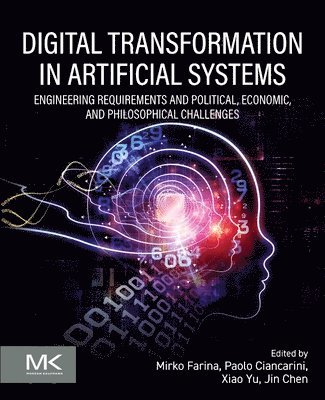
    Farina - Digital Transformation

    Engineering Requirements and Political, Economic, and Philosophical Challenges

    AvMirko Farina,Paolo Ciancarini

    Häftad, Engelska, 2026

    1 875 kr

    Beställningsvara. Skickas inom 10-15 vardagar. Fri frakt över 249 kr.

    Beskrivning

    The last decade has seen exponential growth in the development of digital technologies. This has led to significant shifts in the political arena as well as in the economy, precipitating a series of revolutionary changes in the fabric of our societies, which have had far-reaching consequences and effects on the way we relate and connect to each other. Digital Transformation in Artificial Systems: Engineering Requirements and Political, Economic, and Philosophical Challenges focuses on analyzing the engineering requirements as well as the political consequences, overarching the philosophical and ethical implications of this transformation, especially in relation to its application in artificial systems. In this context, the concept of digital transformation (understood as the practice of redefining models, functions, operations, processes, and activities by leveraging technological advancements to build efficient digital environments) has become increasingly important. This book brings together key concepts, ideas, and frameworks related to this idea. It promotes an inclusive and responsible digital transformation capable of addressing the constraints on the global digital divide, deepening cooperation in digitization, industrialization, and innovation, while furthering our understanding of the ethical and moral challenges associated with such a development. The distinctive and most original element of the book is its interdisciplinarity. It will allow readers to gather crucial insights that will be instrumental to better understand the reach of the forthcoming AI revolution, its multidimensionality, and its potential impact on people and society.

    • Provides a thorough exploration of digital transformation within artificial systems, covering key concepts, methodologies, and emerging trends
    • Shows practical insights into implementing digital transformation strategies in artificial systems, with real-world examples and case studies illustrating successful applications
    • Caters to a broad audience, including professionals, researchers, and students interested in understanding and implementing digital transformation in artificial systems

    Produktinformation

    • Utgivningsdatum:2026-02-13
    • Mått:191 x 235 x undefined mm
    • Vikt:450 g
    • Format:Häftad
    • Språk:Engelska
    • Antal sidor:414
    • Förlag:Elsevier Science
    • ISBN:9780443329647

    Utforska kategorier

    • Systemvetenskap och AI inom Data och IT
    • Företagsekonomi inom Ekonomi och Ledarskap
    • Affärsapplikationer inom Data och IT

    Mer om författaren

    Mirko Farina is a Full Professor of Philosophy of Technology and AI in the School of Philosophy and Social Development at Huaqiao University, a Talent C of the Fujian Province, and the Head of the Human-Machine Interaction Lab at the Institute for Digital Economy and Artificial Systems [Xiamen University and Lomonosov Moscow State University]. Personal Website: https://mirkofarina.weebly.com/Paolo Ciancarini is a Tenured Professor at the Department of Computer Scienceand Engineering of the University of Bologna – Alma Mater Studiorum. He lectureson software engineering and software architecture. Xiao Yu is the Founder & Executive Secretary-General of the Institute for Digital Economy & Artificial Systems. He is also the Founder & Director of the Sichuan Key Laboratory for Digital Administration & Organizational Synergy, (DAOS Lab, 2023–), a government-affiliated research institute jointly built by the Sichuan Provincial Big Data Bureau and the Sichuan Administration Institute.Jin Chen is a Full Professor at the Department of Innovation, Entrepreneurship, andStrategy, Tsinghua University. He is also the Director of the Research Center forTechnological Innovation, Tsinghua University.

    Innehållsförteckning

    • PART A Engineering and politics1. The digital transformation of the public sector: The roles of the product owner2. Exploring new formulations for distributive fairness in intelligent decision-making3. The coevolution dilemma and the artificial intelligence paradox4. Navigating digital sovereignty within regional integration: A conceptual framework5. The reality of digital states6. Navigating the nexus of international order and artificial intelligence regulation: Divergent approaches and global governance implicationsPART B – Economy and philosophy7. Key factors for successful digital transformation in business organizations8. Unilateral sanctions in the cyber age: The impact on state sovereignty and human rights9. Digital transformation as a tool for integration in the Eurasian Economic Union10. From innovation to inaction: Why digital energy fails to empower citizens11. Balancing the scales: Understanding and addressing algorithmic gender discrimination12. Digital transformation and identity13. The critique of human-centered artificial intelligence: Why it is questionable and why it calls for a radical transformation of the human—artificial intelligence relationPART C - New frontiers14. The digitalization of the humanities: Recent trends and future prospects15. Digital transformation and propaganda in the large language models era16. Digital transformation in education: Higher education for everyone17. Criminal justice and artificial intelligence: A defense of the restricted application model for algorithmic sentencing support