• Fri frakt över 249 kr
  • •
  • Snabba leveranser
  • •
  • Billiga böcker
Kundservice

Du är på sajten för privatpersoner.

Företag, bibliotek eller offentlig verksamhet?

Du handlar på classic.bokus.com, där alla dina funktioner finns intakta.
Till classic.bokus.com
Bokus logotyp. Gå till startsidan.
  • Erbjudanden
  • Nyheter
  • Student
  • Topplistor
  • Barn & ungdom
  • Bokus Play
  • E-böcker
  • Pocketböcker
  • Spel & pussel

10% rabatt på allt med kod NYSTART10 →

Sidfot

Mina sidor

    Hjälp

    • Kundservice
    • Vanliga frågor och svar
    • Frakt och leverans
    • Retur vid ångerrätt
    • Reklamera vara
    • Betalning
    • Köpvillkor
    • Allmänna villkor
    • Information om webbplatsens tillgänglighet

    Om Bokus

    • Om oss
    • Pressrum
    • För studenter
    • För företag
    • För bibliotek och offentlig verksamhet
    • För leverantörer
    • Hållbarhet

    Populärt

    • Aktuella erbjudanden
    • Presentkort
    • Studentlitteratur
    • Nya böcker
    • Topplistor
    • Signerade böcker
    • Engelska böcker

    Inspiration

    • Boktips
    • BookTok
    • Populära bokserier
    • Barnbokskaraktärer
    • Populära författare
    Logotyp för Bokus
    Följ oss på Facebook (extern länk)Följ oss på Instagram (extern länk)Följ oss på YouTube (extern länk)Följ oss på TikTok (extern länk)
    bokus @ CookiesAnpassa cookiesIntegritetspolicyKöpvillkor
    Till Citymail hemsida (extern länk)Till Budbee hemsida (extern länk)Till Postnord hemsida (extern länk)Till Schenker hemsida (extern länk)Till Early Bird hemsida (extern länk)Till Walleys hemsida (extern länk)
    1. Naturvetenskap och teknik
    2. Matematik och naturvetenskap
    3. Fysik
    4. Tillämpad fysik

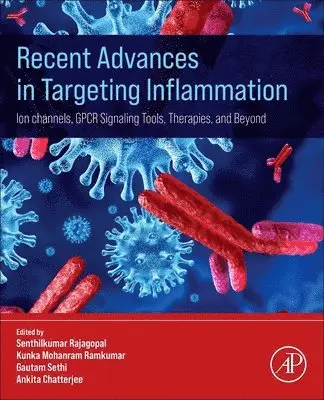
    Recent Advances in Targeting Inflammation

    Ion Channels, GPCR Signaling Tools, Therapies, and Beyond

    AvSenthilkumar Rajagopal,Kunka Mohanram Ramkumar

    Häftad, Engelska, 2026

    1 773 kr

    Kommande

    Beskrivning

    Recent Advances in Targeting Inflammation: Ion Channels, GPCR Signaling Tools, Therapies, and Beyond delves into the multifaceted occurrences of inflammation across different systems, such as neuroinflammation and gastric inflammation. The book's main goal is to present the latest highlights, covering advancements in inflammation, investigational therapies, animal models, and biomarkers. These insights are crucial for better diagnosis, monitoring, and potential therapeutic options for patients suffering from both acute and chronic inflammation. This comprehensive work explores various topics, including ion channel regulation in inflammation, GPCR regulation, signaling pathways, and therapeutic approaches.

    It emphasizes the importance of understanding the role of ion channels, GPCR, and nutrition in managing inflammation effectively. Additionally, the book discusses the global impact of chronic inflammation on health outcomes, stressing the need for improved healthcare planning and strategies.

    • Focuses on the development of multiple discipline approaches in inflammation and nutrition-related research
    • Brings together leading researchers in ion channels' regulation of inflammation
    • Presents essential reference information for researchers in the area
    • Provides current developments in disease, making it a vital resource for students and industry professionals

    Produktinformation

    • Utgivningsdatum:2026-09-10
    • Mått:191 x 235 x undefined mm
    • Format:Häftad
    • Språk:Engelska
    • Antal sidor:600
    • Förlag:Elsevier Science
    • ISBN:9780443338878

    Utforska kategorier

    • Tillämpad fysik inom Naturvetenskap och teknik
    • Biokemi inom Naturvetenskap och teknik
    • Fysiologi inom Medicin

    Mer om författaren

    Dr. Senthilkumar Rajagopal is an Associate Professor/Ramalingaswami Re-entry fellow [DBT] of Department of Biotechnology, REVA University, Bangalore, INDIA. He secured PhD in Biochemistry from Annamalai University, INDIA. He did his three Post-doctoral researches in Anesthesiology in University of Virginia, Charlottesville, Virginia, followed by Department of Cancer Immunology & AIDS, Dana Farber Cancer Institute, Harvard University, Boston, Massachusetts and, Department of Physiology and Biophysics, Virginia Commonwealth University, Richmond, Virginia, USA. Dr. Senthilkumar is a recipient of Rameshwardasji Birla Smarak Kosh Endowment award from Mumbai Medical Trust, Mumbai, INDIA for his master of philosophy work “Role of Cassia auriculata Leaf extract in alcoholic hepatotoxicity” and Ramalingaswami Re-entry Fellowship from Department of Biotechnology, Ministry of Science and Technology, Government of India. In addition, he has received Summer Research Fellowships two times in a row from notable scientific agencies in India such as NASI-INSA-IASc. He has more than 18 years of research experiences in various fields such as Alcoholic hepatotoxicity, Voltage gated calcium channels, protein kinase C phosphorylation, ADAM family, Smooth muscle physiology, G-protein coupled receptor signaling pathways, Neurotransmitters transporters to Central Nervous system. He has published nearly 75 research articles in various peer-reviewed international journals, 46 book chapters, 10 abstracts, 65 conferences proceedings/abstracts and attended various workshops/seminars in India, Canada and USA. He has reviewed and screened the abstracts for National Biotechnology Conferences and Annual Biomedical Research Conference for Minority Students (ABRCMS) and also served the special judge for Biophysical Society award at Virginia Piedmont Regional Science Fair. He has delivered his presentation on “Talk to Expert” series which is organized by India Science, Technology, Engineering and Mathematical facilities map (iSTEM) in association with Principal Scientific adviser to Prime minister office, Govt of India. He conducts research in the area of G-protein coupled receptor mediated intracellular mechanisms by Alcohol-induced digestive disorders in the gastrointestinal tract. Currently, he is mentoring graduate students and having research projects from various funding agencies. Dr. Ramkumar is a Professor of Biotechnology at SRM Institute of Science and Technology, India. He received his doctoral degree from Bharathidasan University, Tiruchirapalli, India, where he was trained in cell signaling networks, particularly pancreatic β-cell apoptosis. He expanded his realm into the cellular pathophysiology of diabetes during his post-doctoral fellowship at the Chonbuk National University Medical School, Republic of Korea. Further, during his research at the Stanford University School of Medicine, USA, he developed molecular imaging methods to study cellular and molecular pathways in vitro and in vivo. During his academic tenure at SRMIST, Dr. Ramkumar established Cell Culture Laboratory with a 'State of Art' infrastructure. He has made several contributions to the cellular signaling network in diabetes. He has developed a high throughput cell-based assay for screening signaling molecules that restore cellular homeostasis. His research interests span the identification of treatment targets for the management of diabetes. Much of his work has been on understanding the transcription factors involved in redox signaling associated with diabetes and its complications. He has also investigated the epigenetic regulation of cellular mediators involved in the pathophysiology of various diseases. Dr. Ramkumar has conducted several "Hands-on Training Workshops" related to Cell culture. He has over 150 scholarly contributions, including 100 peer-reviewed research papers, and based on his research accomplishments, Dr. Ramkumar has been ranked among the top 2% scientists consecutively for two years, as per the global list released by Stanford University, USA. His research has received more the 3 Crores of funding from several Government agencies, including the Science and Engineering Research Board (SERB), Indian Council of Medical Research (ICMR), Department of Biotechnology (DBT), and Department of Science and Technology (DST) and Industries. He is also a recipient of various awards from Government agencies including “Young Scientist Award” from DST and “SERB International Research Experience (SIRE)” award from SERB. Dr. Ramkumar has established Research Cohort with several hospitals and closely associates with clinicians, translating research from bench to bedside. Dr. Gautam Sethi is a tenured Associate Professor in the Department of Pharmacology at the Yong Loo Lin School of Medicine, National University of Singapore. His research focuses on elucidating the molecular mechanisms underlying cancer initiation and progression, particularly the activation of oncogenic transcription factors by carcinogens and inflammatory agents, and the identification of novel therapeutic inhibitors. Dr. Sethi has made substantial and direct scholarly contributions to the fields of gut microbiota, cancer pathophysiology, and host–microbiome interactions, with particular emphasis on immunotherapy, tumor microenvironment modulation, metabolic signaling, and therapy response prediction. He has authored numerous peer‑reviewed research and review articles in high‑impact journals, received multiple international awards, and serves on the editorial boards of more than 15 international journals. Dr. Ankita Chatterjee is an Assistant Professor in Department of Biotechnology, School of Applied Sciences, REVA University, Bangalore, India. Her research area includes microbial technology focusing on the effect of microorganisms and microbial metabolites in reducing the environmental pollutants. The area of research also spans around extraction of pharmaceutically active bioactive compounds from natural sources and their analyses. She has 35 publications at present which include 22 research and review papers in reputed international and national journals as well as 13 book chapters in internationally edited books under reputed publishers. She has served as reviewer for various international journals.

    Innehållsförteckning

    • Section 1: Introduction and Ion channels regulation in inflammation 1. Introduction : Voltage gated ion channels and GPCR signaling in inflammation2. Calcium – dependent regulation of ion channels in inflammation3. Unveiling the Significance of Mitochondrial Ion Channels in Inflammatory Responses4. Neuroinflammation with regards to ion Channels dysregulationSection 2: GPCR regulation in inflammation5. Role of GPCRs in Inflammasome activation and Therapeutics6. G-Protein Coupled Receptors Linked with the MASLD-MASH Transition: Updates for Pharmacotherapeutic Development7. Molecularity of GPCR Signaling involved in Neuroinflammation8. GPCR regulation of chemokine, lipid mediator and neuropeptide receptors in inflammationSection 3: Signaling Pathways in Inflammation9. G protein-coupled receptors: structure- and function-based drug discovery10. Alteration of inflammatory Signaling network in cancer11. Role of MAPK in Neuroinflammation: A molecular approachSection 4: Therapeutic approaches for inflammation12. G-protein-coupled receptors (GPCRs) in the treatment of diabetes13. Application of Nanoparticles for Targeting G Protein-Coupled Receptors14. Advancements in Targeting Ion Channels and GPCRs for inflammation therapy: Molecular Insights and Clinical Implications15. Nano-therapeutic strategies for inflammation via GPCR modulation: An update16. Innovative GPCR Targeting Strategies in Drug Therapy for Inflammatory Diseases: Mechanistic Approaches17. Distinctive applications of nano-therapeutics in mitigating metabolic disorder-inflammation18. Therapeutic approaches for inflammation