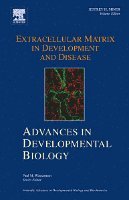
Inbunden, Engelska, 2006
Extracellular Matrix in Development and Disease
1637 kr
Beställningsvara. Skickas inom 10-15 vardagar. Fri frakt över 249 kr.
Beskrivning
Extracellular matrix proteins are serious, common human diseases that are caused by mutations in genes that encode these proteins. This has spurred a great number of researchers to study the extracellular matrix, sometimes by choice and sometimes by necessity. Much progress has been made in the last decade towards understanding what matrix proteins do and how cells interact with and respond to them. Volume 15 is a compilation of reviews by experts in their respective fields. The chapters in this book address the biology of a broad spectrum of extracellular matrix molecules and their functions in development and disease. This book has been designed to focus on a diverse subset of matrix proteins that have been shown to be important for development, function, and disease. The book therefore both presents a broad view of the field and provides crucial details about some of the best-studied matrix molecules.
* Written by leaders in the field* Discusses the potential of matrix components to be used as therapeutic tools for the treatment and prevention of cancer* Offers a section on integrin signaling and the development of the central nervous system, detailing the migration of neurons and the glia* Covers a diverse array of molecules such as laminins, collagens, heparan sulfate proteoglycans, integrins, and more
* Written by leaders in the field* Discusses the potential of matrix components to be used as therapeutic tools for the treatment and prevention of cancer* Offers a section on integrin signaling and the development of the central nervous system, detailing the migration of neurons and the glia* Covers a diverse array of molecules such as laminins, collagens, heparan sulfate proteoglycans, integrins, and more
Produktinformation
- Utgivningsdatum: 2006-01-04
- Mått: 152 x 229 x 16 mm
- Vikt: 600 g
- Format: Inbunden
- Språk: Engelska
- Serie: Advances in Developmental Biology
- Antal sidor: 248
- Förlag: Elsevier Science
- Medarbetare: Jeffrey H. Miner
- ISBN: 9780444518460
Utforska kategorier
Betyg & recensioner
0 recensioner
Inga recensioner tillgängliga.