• Fri frakt över 249 kr
  • •
  • Snabba leveranser
  • •
  • Billiga böcker
Kundservice

Du är på sajten för privatpersoner.

Företag, bibliotek eller offentlig verksamhet?

Du handlar på classic.bokus.com, där alla dina funktioner finns intakta.
Till classic.bokus.com
Bokus logotyp. Gå till startsidan.
  • Erbjudanden
  • Nyheter
  • Student
  • Topplistor
  • Barn & ungdom
  • Bokus Play
  • E-böcker
  • Pocketböcker
  • Spel & pussel

10% rabatt på allt med kod: NYSTART10 →

Sidfot

Mina sidor

    Hjälp

    • Kundservice
    • Vanliga frågor och svar
    • Frakt och leverans
    • Retur vid ångerrätt
    • Reklamera vara
    • Betalning
    • Köpvillkor
    • Allmänna villkor
    • Information om webbplatsens tillgänglighet

    Om Bokus

    • Om oss
    • Pressrum
    • För studenter
    • För företag
    • För bibliotek och offentlig verksamhet
    • För leverantörer
    • Hållbarhet

    Populärt

    • Aktuella erbjudanden
    • Presentkort
    • Studentlitteratur
    • Nya böcker
    • Topplistor
    • Signerade böcker
    • Engelska böcker

    Inspiration

    • Boktips
    • BookTok
    • Populära bokserier
    • Barnbokskaraktärer
    • Populära författare
    Logotyp för Bokus
    Följ oss på Facebook (extern länk)Följ oss på Instagram (extern länk)Följ oss på YouTube (extern länk)Följ oss på TikTok (extern länk)
    bokus @ CookiesAnpassa cookiesIntegritetspolicyKöpvillkor
    Till Citymail hemsida (extern länk)Till Budbee hemsida (extern länk)Till Postnord hemsida (extern länk)Till Schenker hemsida (extern länk)Till Early Bird hemsida (extern länk)Till Walleys hemsida (extern länk)
    1. Samhälle och politik
    2. Samhälle och kultur
    3. Kultur och medier
    4. Referensverk och tvärvetenskap

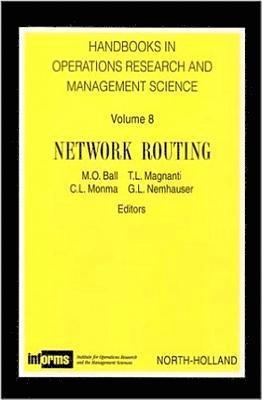
    Network Routing

    Inbunden, Engelska, 1995

    Del 8 i serien Handbooks in Operations Research and Management Science

    701 kr

    Beställningsvara. Skickas inom 10-15 vardagar. Fri frakt över 249 kr.

    Beskrivning

    The papers in this volume consider a general area of study known as network routing. The underlying problems are conceptually simple, yet mathematically complex and challenging. How can we best route material or people from one place to another? Or, how can we best design a system (for instance locate facilities) to provide services and goods as efficiently and equitably as possible? The problems encountered in answering these questions often have an underlying combinatorial structure, for example, either we dispatch a vehicle or we do not, or we use one particular route or another. The problems also typically have an underlying network structure (a communication or transportation network). In addition, models for these problems are often very large with hundreds or thousands of constraints and variables. A companion volume in the "Handbook" series, entitled "Network Models", treats basic network models such as minimum cost flows, matching and the travelling salesman problem, as well as, several complex network topics, not directly related to routing, such as network design and network reliability.

    Produktinformation

    • Utgivningsdatum:1995-10-30
    • Mått:175 x 245 x 0 mm
    • Vikt:1 910 g
    • Format:Inbunden
    • Språk:Engelska
    • Serie:Handbooks in Operations Research and Management Science
    • Antal sidor:796
    • Förlag:Elsevier Science
    • ISBN:9780444821416

    Utforska kategorier

    • Referensverk och tvärvetenskap inom Samhälle och politik
    • Tillämpad matematik inom Naturvetenskap och teknik
    • Nätverk och kommunikation inom Data och IT

    Innehållsförteckning

    • Part 1 Vehicle routing, M. Fisher: first generation research - simple heuristics; generation two - mathematical programming based heuristics; generation 3. Part 2 Time constrained routing and scheduling, J. Desrosiers et al: fixed schedule problems; the travelling salesman problem with time windows; constrained shortest path problems; the vehicle routing problem with time windows; pick-up and delivery problems with time windows; a unified framework for fleet and crew scheduling problems; conclusions and perspectives. Part 3 Stochastic and dynamic networks and routing, W.B. Powell et al: a priori (two-stage) stochastic models; modelling issues for dynamic problems; dynamic models in transportation and logistics; algorithms and formulations for deterministic dynamic networks; infinite horizon network models; stochastic programming for networks; stochastic programming models in networks and routing; approximations for networks with random arc capacities; evaluating dynamic models. Part 4 Analysis of vehicle routing and inventory-routing problems, A. Federgruen and D. Simchi-Levi: the capacitated vehicle routing problem (CVRP) with split demands; the CVRP with unequal demands; inventory-routing models; the multi-depot CVRP; generalizations and extensions. Part 5 Arch routing methods and applications, A.A. Assad and B.L. Golden: the classical postman problems; the rural postman problem; the capacitated arc routing problem; algorithms for capacitated arc routing problems; variants of postman problems; arc routing for sanitation services; postal delivery routing problems; routing for meter reading and snow control; applications in manufacturing and other areas; conclusions. Part 6 Network equilibrium models and algorithms, M. Florian and D. Hearn: equivalent problems - existence and uniqueness of solutions; some optimization reformulations; algorithms for the symmetric NEM; solving the asymmetric NEM; stochastic network equilibrium; other network equilibrium models; reference notes. Part 7 Location on networks, M. Labbe et al: the general framework and its properties; the median (minisum) problems; the center (minimax problems); economic models of location; discrete location problems; conclusion. Part 8 VLSI network design, R.H. Mohring et al: layout by graph partitioning; the divide and conquer layout algorithm; bifurcators and separators; bipartitioning; from planar graphs to switchboxes; channel routing in the knock-knee mode; layer assignment; Manhattan routing; via minimization; single layer routing; linear layout methods; the VLSI background; graph-theoretic formulations and related problems; complexity results; algorithms. Part 9 Network models in economics, W.W. Sharkey: cost allocation on networks; matching models in economics; optimal pricing and allocation of waiting time in stochastic service systems; concluding comments.