• Fri frakt över 249 kr
  • •
  • Snabba leveranser
  • •
  • Billiga böcker
Kundservice

Du är på sajten för privatpersoner.

Företag, bibliotek eller offentlig verksamhet?

Du handlar på classic.bokus.com, där alla dina funktioner finns intakta.
Till classic.bokus.com
Bokus logotyp. Gå till startsidan.
  • Erbjudanden
  • Nyheter
  • Student
  • Topplistor
  • Barn & ungdom
  • Bokus Play
  • E-böcker
  • Pocketböcker
  • Spel & pussel

10% rabatt på allt med kod NYSTART10 →

Sidfot

Mina sidor

    Hjälp

    • Kundservice
    • Vanliga frågor och svar
    • Frakt och leverans
    • Retur vid ångerrätt
    • Reklamera vara
    • Betalning
    • Köpvillkor
    • Allmänna villkor
    • Information om webbplatsens tillgänglighet

    Om Bokus

    • Om oss
    • Pressrum
    • För studenter
    • För företag
    • För bibliotek och offentlig verksamhet
    • För leverantörer
    • Hållbarhet

    Populärt

    • Aktuella erbjudanden
    • Presentkort
    • Studentlitteratur
    • Nya böcker
    • Topplistor
    • Signerade böcker
    • Engelska böcker

    Inspiration

    • Boktips
    • BookTok
    • Populära bokserier
    • Barnbokskaraktärer
    • Populära författare
    Logotyp för Bokus
    Följ oss på Facebook (extern länk)Följ oss på Instagram (extern länk)Följ oss på YouTube (extern länk)Följ oss på TikTok (extern länk)
    bokus @ CookiesAnpassa cookiesIntegritetspolicyKöpvillkor
    Till Citymail hemsida (extern länk)Till Budbee hemsida (extern länk)Till Postnord hemsida (extern länk)Till Schenker hemsida (extern länk)Till Early Bird hemsida (extern länk)Till Walleys hemsida (extern länk)
    1. Naturvetenskap och teknik
    2. Matematik och naturvetenskap
    3. Matematik
    4. Matematisk statistik

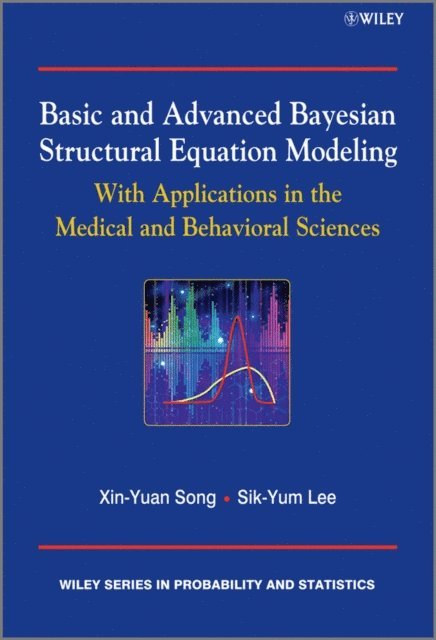
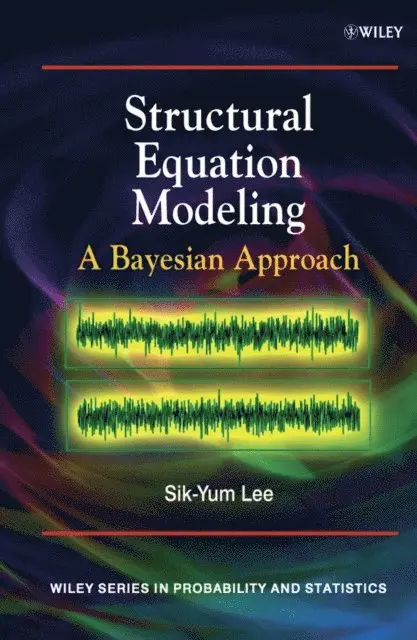
    Structural Equation Modeling

    A Bayesian Approach

    AvSik-Yum Lee

    Inbunden, Engelska, 2007

    Del 680 i serien Wiley Series in Probability and Statistics

    1 457 kr

    Beställningsvara. Skickas inom 5-8 vardagar. Fri frakt över 249 kr.
    Fler format och utgåvor

    E-bok

    1 672 kr

    Beskrivning

    ***Winner of the 2008 Ziegel Prize for outstanding new book of the year*** Structural equation modeling (SEM) is a powerful multivariate method allowing the evaluation of a series of simultaneous hypotheses about the impacts of latent and manifest variables on other variables, taking measurement errors into account. As SEMs have grown in popularity in recent years, new models and statistical methods have been developed for more accurate analysis of more complex data. A Bayesian approach to SEMs allows the use of prior information resulting in improved parameter estimates, latent variable estimates, and statistics for model comparison, as well as offering more reliable results for smaller samples.Structural Equation Modeling introduces the Bayesian approach to SEMs, including the selection of prior distributions and data augmentation, and offers an overview of the subject’s recent advances. Demonstrates how to utilize powerful statistical computing tools, including the Gibbs sampler, the Metropolis-Hasting algorithm, bridge sampling and path sampling to obtain the Bayesian results.Discusses the Bayes factor and Deviance Information Criterion (DIC) for model comparison.Includes coverage of complex models, including SEMs with ordered categorical variables, and dichotomous variables, nonlinear SEMs, two-level SEMs, multisample SEMs, mixtures of SEMs, SEMs with missing data, SEMs with variables from an exponential family of distributions, and some of their combinations.Illustrates the methodology through simulation studies and examples with real data from business management, education, psychology, public health and sociology.Demonstrates the application of the freely available software WinBUGS via a supplementary website featuring computer code and data sets.Structural Equation Modeling: A Bayesian Approach is a multi-disciplinary text ideal for researchers and students in many areas, including: statistics, biostatistics, business, education, medicine, psychology, public health and social science.

    Produktinformation

    • Utgivningsdatum:2007-01-26
    • Mått:160 x 235 x 31 mm
    • Vikt:771 g
    • Format:Inbunden
    • Språk:Engelska
    • Serie:Wiley Series in Probability and Statistics
    • Antal sidor:464
    • Förlag:John Wiley & Sons Inc
    • ISBN:9780470024232

    Utforska kategorier

    • Matematisk statistik inom Naturvetenskap och teknik

    Mer om författaren

    Sik-Yum Lee is a professor of statistics at the Chinese University of Hong Kong. He earned his Ph.D. in biostatistics at the University of California, Los Angeles, USA. He received a distinguished service award from the International Chinese Statistical Association, is a former president of the Hong Kong Statistical Society, and is an elected member of the International Statistical Institute and a Fellow of the American Statistical Association. He serves as Associate Editor for Psychometrika and Computational Statistics & Data Analysis, and as a member of the Editorial Board of British Journal of Mathematical and Statistical Psychology, Structural Equation Modeling, Handbook of Computing and Statistics with Applications and Chinese Journal of Medicine. his research interests are in structural equation models, latent variable models, Bayesian methods and statistical diagnostics. he is editor of Handbook of Latent Variable and Related Models and author of over 140 papers.

    Recensioner i media

    "This book is a welcome addition to any library and should be a valuable resource for research and teaching." (Technometrics, August 2008)

    Innehållsförteckning

    • About the Author xiPreface xiii1 Introduction 11.1 Standard Structural Equation Models 11.2 Covariance Structure Analysis 21.3 Why a New Book? 31.4 Objectives of the Book 41.5 Data Sets and Notations 6Appendix 1.1 7References 102 Some Basic Structural Equation Models 132.1 Introduction 132.2 Exploratory Factor Analysis 152.3 Confirmatory and Higher-order Factor Analysis Models 182.4 The LISREL Model 222.5 The Bentler–Weeks Model 262.6 Discussion 27References 283 Covariance Structure Analysis 313.1 Introduction 313.2 Definitions, Notations and Preliminary Results 333.3 GLS Analysis of Covariance Structure 363.4 ml Analysis of Covariance Structure 413.5 Asymptotically Distribution-free Methods 443.6 Some Iterative Procedures 47Appendix 3.1: Matrix Calculus 53Appendix 3.2: Some Basic Results in Probability Theory 57Appendix 3.3: Proofs of Some Results 59References 654 Bayesian Estimation of Structural Equation Models 674.1 Introduction 674.2 Basic Principles and Concepts of Bayesian Analysis of SEMs 704.3 Bayesian Estimation of the CFA Model 814.4 Bayesian Estimation of Standard SEMs 954.5 Bayesian Estimation via WinBUGS 98Appendix 4.1: The Metropolis–Hastings Algorithm 104Appendix 4.2: EPSR Value 105Appendix 4.3: Derivations of Conditional Distributions 106References 1085 Model Comparison and Model Checking 1115.1 Introduction 1115.2 Bayes Factor 1135.3 Path Sampling 1155.4 An Application: Bayesian Analysis of SEMs with Fixed Covariates 1205.5 Other Methods 1275.6 Discussion 130Appendix 5.1: Another Proof of Equation (5.10) 131Appendix 5.2: Conditional Distributions for Simulating (θ, ΩlY, t) 133Appendix 5.3: PP p-values for Model Assessment 136References 1366 Structural Equation Models with Continuous and Ordered Categorical Variables 1396.1 Introduction 1396.2 The Basic Model 1426.3 Bayesian Estimation and Goodness-of-fit 1446.4 Bayesian Model Comparison 1556.5 Application 1: Bayesian Selection of the Number of Factors in EFA 1596.6 Application 2: Bayesian Analysis of Quality of Life Data 164References 1727 Structural Equation Models with Dichotomous Variables 1757.1 Introduction 1757.2 Bayesian Analysis 1777.3 Analysis of a Multivariate Probit Confirmatory Factor Analysis Model 1867.4 Discussion 190Appendix 7.1: Questions Associated with the Manifest Variables 191References 1928 Nonlinear Structural Equation Models 1958.1 Introduction 1958.2 Bayesian Analysis of a Nonlinear SEM 1978.3 Bayesian Estimation of Nonlinear SEMs with Mixed Continuous and Ordered Categorical Variables 2158.4 Bayesian Estimation of SEMs with Nonlinear Covariates and Latent Variables 2208.5 Bayesian Model Comparison 230References 2399 Two-level Nonlinear Structural Equation Models 2439.1 Introduction 2439.2 A Two-level Nonlinear SEM with Mixed Type Variables 2449.3 Bayesian Estimation 2479.4 Goodness-of-fit and Model Comparison 2559.5 An Application: Filipina CSWs Study 2599.6 Two-level Nonlinear SEMs with Cross-level Effects 2679.7 Analysis of Two-level Nonlinear SEMs using WinBUGS 275Appendix 9.1: Conditional Distributions: Two-level Nonlinear Sem 279Appendix 9.2: MH Algorithm: Two-level Nonlinear SEM 283Appendix 9.3: PP p-value for Two-level NSEM with Mixed Continuous and Ordered-categorical Variables 285Appendix 9.4: Questions Associated with the Manifest Variables 286Appendix 9.5: Conditional Distributions: SEMs with Cross-level Effects 286Appendix 9.6: The MH algorithm: SEMs with Cross-level Effects 289References 29010 Multisample Analysis of Structural Equation Models 29310.1 Introduction 29310.2 The Multisample Nonlinear Structural Equation Model 29410.3 Bayesian Analysis of Multisample Nonlinear SEMs 29710.4 Numerical Illustrations 302Appendix 10.1: Conditional Distributions: Multisample SEMs 313References 31611 Finite Mixtures in Structural Equation Models 31911.1 Introduction 31911.2 Finite Mixtures in SEMs 32111.3 Bayesian Estimation and Classification 32311.4 Examples and Simulation Study 33011.5 Bayesian Model Comparison of Mixture SEMs 344Appendix 11.1: The Permutation Sampler 351Appendix 11.2: Searching for Identifiability Constraints 352References 35212 Structural Equation Models with Missing Data 35512.1 Introduction 35512.2 A General Framework for SEMs with Missing Data that are Mar 35712.3 Nonlinear SEM with Missing Continuous and Ordered Categorical Data 35912.4 Mixture of SEMs with Missing Data 37012.5 Nonlinear SEMs with Nonignorable Missing Data 37512.6 Analysis of SEMs with Missing Data via WinBUGS 386Appendix 12.1: Implementation of the MH Algorithm 389References 39013 Structural Equation Models with Exponential Family of Distributions 39313.1 Introduction 39313.2 The SEM Framework with Exponential Family of Distributions 39413.3 A Bayesian Approach 39813.4 A Simulation Study 40213.5 A Real Example: A Compliance Study of Patients 40413.6 Bayesian Analysis of an Artificial Example using WinBUGS 41113.7 Discussion 416Appendix 13.1: Implementation of the MH Algorithms 417Appendix 13.2 419References 41914 Conclusion 421References 425Index 427