• Fri frakt över 249 kr
  • •
  • Snabba leveranser
  • •
  • Billiga böcker
Kundservice

Du är på sajten för privatpersoner.

Företag, bibliotek eller offentlig verksamhet?

Du handlar på classic.bokus.com, där alla dina funktioner finns intakta.
Till classic.bokus.com
Bokus logotyp. Gå till startsidan.
  • Erbjudanden
  • Nyheter
  • Student
  • Topplistor
  • Barn & ungdom
  • Bokus Play
  • E-böcker
  • Pocketböcker
  • Spel & pussel

10% rabatt på allt med kod: NYSTART10 →

Sidfot

Mina sidor

    Hjälp

    • Kundservice
    • Vanliga frågor och svar
    • Frakt och leverans
    • Retur vid ångerrätt
    • Reklamera vara
    • Betalning
    • Köpvillkor
    • Allmänna villkor
    • Information om webbplatsens tillgänglighet

    Om Bokus

    • Om oss
    • Pressrum
    • För studenter
    • För företag
    • För bibliotek och offentlig verksamhet
    • För leverantörer
    • Hållbarhet

    Populärt

    • Aktuella erbjudanden
    • Presentkort
    • Studentlitteratur
    • Nya böcker
    • Topplistor
    • Signerade böcker
    • Engelska böcker

    Inspiration

    • Boktips
    • BookTok
    • Populära bokserier
    • Barnbokskaraktärer
    • Populära författare
    Logotyp för Bokus
    Följ oss på Facebook (extern länk)Följ oss på Instagram (extern länk)Följ oss på YouTube (extern länk)Följ oss på TikTok (extern länk)
    bokus @ CookiesAnpassa cookiesIntegritetspolicyKöpvillkor
    Till Citymail hemsida (extern länk)Till Budbee hemsida (extern länk)Till Postnord hemsida (extern länk)Till Schenker hemsida (extern länk)Till Early Bird hemsida (extern länk)Till Walleys hemsida (extern länk)
    1. Naturvetenskap och teknik
    2. Teknik och industri
    3. Elektronik och kommunikationer

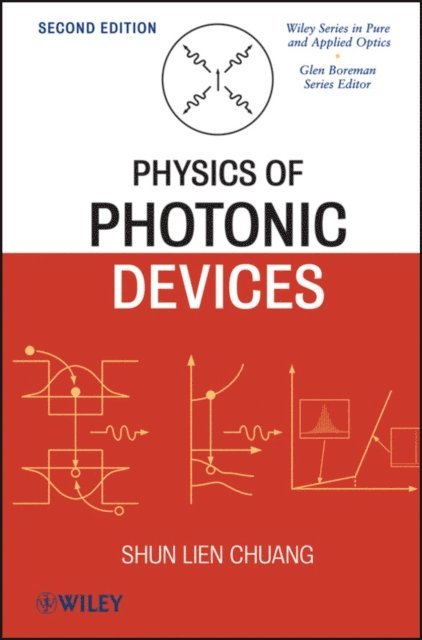
    Physics of Photonic Devices

    AvShun Lien Chuang

    Inbunden, Engelska, 2009

    Del 69 i serien Wiley Series in Pure and Applied Optics

    2 033 kr

    Beställningsvara. Skickas inom 5-8 vardagar. Fri frakt över 249 kr.

    Fler format och utgåvor

    E-bok

    2 351 kr

    Beskrivning

    The most up-to-date book available on the physics of photonic devices This new edition of Physics of Photonic Devices incorporates significant advancements in the field of photonics that have occurred since publication of the first edition (Physics of Optoelectronic Devices). New topics covered include a brief history of the invention of semiconductor lasers, the Lorentz dipole method and metal plasmas, matrix optics, surface plasma waveguides, optical ring resonators, integrated electroabsorption modulator-lasers, and solar cells. It also introduces exciting new fields of research such as: surface plasmonics and micro-ring resonators; the theory of optical gain and absorption in quantum dots and quantum wires and their applications in semiconductor lasers; and novel microcavity and photonic crystal lasers, quantum-cascade lasers, and GaN blue-green lasers within the context of advanced semiconductor lasers.Physics of Photonic Devices, Second Edition presents novel information that is not yet available in book form elsewhere. Many problem sets have been updated, the answers to which are available in an all-new Solutions Manual for instructors. Comprehensive, timely, and practical, Physics of Photonic Devices is an invaluable textbook for advanced undergraduate and graduate courses in photonics and an indispensable tool for researchers working in this rapidly growing field.

    Produktinformation

    • Utgivningsdatum:2009-02-06
    • Mått:161 x 243 x 46 mm
    • Vikt:1 315 g
    • Format:Inbunden
    • Språk:Engelska
    • Serie:Wiley Series in Pure and Applied Optics
    • Antal sidor:848
    • Upplaga:2
    • Förlag:John Wiley & Sons Inc
    • ISBN:9780470293195

    Utforska kategorier

    • Elektronik och kommunikationer inom Naturvetenskap och teknik

    Mer om författaren

    Shun Lien Chuang, PhD, is the MacClinchie Distinguished Professor in the Department of Electrical and Computer Engineering at the University of Illinois, Urbana-Champaign. His research centers on semiconductor optoelectronic and nanophotonic devices. He is a Fellow of the American Physical Society, IEEE, and the Optical Society of America. He received the Engineering Excellence Award from the OSA, the Distinguished Lecturer Award and the William Streifer Scientific Achievement Award from the IEEE Lasers and Electro-Optics Society, and the Humboldt Research Award for Senior U.S. Scientists from the Alexander von Humboldt Foundation.

    Innehållsförteckning

    • Preface xiiiChapter 1. Introduction 11.1 Basic Concepts of Semiconductor Band and Bonding Diagrams 11.2 The Invention of Semiconductor Lasers 41.3 The Field of Optoelectronics 81.4 Overview of the Book 15Problems 19References 19Bibliography 21Part I Fundamentals 25Chapter 2. Basic Semiconductor Electronics 272.1 Maxwell’s Equations and Boundary Conditions 272.2 Semiconductor Electronics Equations 302.3 Generation and Recombination in Semiconductors 402.4 Examples and Applications to Optoelectronic Devices 482.5 Semiconductor p-N and n-P Heterojunctions 532.6 Semiconductor n-N Heterojunctions and Metal–Semiconductor Junctions 69Problems 73References 74Chapter 3. Basic Quantum Mechanics 773.1 Schrödinger Equation 783.2 The Square Well 803.3 The Harmonic Oscillator 903.4 The Hydrogen Atom and Exciton in 2D and 3D 953.5 Time-Independent Perturbation Theory 973.6 Time-Dependent Perturbation Theory 104Appendix 3A: Löwdin’s Renormalization Method 107Problems 110References 111Chapter 4. Theory of Electronic Band Structures in Semiconductors 1134.1 The Bloch Theorem and the k p Method for Simple Bands Kane’s Model for Band Structure: The k p Method with 1134.2 the Spin–Orbit Interaction 1184.3 Luttinger–Kohn Model: The k p Method for Degenerate Bands 1264.4 The Effective Mass Theory for a Single Band and Degenerate Bands 1304.5 Strain Effects on Band Structures 1324.6 Electronic States in an Arbitrary One-Dimensional Potential 1444.7 Kronig–Penney Model for a Superlattice 1524.8 Band Structures of Semiconductor Quantum Wells 1584.9 Band Structures of Strained Semiconductor Quantum Wells 168Problems 172References 174Part II Propagation of Light 179Chapter 5. Electromagnetics and Light Propagation 1815.1 Time-Harmonic Fields and Duality Principle 1815.2 Poynting’s Theorem and Reciprocity Relations 1835.3 Plane Wave Solutions for Maxwell’s Equations in Homogeneous Media 1865.4 Light Propagation in Isotropic Media 1865.5 Wave Propagation in Lossy Media: Lorentz Oscillator Model and Metal Plasma 1895.6 Plane Wave Reflection from a Surface 1975.7 Matrix Optics 2025.8 Propagation Matrix Approach for Plane Wave Reflection from a Multilayered Medium 2065.9 Wave Propagation in Periodic Media 210Appendix 5A: Kramers–Kronig Relations 220Problems 223References 224Chapter 6. Light Propagation in Anisotropic Media and Radiation 2276.1 Light Propagation in Uniaxial Media 2276.2 Wave Propagation in Gyrotropic Media: Magnetooptic Effects 2396.3 General Solutions to Maxwell’s Equations and Gauge Transformations 2466.4 Radiation and the Far-Field Pattern 249Problems 254References 256Chapter 7. Optical Waveguide Theory 2577.1 Symmetric Dielectric Slab Waveguides 2577.2 Asymmetric Dielectric Slab Waveguides 2687.3 Ray Optics Approach to Waveguide Problems 2717.4 Rectangular Dielectric Waveguides 2737.5 The Effective Index Method 2797.6 Wave Guidance in a Lossy or Gain Medium 2817.7 Surface Plasmon Waveguides 285Problems 290References 293Chapter 8. Coupled-Mode Theory 2958.1 Waveguide Couplers 2958.2 Coupled Optical Waveguides 3008.3 Applications of Optical Waveguide Couplers 3078.4 Optical Ring Resonators and Add-Drop Filters 3118.5 Distributed Feedback (DFB) Structures 322Appendix 8A: Coupling Coefficients for Parallel Waveguides 332Appendix 8B: Improved Coupled-Mode Theory 333Problems 334References 339Part III Generation of Light 345Chapter 9. Optical Processes in Semiconductors 3479.1 Optical Transitions Using Fermi’s Golden Rule 3479.2 Spontaneous and Stimulated Emissions 3539.3 Interband Absorption and Gain of Bulk Semiconductors 3609.4 Interband Absorption and Gain in a Quantum Well 3659.5 Interband Momentum Matrix Elements of Bulk and Quantum-Well Semiconductors 3719.6 Quantum Dots and Quantum Wires 3759.7 Intersubband Absorption 3849.8 Gain Spectrum in a Quantum-Well Laser with Valence-Band Mixing Effects 391Appendix 9A: Coordinate Transformation of the Basis Functions and the Momentum Matrix Elements 398Problems 401References 405Chapter 10. Fundamentals of Semiconductor Lasers 41110.1 Double-Heterojunction Semiconductor Lasers 41210.2 Gain-Guided and Index-Guided Semiconductor Lasers 42810.3 Quantum-Well Lasers 43210.4 Strained Quantum-Well Lasers 44610.5 Strained Quantum-Dot Lasers 457Problems 472References 474Chapter 11. Advanced Semiconductor Lasers 48711.1 Distributed Feedback Lasers 48711.2 Vertical Cavity Surface-Emitting Lasers 50211.3 Microcavity and Photonic Crystal Lasers 51511.4 Quantum-Cascade Lasers 53011.5 GaN-Based Blue–Green Lasers and LEDs 54811.6 Coupled Laser Arrays 571Appendix 11A: Hamiltonian for Strained Wurtzite Crystals 578Appendix 11B: Band-Edge Optical Transition Matrix Elements 581Problems 583References 584Part IV Modulation of Light 603Chapter 12. Direct Modulation of Semiconductor Lasers 60512.1 Rate Equations and Linear Gain Analysis 60512.2 High-Speed Modulation Response with Nonlinear Gain Saturation 61112.3 Transport Effects on Quantum-Well Lasers: Electrical versus Optical Modulation 61412.4 Semiconductor Laser Spectral Linewidth and the Linewidth Enhancement Factor 62212.5 Relative Intensity Noise Spectrum 629Problems 632References 632Chapter 13. Electrooptic and Acoustooptic Modulators 63913.1 Electrooptic Effects and Amplitude Modulators 63913.2 Phase Modulators 64813.3 Electrooptic Effects in Waveguide Devices 65213.4 Scattering of Light by Sound: Raman–Nath and Bragg Diffractions 65813.5 Coupled-Mode Analysis for Bragg Acoustooptic Wave Couplers 661Problems 664References 666Chapter 14. Electroabsorption Modulators 66914.1 General Formulation for Optical Absorption Due to an Electron–Hole Pair 67014.2 Franz–Keldysh Effect: Photon-Assisted Tunneling 67314.3 Exciton Effect 67714.4 Quantum Confined Stark Effect (QCSE) 68314.5 Electroabsorption Modulator 69114.6 Integrated Electroabsorption Modulator-Laser (EML) 69314.7 Self-Electrooptic Effect Devices (SEEDs) 702Appendix 14A: Two-Particle Wave Function and the Effective Mass Equation 705Appendix 14B: Solution of the Electron–Hole Effective-Mass Equation with Excitonic Effects 709Problems 714References 714Part V Detection of Light and Solar Cells 721Chapter 15. Photodetectors and Solar Cells 72315.1 Photoconductors 72315.2 p-n Junction Photodiodes 73415.3 p-i-n Photodiodes 74015.4 Avalanche Photodiodes 74415.5 Intersubband Quantum-Well Photodetectors 75615.6 Solar Cells 761Problems 776References 778Appendix A. Semiconductor Heterojunction Band Lineups in the Model–Solid Theory 787Appendix B. Optical Constants of GaAs and InP 797Appendix C. Appendix D. Electronic Properties of Si, Ge, and a Few Binary, Ternary, and Quaternary Compounds 801Parameters for InN, GaN, AlN, and Their Ternary Compounds 807Index 811