• Fri frakt över 249 kr
  • •
  • Snabba leveranser
  • •
  • Billiga böcker
Kundservice

Du är på sajten för privatpersoner.

Företag, bibliotek eller offentlig verksamhet?

Du handlar på classic.bokus.com, där alla dina funktioner finns intakta.
Till classic.bokus.com
Bokus logotyp. Gå till startsidan.
  • Erbjudanden
  • Nyheter
  • Student
  • Topplistor
  • Barn & ungdom
  • Bokus Play
  • E-böcker
  • Pocketböcker
  • Spel & pussel

10% rabatt på allt med kod NYSTART10 →

Sidfot

Mina sidor

    Hjälp

    • Kundservice
    • Vanliga frågor och svar
    • Frakt och leverans
    • Retur vid ångerrätt
    • Reklamera vara
    • Betalning
    • Köpvillkor
    • Allmänna villkor
    • Information om webbplatsens tillgänglighet

    Om Bokus

    • Om oss
    • Pressrum
    • För studenter
    • För företag
    • För bibliotek och offentlig verksamhet
    • För leverantörer
    • Hållbarhet

    Populärt

    • Aktuella erbjudanden
    • Presentkort
    • Studentlitteratur
    • Nya böcker
    • Topplistor
    • Signerade böcker
    • Engelska böcker

    Inspiration

    • Boktips
    • BookTok
    • Populära bokserier
    • Barnbokskaraktärer
    • Populära författare
    Logotyp för Bokus
    Följ oss på Facebook (extern länk)Följ oss på Instagram (extern länk)Följ oss på YouTube (extern länk)Följ oss på TikTok (extern länk)
    bokus @ CookiesAnpassa cookiesIntegritetspolicyKöpvillkor
    Till Citymail hemsida (extern länk)Till Budbee hemsida (extern länk)Till Postnord hemsida (extern länk)Till Schenker hemsida (extern länk)Till Early Bird hemsida (extern länk)Till Walleys hemsida (extern länk)
    1. Ekonomi och Ledarskap
    2. Ledarskapsböcker

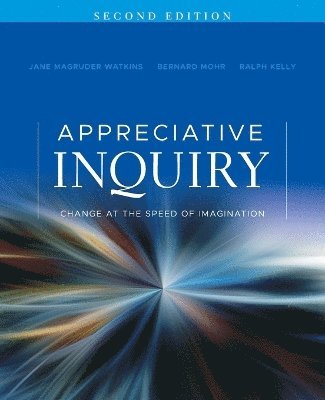
    Appreciative Inquiry

    Change at the Speed of Imagination

    AvJane Magruder Watkins,Bernard J. Mohr

    Häftad, Engelska, 2011

    Del 35 i serien J-B O-D (Organizational Development)

    797 kr

    Beställningsvara. Skickas inom 5-8 vardagar. Fri frakt över 249 kr.

    Beskrivning

    Thoroughly revised and updated, the second edition of Appreciative Inquiry offers OD and HR professionals a user-friendly resource for discovering how they can tap into the power of the Appreciative Inquiry (AI) process. An innovative process, AI is an effective way to work with a company as an organic system whose success depends on a holistic approach to connect that organization's human, technical, and organizational functions. This new edition meets the challenge of making the AI process accessible and updates three key areas of the process: the theoretical basis, fundamental assumptions and beliefs, and the basic processes. It includes step-by-step guidelines on how to apply AI in a variety of organizational situations and shows how it can be used with a wide range of initiatives, such as coaching, leadership development, strategic planning, and teambuilding."If there's one book to read on AI, this is it. It provides the context and rationale for this paradigm changing approach to change at any level of system. Buy it, read it, use it and enjoy achieving great results and renewed energy and enthusiasm."—Barbara Sloan, director, Organizational Development and Learning, New York University, Langone Medical Center"Appreciative Inquiry brings the freedom and creativity of AI together with the 'nuts and bolts' of how to actually do it all. It contains everything I would want to have as a fresh practitioner, from potential designs to sample questions and excellent Case Stories."—David Shaked, founder and CEO, Almond Insight, United Kingdom"This book serves as a complete roadmap for those interested in the philosophy and practice of Appreciative Inquiry. The Case Stories encourage readers to find their own way on the journey by providing examples of successful interventions."—Terry Egan, professor, Management Studies, Pepperdine University

    Produktinformation

    • Utgivningsdatum:2011-05-06
    • Mått:173 x 229 x 23 mm
    • Vikt:522 g
    • Format:Häftad
    • Språk:Engelska
    • Serie:J-B O-D (Organizational Development)
    • Antal sidor:336
    • Upplaga:2
    • Förlag:John Wiley & Sons Inc
    • ISBN:9780470527979

    Utforska kategorier

    • Ledarskapsböcker inom Ekonomi och Ledarskap
    • Affärsutveckling inom Ekonomi och Ledarskap

    Mer om författaren

    Jane Magruder Watkins is a past chair of the board of the NTL Institute for Applied Behavioral Science and a founding member of Appreciative Inquiry Consulting. She has more than thirty-five years in the field of organization development and has worked with a wide range of private, public, and government organizations, including Avon, GTE, Detroit Edison, SmithKline Beecham, ScottishPower, and more than 200 international organizations in nearly 50 countries. Bernard J. Mohr is the author of many books and articles on collaborative organization innovation and design. One of the original pioneers in the field of Appreciative Inquiry, Bernard co-founded Innovation Partners International and co-created the NTL Institute Certificate in Appreciative Inquiry.Ralph Kelly is a co-founder of Appreciative Inquiry Unlimited, a founding member of Appreciative Inquiry Consulting, and an Associate in the Taos Institute. He has over 35 years experience in the field of OD, and has worked with a rich variety of non-profit, faith-centered, government, private and academic organizations in over 40 countries.

    Innehållsförteckning

    • Chart of Case Stories xiii CHAPTER 1: The Case for a New Approach to Change 1The Emerging Paradigm 9The New Sciences 12Thinking About Problems Using the New Paradigm 16CHAPTER 2: Appreciative Inquiry: History, Theory, and Practice 21Defining Appreciative Inquiry 22A History of Appreciative Inquiry 23AI and the Field of Organization Development 31The Relevance of AI to Complex, Transformative Change 33AI and the Challenge of Organization Transformation 34Complex Change and the Two Gifts of Appreciative Inquiry 36The Theoretical Basis for Appreciative Inquiry 38Social Constructionism 38The Power of Image 42Social Constructionism + The Power of Image = Appreciative Inquiry in Organization Change 47What Good Are Positive Emotions? 48Case Story: Living Well with Dementia: Creating a Regional Strategy for the East Midlands, by Julie Barnes and Jill Guild 50CHAPTER 3: Appreciative Inquiry as a Perspective for Organization Change 67The "DNA" of Appreciative Inquiry 68The Core Principles of AI 71Are Principles Important? 71The Five Original Principles Plus Wholeness 72The Five Generic Core Processes for Guiding AI-Based Change 82Multiple Models of the Five Generic Core Processes of AI 83The Original Cooperrider/Srivastva Model 83The GEM Initiative Four-D Model 85A Fifth D 86The Mohr/Jacobsgaard Four “I” Model 89Skills and Knowledge Needed to Lead AI Processes 92Case Story: Using the SOAR Framework at Aerospace Alliant International (AAI), by Jacqueline M. Stavros 99Case Story: The Results of Appreciative Management by a Corporate Manager, by Daniel Saint 108CHAPTER 4: Choose the Positive as the Focus of Inquiry (Defi ne) 111Define: Focusing on the Positive 111Raising the Choice Point 113Explaining and Demonstrating 116Identifying the Focus for Inquiry 121Case Story: AI Stories from a Training and Technical Assistance Center (T/TAC): New Possibilities for Improving Outcomes for Students with Disabilities, by Denyse Doerries, Donni Davis-Perry, and Lori Korinek 129Case Story: From Defi cits to Strengths: Six Sigma from the AI Perspective, by David Shaked 139CHAPTER 5: Inquire into Stories of What Gives Life in the System (Discover) 145Rationale for the Use of Stories 146A Preparation Workshop to Develop the Customized Interview Protocol and Decide on an Inquiry Process 148Step 1: Select a Core Group and Possibly a Steering Team 150Step 2: Orient Participants to the Goals of the Workshop and to Their Role in Meeting the Goals 151Step 3: Quickly Get Participants into an Experience of AI 154Step 4: Debrief the Mini-AI Experience 157Step 5: Share Highlights of the Interviews and Select Topics for Further Inquiry 157Step 6: Create Questions to Be Added to the Four Generic Questions 160Step 7: Develop the Inquiry Process 166Interviewer Training 171Conclusion 173Case Story: Appreciative Living: Using AI in Daily Life, by Jacqueline Kelm 175Case Story: Appreciative Life Coaching, by Bob Tschannen-Moran 184CHAPTER 6: Locate Themes That Appear in the Stories (Discover) 191Identifying Themes 193Example of the Themes 193A Process for Selecting Themes 198Expanding the Dialogue 201Case Story: Appreciative Inquiry at Los Angeles Universal Preschool (LAUP): The LAUP/UDEM Dream Team, by Terri Egan, Nancy Westrup Villarreal, and Daphne Deporres 203CHAPTER 7: Create Shared Images for a Preferred Future (Dream) 213Articulating the Dream of an Organization’s Future 214Examples of Ways to Facilitate Creation of Shared Images 217Provocative Propositions 218Case Story: Advancing the Safety and Quality of Care in the Emergency Department Over Time: A Story with Three Acts, by Nancy Shendell-Falik, Amy Doran, and Bernard J. Mohr 223Case Story: Appreciative Inquiry with a Search Committee, by Liz Workman 234CHAPTER 8: Innovate Ways to Create That Preferred Future (Deliver) 237Organization Design Processes 241The Individual Action Approach 241The Whole System Design Approach 242A Design Framework: The ABC Model 242Assumptions of the Organization Inquiry Model 244How to Use the Organization Inquiry Model 247Case Story: Building Momentum for Sustainable Changes in Education: Toronto District School Board, by Sue Derby, Maureen McKenna, Karen Leckie, and Nancy Nightingale 259Case Story: Introducing Appreciative Inquiry into a Community Network Project in Liverpool, England, by Tim Slack and Phil Taylor 266CHAPTER 9: Valuation 275Classical Evaluation 275Evaluation from Appreciative Inquiry Perspective 276Learnings, Innovations, and Reaffi rmations from This Case 279Evaluation as an Integral Part of Any AI Process 281Case Story: Valuation of the Effectiveness of AI for the Zambia Police Services Victim Support Unit, by Mette Jacobsgaard 283References and Bibliography 295About the Authors 301Index 307