• Fri frakt över 249 kr
  • •
  • Snabba leveranser
  • •
  • Billiga böcker
Kundservice

Du är på sajten för privatpersoner.

Företag, bibliotek eller offentlig verksamhet?

Du handlar på classic.bokus.com, där alla dina funktioner finns intakta.
Till classic.bokus.com
Bokus logotyp. Gå till startsidan.
  • Erbjudanden
  • Nyheter
  • Student
  • Topplistor
  • Barn & ungdom
  • Bokus Play
  • E-böcker
  • Pocketböcker
  • Spel & pussel

10% rabatt på allt med kod: NYSTART10 →

Sidfot

Mina sidor

    Hjälp

    • Kundservice
    • Vanliga frågor och svar
    • Frakt och leverans
    • Retur vid ångerrätt
    • Reklamera vara
    • Betalning
    • Köpvillkor
    • Allmänna villkor
    • Information om webbplatsens tillgänglighet

    Om Bokus

    • Om oss
    • Pressrum
    • För studenter
    • För företag
    • För bibliotek och offentlig verksamhet
    • För leverantörer
    • Hållbarhet

    Populärt

    • Aktuella erbjudanden
    • Presentkort
    • Studentlitteratur
    • Nya böcker
    • Topplistor
    • Signerade böcker
    • Engelska böcker

    Inspiration

    • Boktips
    • BookTok
    • Populära bokserier
    • Barnbokskaraktärer
    • Populära författare
    Logotyp för Bokus
    Följ oss på Facebook (extern länk)Följ oss på Instagram (extern länk)Följ oss på YouTube (extern länk)Följ oss på TikTok (extern länk)
    bokus @ CookiesAnpassa cookiesIntegritetspolicyKöpvillkor
    Till Citymail hemsida (extern länk)Till Budbee hemsida (extern länk)Till Postnord hemsida (extern länk)Till Schenker hemsida (extern länk)Till Early Bird hemsida (extern länk)Till Walleys hemsida (extern länk)
    1. Naturvetenskap och teknik
    2. Matematik och naturvetenskap
    3. Matematik

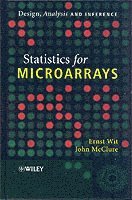
    Statistics for Microarrays

    Design, Analysis and Inference

    AvErnst Wit,John McClure

    Inbunden, Engelska, 2004

    1 243 kr

    Beställningsvara. Skickas inom 5-8 vardagar. Fri frakt över 249 kr.

    Beskrivning

    Interest in microarrays has increased considerably in the last ten years. This increase in the use of microarray technology has led to the need for good standards of microarray experimental notation, data representation, and the introduction of standard experimental controls, as well as standard data normalization and analysis techniques. Statistics for Microarrays: Design, Analysis and Inference is the first book that presents a coherent and systematic overview of statistical methods in all stages in the process of analysing microarray data – from getting good data to obtaining meaningful results. Provides an overview of statistics for microarrays, including experimental design, data preparation, image analysis, normalization, quality control, and statistical inference.Features many examples throughout using real data from microarray experiments.Computational techniques are integrated into the text.Takes a very practical approach, suitable for statistically-minded biologists.Supported by a Website featuring colour images, software, and data sets.Primarily aimed at statistically-minded biologists, bioinformaticians, biostatisticians, and computer scientists working with microarray data, the book is also suitable for postgraduate students of bioinformatics.

    Produktinformation

    • Utgivningsdatum:2004-06-22
    • Mått:154 x 239 x 20 mm
    • Vikt:539 g
    • Format:Inbunden
    • Språk:Engelska
    • Antal sidor:282
    • Förlag:John Wiley & Sons Inc
    • ISBN:9780470849934

    Utforska kategorier

    • Matematik inom Naturvetenskap och teknik
    • Biologi inom Naturvetenskap och teknik

    Mer om författaren

    Ernst Wit is the author of Statistics for Microarrays: Design, Analysis and Inference, published by Wiley.John McClure is the author of Statistics for Microarrays: Design, Analysis and Inference, published by Wiley.

    Recensioner i media

    "I liked this book and would recommend it to any statistician new to microarray data analysis…a unique combination of features that make it a contender among the standard textbooks…" (Journal of the American Statistical Association, June 2006) "...clear...up-to-date...lively advice...an excellent reference text for any researcher interested in the analysis of transcriptomic data." (Short Book Reviews, Vol.25, No.1, April 2005)"...this is a very good introduction to one of the most widely used methods for assessing differential expression..." (Journal of the Royal Statistical Society, Vol 168 (4) 2005)"...presents a coherent and systematic overview of statistical methods in all stages of the process of analysing microarray data..." (Zentralblatt Math, Vol.1049, 2004)

    Innehållsförteckning

    • Preface. 1 Preliminaries.1.1 Using the R Computing Environment.1.1.1 Installing smida.1.1.2 Loading smida.1.2 Data Sets from Biological Experiments.1.2.1 Arabidopsis experiment: Anna Amtmann.1.2.2 Skin cancer experiment: Nighean Barr.1.2.3 Breast cancer experiment: John Bartlett.1.2.4 Mammary gland experiment: Gusterson group.1.2.5 Tuberculosis experiment: BµG@S group.I Getting Good Data.2 Set-up of a Microarray Experiment.2.1 Nucleic Acids: DNA and RNA.2.2 Simple cDNA Spotted Microarray Experiment.2.2.1 Growing experimental material.2.2.2 Obtaining RNA.2.2.3 Adding spiking RNA and poly-T primer.2.2.4 Preparing the enzyme environment.2.2.5 Obtaining labelled cDNA.2.2.6 Preparing cDNA mixture for hybridization.2.2.7 Slide hybridization.3 Statistical Design of Microarrays.3.1 Sources of Variation.3.2 Replication.3.2.1 Biological and technical replication.3.2.2 How many replicates?3.2.3 Pooling samples.3.3 Design Principles.3.3.1 Blocking, crossing and randomization.3.3.2 Design and normalization.3.4 Single-channelMicroarray Design.3.4.1 Design issues.3.4.2 Design layout.3.4.3 Dealing with technical replicates.3.5 Two-channelMicroarray Designs.3.5.1 Optimal design of dual-channel arrays.3.5.2 Several practical two-channel designs.4 Normalization.4.1 Image Analysis.4.1.1 Filtering.4.1.2 Gridding.4.1.3 Segmentation.4.1.4 Quantification.4.2 Introduction to Normalization.4.2.1 Scale of gene expression data.4.2.2 Using control spots for normalization.4.2.3 Missing data.4.3 Normalization for Dual-channel Arrays.4.3.1 Order for the normalizations.4.3.2 Spatial correction.4.3.3 Background correction.4.3.4 Dye effect normalization.4.3.5 Normalization within and across conditions.4.4 Normalization of Single-channel Arrays.4.4.1 Affymetrix data structure.4.4.2 Normalization of Affymetrix data.5 Quality Assessment.5.1 Using MIAME in Quality Assessment.5.1.1 Components of MIAME.5.2 Comparing Multivariate Data.5.2.1 Measurement scale.5.2.2 Dissimilarity and distance measures.5.2.3 Representing multivariate data.5.3 Detecting Data Problems.5.3.1 Clerical errors.5.3.2 Normalization problems.5.3.3 Hybridization problems.5.3.4 Array mishandling.5.4 Consequences of Quality Assessment Checks.6 Microarray Myths: Data.6.1 Design.6.1.1 Single-versus dual-channel designs?6.1.2 Dye-swap experiments.6.2 Normalization.6.2.1 Myth: ‘microarray data is Gaussian’.6.2.2 Myth: ‘microarray data is not Gaussian’.6.2.3 Confounding spatial and dye effect.6.2.4 Myth: ‘non-negative background subtraction’.II Getting Good Answers.7 Microarray Discoveries.7.1 Discovering Sample Classes.7.1.1 Why cluster samples?7.1.2 Sample dissimilarity measures.7.1.3 Clustering methods for samples.7.2 Exploratory Supervised Learning.7.2.1 Labelled dendrograms.7.2.2 Labelled PAM-type clusterings.7.3 Discovering Gene Clusters.7.3.1 Similarity measures for expression profiles.7.3.2 Gene clustering methods.8 Differential Expression.8.1 Introduction.8.1.1 Classical versus Bayesian hypothesis testing.8.1.2 Multiple testing ‘problem’.8.2 Classical Hypothesis Testing.8.2.1 What is a hypothesis test?8.2.2 Hypothesis tests for two conditions.8.2.3 Decision rules.8.2.4 Results from skin cancer experiment.8.3 Bayesian Hypothesis Testing.8.3.1 A general testing procedure.8.3.2 Bayesian t-test.9 Predicting Outcomes with Gene Expression Profiles.9.1 Introduction.9.1.1 Probabilistic classification theory.9.1.2 Modelling and predicting continuous variables.9.2 Curse of Dimensionality: Gene Filtering.9.2.1 Use only significantly expressed genes.9.2.2 PCA and gene clustering.9.2.3 Penalized methods.9.2.4 Biological selection.9.3 Predicting ClassMemberships.9.3.1 Variance-bias trade-off in prediction.9.3.2 Linear discriminant analysis.9.3.3 k-nearest neighbour classification.9.4 Predicting Continuous Responses.9.4.1 Penalized regression: LASSO.9.4.2 k-nearest neighbour regression.10 Microarray Myths: Inference.10.1 Differential Expression.10.1.1 Myth: ‘Bonferroni is too conservative’.10.1.2 FPR and collective multiple testing.10.1.3 Misinterpreting FDR.10.2 Prediction and Learning.10.2.1 Cross-validation.Bibliography.Index.