• Fri frakt över 249 kr
  • •
  • Snabba leveranser
  • •
  • Billiga böcker
Kundservice

Du är på sajten för privatpersoner.

Företag, bibliotek eller offentlig verksamhet?

Du handlar på classic.bokus.com, där alla dina funktioner finns intakta.
Till classic.bokus.com
Bokus logotyp. Gå till startsidan.
  • Erbjudanden
  • Student
  • Topplistor
  • Barn & ungdom
  • Bokus Play
  • E-böcker
  • Ljudböcker
  • Pocketböcker
  • Spel & pussel

10% rabatt på allt med kod NYSTART10 →

Sidfot

Mina sidor

    Hjälp

    • Kundservice
    • Vanliga frågor och svar
    • Frakt och leverans
    • Retur vid ångerrätt
    • Reklamera vara
    • Betalning
    • Köpvillkor
    • Allmänna villkor
    • Information om webbplatsens tillgänglighet

    Om Bokus

    • Om oss
    • Pressrum
    • För studenter
    • För företag
    • För bibliotek och offentlig verksamhet
    • För leverantörer
    • Hållbarhet

    Populärt

    • Aktuella erbjudanden
    • Presentkort
    • Studentlitteratur
    • Nya böcker
    • Topplistor
    • Signerade böcker
    • Engelska böcker

    Inspiration

    • Boktips
    • BookTok
    • Populära bokserier
    • Barnbokskaraktärer
    • Populära författare
    Logotyp för Bokus
    Följ oss på Facebook (extern länk)Följ oss på Instagram (extern länk)Följ oss på YouTube (extern länk)Följ oss på TikTok (extern länk)
    bokus @ CookiesAnpassa cookiesIntegritetspolicyKöpvillkor
    Till Citymail hemsida (extern länk)Till Budbee hemsida (extern länk)Till Postnord hemsida (extern länk)Till Schenker hemsida (extern länk)Till Early Bird hemsida (extern länk)Till Walleys hemsida (extern länk)
    1. Naturvetenskap och teknik
    2. Teknik och industri
    3. Teknik: allmänt

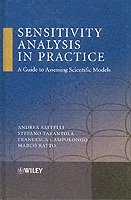
    Sensitivity Analysis in Practice

    A Guide to Assessing Scientific Models

    AvAndrea Saltelli,Stefano Tarantola

    Inbunden, Engelska, 2004

    1 050 kr

    Beställningsvara. Skickas inom 5-8 vardagar. Fri frakt över 249 kr.

    Beskrivning

    Sensitivity analysis should be considered a pre-requisite for statistical model building in any scientific discipline where modelling takes place. For a non-expert, choosing the method of analysis for their model is complex, and depends on a number of factors. This  book guides the non-expert through their problem in order to enable them to choose and apply the most appropriate method. It offers a review of the state-of-the-art in sensitivity analysis, and is suitable for a wide range of practitioners. It is focussed on the use of SIMLAB – a widely distributed freely-available sensitivity analysis software package developed by the authors – for solving problems in sensitivity analysis of statistical models. Other key features: Provides an accessible overview of the current most widely used methods for sensitivity analysis.Opens with a detailed worked example to explain the motivation behind the book.Includes a range of examples to help illustrate the concepts discussed.Focuses on implementation of the methods in the software SIMLAB - a freely-available sensitivity analysis software package developed by the authors.Contains a large number of references to sources for further reading.Authored by the leading authorities on sensitivity analysis.

    Produktinformation

    • Utgivningsdatum:2004-02-24
    • Mått:155 x 235 x 20 mm
    • Vikt:480 g
    • Format:Inbunden
    • Språk:Engelska
    • Antal sidor:232
    • Förlag:John Wiley & Sons Inc
    • ISBN:9780470870938

    Utforska kategorier

    • Teknik: allmänt inom Naturvetenskap och teknik
    • Naturvetenskap:allmänt inom Naturvetenskap och teknik

    Mer om författaren

    Andrea Saltelli, Joint Research Centre of the European Commission, Ispra, Unit of Applied Statistics and Econometrics. Presently leading the Econometric and Applied Statistics Unit of the Joint Research Centre, lead author Professor Saltelli has published many articles in numerous journals over the last 30 years. He is also the main author and main editor of two previous books (both for Wiley).

    Recensioner i media

    "...an interesting and informative book..." (Technometrics, May 2005) "...provides an accessible overview of the most widely used sensitivity analysis methods." (Zentralblatt Math, Vol.1049, 2004)"...well written..." (Statistical Methods in Medical Research, Vol 14 2005)

    Innehållsförteckning

    • PREFACE. 1. A WORKED EXAMPLE.1.1 A simple model.1.2 Modulus version of the simple model.1.3 Six-factor version of the simple model.1.4 The simple model ‘by groups’.1.5 The (less) simple correlated-input model.1.6 Conclusions.2. GLOBAL SENSITIVITY ANALYSIS FOR IMPORTANCE ASSESSMENT.2.1 Examples at a glance.2.2 What is sensitivity analysis?2.3 Properties of an ideal sensitivity analysis method.2.4 Defensible settings for sensitivity analysis.2.5 Caveats.3. TEST CASES.3.1 The jumping man. Applying variance-based methods.3.2 Handling the risk of a financial portfolio: the problem of hedging. Applying Monte Carlo filtering and variance-based methods.3.3 A model of fish population dynamics. Applying the method of Morris.3.4 The Level E model. Radionuclide migration in the geosphere. Applying variance-based methods and Monte Carlo filtering.3.5 Two spheres. Applying variance based methods in estimation/calibration problems.3.6 A chemical experiment. Applying variance based methods in estimation/calibration problems.3.7 An analytical example. Applying the method of Morris.4. THE SCREENING EXERCISE.4.1 Introduction.4.2 The method of Morris.4.3 Implementing the method.4.4 Putting the method to work: an analytical example.4.5 Putting the method to work: sensitivity analysis of a fish population model.4.6 Conclusions.5. METHODS BASED ON DECOMPOSING THE VARIANCE OF THE OUTPUT.5.1 The settings.5.2 Factors Prioritisation Setting.5.3 First-order effects and interactions.5.4 Application of Si to Setting ‘Factors Prioritisation’.5.5 More on variance decompositions.5.6 Factors Fixing (FF) Setting.5.7 Variance Cutting (VC) Setting.5.8 Properties of the variance based methods.5.9 How to compute the sensitivity indices: the case of orthogonal input.5.9.1 A digression on the Fourier Amplitude Sensitivity Test (FAST).5.10 How to compute the sensitivity indices: the case of non-orthogonal input.5.11 Putting the method to work: the Level E model.5.11.1 Case of orthogonal input factors.5.11.2 Case of correlated input factors.5.12 Putting the method to work: the bungee jumping model.5.13 Caveats.6. SENSITIVITY ANALYSIS IN DIAGNOSTIC MODELLING: MONTE CARLO FILTERING AND REGIONALISED SENSITIVITY ANALYSIS, BAYESIAN UNCERTAINTY ESTIMATION AND GLOBAL SENSITIVITY ANALYSIS.6.1 Model calibration and Factors Mapping Setting.6.2 Monte Carlo filtering and regionalised sensitivity analysis.6.2.1 Caveats.6.3 Putting MC filtering and RSA to work: the problem of hedging a financial portfolio.6.4 Putting MC filtering and RSA to work: the Level E test case.6.5 Bayesian uncertainty estimation and global sensitivity analysis.6.5.1 Bayesian uncertainty estimation.6.5.2 The GLUE case.6.5.3 Using global sensitivity analysis in the Bayesian uncertainty estimation.6.5.4 Implementation of the method.6.6 Putting Bayesian analysis and global SA to work: two spheres.6.7 Putting Bayesian analysis and global SA to work: a chemical experiment.6.7.1 Bayesian uncertainty analysis (GLUE case).6.7.2 Global sensitivity analysis.6.7.3 Correlation analysis.6.7.4 Further analysis by varying temperature in the data set: fewer interactions in the model.6.8 Caveats.7. HOW TO USE SIMLAB.7.1 Introduction.7.2 How to obtain and install SIMLAB.7.3 SIMLAB main panel.7.4 Sample generation.7.4.1 FAST.7.4.2 Fixed sampling.7.4.3 Latin hypercube sampling (LHS).7.4.4 The method of Morris.7.4.5 Quasi-Random LpTau.7.4.6 Random.7.4.7 Replicated Latin Hypercube (r-LHS).7.4.8 The method of Sobol’.7.4.9 How to induce dependencies in the input factors.7.5 How to execute models.7.6 Sensitivity analysis.8. FAMOUS QUOTES: SENSITIVITY ANALYSIS IN THE SCIENTIFIC DISCOURSE.REFERENCES.INDEX.