• Fri frakt över 249 kr
  • •
  • Snabba leveranser
  • •
  • Billiga böcker
Kundservice

Du är på sajten för privatpersoner.

Företag, bibliotek eller offentlig verksamhet?

Du handlar på classic.bokus.com, där alla dina funktioner finns intakta.
Till classic.bokus.com
Bokus logotyp. Gå till startsidan.
  • Erbjudanden
  • Nyheter
  • Student
  • Topplistor
  • Barn & ungdom
  • Bokus Play
  • E-böcker
  • Pocketböcker
  • Spel & pussel

10% studentrabatt med kod TERM26

Sidfot

Mina sidor

    Hjälp

    • Kundservice
    • Vanliga frågor och svar
    • Frakt och leverans
    • Retur vid ångerrätt
    • Reklamera vara
    • Betalning
    • Köpvillkor
    • Allmänna villkor
    • Information om webbplatsens tillgänglighet

    Om Bokus

    • Om oss
    • Pressrum
    • För studenter
    • För företag
    • För bibliotek och offentlig verksamhet
    • För leverantörer
    • Hållbarhet

    Populärt

    • Aktuella erbjudanden
    • Presentkort
    • Studentlitteratur
    • Nya böcker
    • Topplistor
    • Signerade böcker
    • Engelska böcker

    Inspiration

    • Boktips
    • BookTok
    • Populära bokserier
    • Barnbokskaraktärer
    • Populära författare
    Logotyp för Bokus
    Följ oss på Facebook (extern länk)Följ oss på Instagram (extern länk)Följ oss på YouTube (extern länk)Följ oss på TikTok (extern länk)
    bokus @ CookiesAnpassa cookiesIntegritetspolicyKöpvillkor
    Till Citymail hemsida (extern länk)Till Budbee hemsida (extern länk)Till Postnord hemsida (extern länk)Till Schenker hemsida (extern länk)Till Early Bird hemsida (extern länk)Till Walleys hemsida (extern länk)
    1. Naturvetenskap och teknik
    2. Matematik och naturvetenskap
    3. Biologi
    4. Biokemi

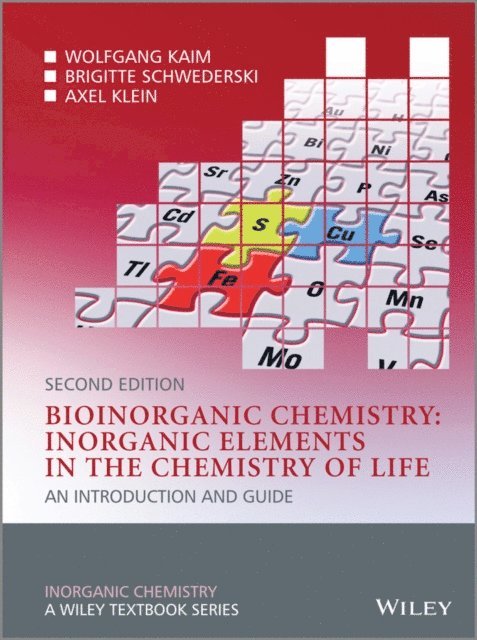
    Bioinorganic Chemistry -- Inorganic Elements in the Chemistry of Life

    An Introduction and Guide

    AvWolfgang Kaim,Brigitte Schwederski

    Häftad, Engelska, 2013

    Del i serien Inorganic Chemistry: A Textbook Series

    566 kr

    Tillfälligt slut

    Fler format och utgåvor

    Inbunden

    Tillf. slut

    Beskrivning

    The field of Bioinorganic Chemistry has grown significantly in recent years; now one of the major sub-disciplines of Inorganic Chemistry, it has also pervaded other areas of the life sciences due to its highly interdisciplinary nature.Bioinorganic Chemistry: Inorganic Elements in the Chemistry of Life, Second Edition provides a detailed introduction to the role of inorganic elements in biology, taking a systematic element-by-element approach to the topic. The second edition of this classic text has been fully revised and updated to include new structure information, emerging developments in the field, and an increased focus on medical applications of inorganic compounds. New topics have been added including materials aspects of bioinorganic chemistry, elemental cycles, bioorganometallic chemistry, medical imaging and therapeutic advances.Topics covered include: Metals at the center of photosynthesisUptake, transport, and storage of essential elementsCatalysis through hemoproteinsBiological functions of molybdenum, tungsten, vanadium and chromiumFunction and transport of alkaline and alkaline earth metal cationsBiomineralizationBiological functions of the non-metallic inorganic elementsBioinorganic chemistry of toxic metalsBiochemical behavior of radionuclides and medical imaging using inorganic compoundsChemotherapy involving non-essential elementsThis full color text provides a concise and comprehensive review of bioinorganic chemistry for advanced students of chemistry, biochemistry, biology, medicine and environmental science.

    Produktinformation

    • Utgivningsdatum:2013-10-04
    • Mått:191 x 246 x 20 mm
    • Vikt:921 g
    • Format:Häftad
    • Språk:Engelska
    • Serie:Inorganic Chemistry: A Textbook Series
    • Antal sidor:432
    • Upplaga:2
    • Förlag:John Wiley & Sons Inc
    • ISBN:9780470975237

    Utforska kategorier

    • Biokemi inom Naturvetenskap och teknik
    • Biologi inom Naturvetenskap och teknik
    • Oorganisk kemi inom Naturvetenskap och teknik

    Mer om författaren

    Professor Dr Wolfgang Kaim, Institute of Inorganic Chemistry, University of Stuttgart, GermanyWolfgang Kaim was born in 1951 near Frankfurt am Main, Germany, and studied chemistry at the universities of Frankfurt and Konstanz. After obtaining his PhD with H. Bock in 1978 he spent a postdoctoral year with F.A. Cotton at the University of Texas A&M University. In 1987 he moved from the University of Frankfurt to a Full Professorship at the University of Stuttgart. His main research interests focus on the charge and electron transfer reactivity of molecular compounds and various aspects of coordination chemistry. Dr Brigitte Schwederski, Institute of Inorganic Chemistry, University of Stuttgart, GermanyBrigitte Schwederski was born in 1959 in Recklinghausen, Germany. From 1977 to 1983 she studied chemistry and biology at the University of Bochum and in 1988 completed her PhD in the research group of Dale W. Margerum at Purdue University, Indiana. Since 1988 she has been a Research Assistant at the University of Stuttgart. Her main research interests include inorganic model complexes of bioinorganic systems, their characteristics and reactivity. Professor Dr. Axel Klein, Universitaet zu Koeln, Institut fuer Anorganische Chemie, GermanyAxel Klein is a Professor of Inorganic Chemistry at the University of Cologne, Germany. His research interests lie in the preparation and investigation of novel coordination compounds including organometallic derivatives, aiming at the rational design, preparation and use of coordination units with specific properties in mononuclear or oligonuclear complexes or as part of materials.

    Innehållsförteckning

    • Preface to the Second Edition xiPreface to the First Edition xiii1 Historical Background, Current Relevance and Perspectives 12 Some General Principles 72.1 Occurrence and Availability of Inorganic Elements in Organisms 72.2 Biological Functions of Inorganic Elements 142.3 Biological Ligands for Metal Ions 162.4 Relevance of Model Compounds 343 Cobalamins, Including Vitamin and Coenzyme B12 373.1 History and Structural Characterization 373.2 General Reactions of Alkylcobalamins 413.3 Enzyme Functions of Cobalamins 453.4 Model Systems and the Enzymatic Activation of the Co–C Bond 524 Metals at the Center of Photosynthesis: Magnesium and Manganese 574.1 Volume and Efficiency of Photosynthesis 574.2 Primary Processes in Photosynthesis 594.3 Manganese-catalyzed Oxidation of Water to O2 685 The Dioxygen Molecule, O2: Uptake, Transport and Storage of an Inorganic Natural Product 775.1 Molecular and Chemical Properties of Dioxygen, O2 775.2 Oxygen Transport and Storage through Hemoglobin and Myoglobin 825.3 Alternative Oxygen Transport in Some Lower Animals: Hemerythrin and Hemocyanin 925.4 Conclusion 966 Catalysis through Hemoproteins: Electron Transfer, Oxygen Activation and Metabolism of Inorganic Intermediates 996.1 Cytochromes 1016.2 Cytochrome P-450: Oxygen Transfer from O2 to Nonactivated Substrates 1036.3 Peroxidases: Detoxification and Utilization of Doubly Reduced Dioxygen 1086.4 Controlling the Reaction Mechanism of the Oxyheme Group: Generation and Function of Organic Free Radicals 1106.5 Hemoproteins in the Catalytic Transformation of Partially Reduced Nitrogen and Sulfur Compounds 1127 Iron–Sulfur and Other Non-heme Iron Proteins 1177.1 Biological Relevance of the Element Combination Iron–Sulfur 1177.2 Rubredoxins 1227.3 [2Fe-2S] Centers 1227.4 Polynuclear Fe/S Clusters: Relevance of the Protein Environment and Catalytic Activity 1237.5 Model Systems for Fe/S Proteins 1287.6 Iron-containing Enzymes without Porphyrin or Sulfide Ligands 1308 Uptake, Transport and Storage of an Essential Element, as Exemplified by Iron 1398.1 The Problem of Iron Mobilization: Oxidation States, Solubility and Medical Relevance 1408.2 Siderophores: Iron Uptake by Microorganisms 1418.3 Phytosiderophores: Iron Uptake by Plants 1498.4 Transport and Storage of Iron 1508.4.3 Hemosiderin 1599 Nickel-containing Enzymes: The Remarkable Career of a Long-overlooked Biometal 1639.1 Overview 1639.2 Urease 1649.3 Hydrogenases 1669.4 CO Dehydrogenase = CO Oxidoreductase = Acetyl-CoA Synthase 1699.5 Methyl-coenzyme M Reductase (Including the F430 Cofactor) 1729.6 Superoxide Dismutase 1779.7 Model Compounds 17810 Copper-containing Proteins: An Alternative to Biological Iron 18310.1 Type 1: "Blue" Copper Centers 18610.2 Type 2 and Type 3 Copper Centers in O2-activating Proteins: Oxygen Transport and Oxygenation 19110.3 Copper Proteins as Oxidases/Reductases 19510.4 Cytochrome c Oxidase 20010.5 Cu,Zn- and Other Superoxide Dismutases: Substrate-specific Antioxidants 20311 Biological Functions of the "Early" Transition Metals: Molybdenum, Tungsten, Vanadium and Chromium 21111.1 Oxygen Transfer through Tungsten- and Molybdenum-containing Enzymes 21111.2 Metalloenzymes in the Biological Nitrogen Cycle: Molybdenum-dependent Nitrogen Fixation 21911.3 Alternative Nitrogenases 22611.4 Biological Vanadium Outside of Nitrogenases 22911.5 Chromium(III) in the Metabolism? 23112 Zinc: Structural and Gene-regulatory Functions and the Enzymatic Catalysis of Hydrolysis and Condensation Reactions 23512.1 Overview 23512.2 Carboanhydrase 23812.3 Carboxypeptidase A and Other Hydrolases 24312.4 Catalysis of Condensation Reactions by Zinc-containing Enzymes 24812.5 Alcohol Dehydrogenase and Related Enzymes 24912.6 The "Zinc Finger" and Other Gene-regulatory Zinc Proteins 25112.7 Insulin, hGH, Metallothionein and DNA Repair Systems as Zinc-containing Proteins 25313 Unequally Distributed Electrolytes: Function and Transport of Alkali and Alkaline Earth Metal Cations 25713.1 Characterization and Biological Roles of K+, Na+, Ca2+ and Mg2+ 25713.2 Complexes of Alkali and Alkaline Earth Metal Ions with Macrocycles 26413.3 Ion Channels 26713.4 Ion Pumps 27014 Catalysis and Regulation of Bioenergetic Processes by the Alkaline Earth Metal Ions Mg2+ and Ca2+ 27714.1 Magnesium: Catalysis of Phosphate Transfer by Divalent Ions 27714.2 The Ubiquitous Regulatory Role of Ca2+ 28315 Biomineralization: The Controlled Assembly of "Advanced Materials" in Biology 29515.1 Overview 29515.2 Nucleation and Crystal Growth 29915.3 Examples of Biominerals 30115.4 Biomimetic Materials 31016 Biological Functions of the Nonmetallic Inorganic Elements 31516.1 Overview 31516.2 Boron 31516.3 Silicon 31516.4 Arsenic and Trivalent Phosphorus 31616.5 Bromine 31716.6 Fluorine 31716.7 Iodine 31816.8 Selenium 32017 The Bioinorganic Chemistry of the Quintessentially Toxic Metals 32717.1 Overview 32717.2 Lead 32917.3 Cadmium 33217.4 Thallium 33417.5 Mercury 33517.6 Aluminum 34017.7 Beryllium 34217.8 Chromium and Tungsten 34317.9 Toxicity of Nanomaterials 34418 Biochemical Behavior of Radionuclides and Medical Imaging Using Inorganic Compounds 34918.1 Radiation Risks and Medical Benefits from Natural and Synthetic Radionuclides 34918.2 Medical Imaging Based on Nonradioactive Inorganic Compounds 36219 Chemotherapy Involving Nonessential Elements 36919.1 Overview 36919.2 Platinum Complexes in Cancer Therapy 36919.3 New Anticancer Drugs Based on Transition Metal Complexes 37819.4 Further Inorganic Compounds in (Noncancer) Chemotherapy 38319.5 Bioorganometallic Chemistry of Nonessential Elements 387Further Reading 389References 389Index 393