• Fri frakt över 249 kr
  • •
  • Snabba leveranser
  • •
  • Billiga böcker
Kundservice

Du är på sajten för privatpersoner.

Företag, bibliotek eller offentlig verksamhet?

Du handlar på classic.bokus.com, där alla dina funktioner finns intakta.
Till classic.bokus.com
Bokus logotyp. Gå till startsidan.
  • Erbjudanden
  • Nyheter
  • Student
  • Topplistor
  • Barn & ungdom
  • Bokus Play
  • E-böcker
  • Pocketböcker
  • Spel & pussel

10% rabatt på allt med kod NYSTART10 →

Sidfot

Mina sidor

    Hjälp

    • Kundservice
    • Vanliga frågor och svar
    • Frakt och leverans
    • Retur vid ångerrätt
    • Reklamera vara
    • Betalning
    • Köpvillkor
    • Allmänna villkor
    • Information om webbplatsens tillgänglighet

    Om Bokus

    • Om oss
    • Pressrum
    • För studenter
    • För företag
    • För bibliotek och offentlig verksamhet
    • För leverantörer
    • Hållbarhet

    Populärt

    • Aktuella erbjudanden
    • Presentkort
    • Studentlitteratur
    • Nya böcker
    • Topplistor
    • Signerade böcker
    • Engelska böcker

    Inspiration

    • Boktips
    • BookTok
    • Populära bokserier
    • Barnbokskaraktärer
    • Populära författare
    Logotyp för Bokus
    Följ oss på Facebook (extern länk)Följ oss på Instagram (extern länk)Följ oss på YouTube (extern länk)Följ oss på TikTok (extern länk)
    bokus @ CookiesAnpassa cookiesIntegritetspolicyKöpvillkor
    Till Citymail hemsida (extern länk)Till Budbee hemsida (extern länk)Till Postnord hemsida (extern länk)Till Schenker hemsida (extern länk)Till Early Bird hemsida (extern länk)Till Walleys hemsida (extern länk)
    1. Samhälle och politik
    2. Samhälle och kultur
    3. Kultur och medier
    4. Referensverk och tvärvetenskap

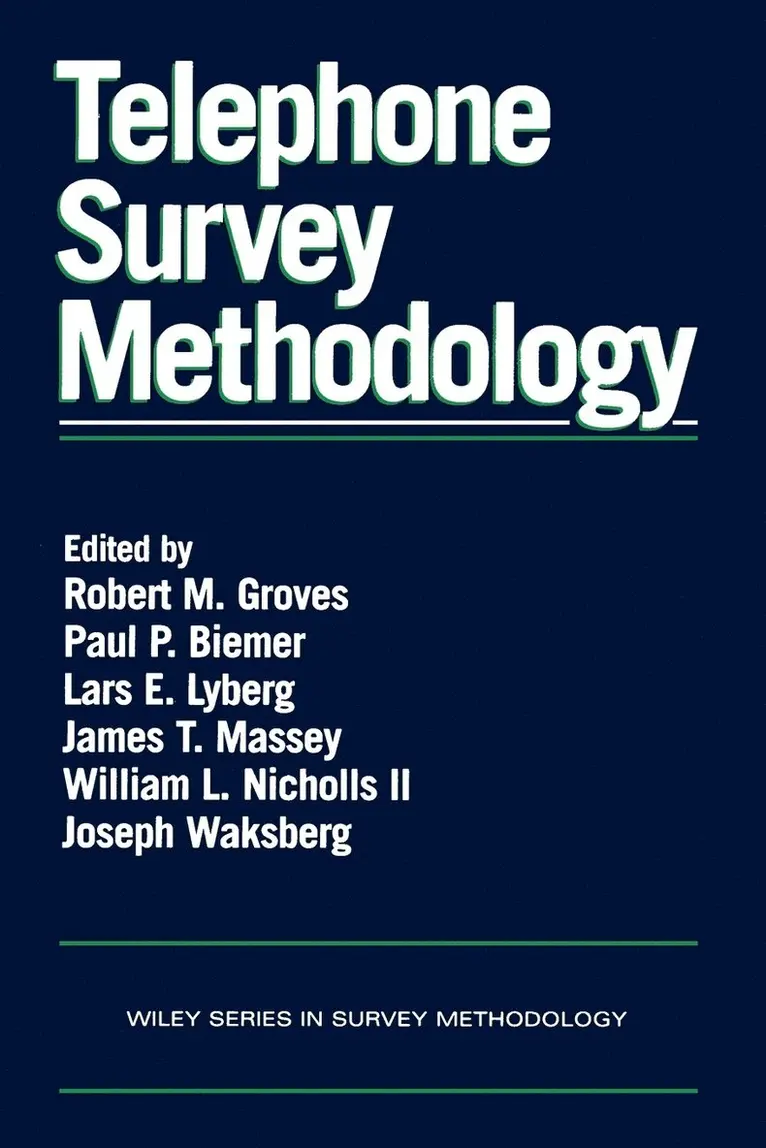
    Telephone Survey Methodology

    AvPaul Beimer,Groves

    Häftad, Engelska, 2001

    Del 328 i serien Wiley Series in Survey Methodology

    1 653 kr

    Beställningsvara. Skickas inom 5-8 vardagar. Fri frakt över 249 kr.

    Beskrivning

    Noted survey experts present recent developments in telephone survey techniques from around the world, describing work in commercial settings, academic research, and governmental statistical agencies. There are reports from the United States, several European countries, and Australia on trends in coverage of household populations, effects due to mode of data collection, and the state of the art in technology. Also covered are choice of target population, sample design, questionnaire construction, interviewing techniques, measurement error issues, nonresponse characteristics, administrative issues, and the use of Computer Assisted Telephone Interviewing (CATI). Includes in-depth reviews of the literature.

    Produktinformation

    • Utgivningsdatum:2001-10-12
    • Mått:150 x 224 x 41 mm
    • Vikt:862 g
    • Format:Häftad
    • Språk:Engelska
    • Serie:Wiley Series in Survey Methodology
    • Antal sidor:608
    • Förlag:John Wiley & Sons Inc
    • ISBN:9780471209560

    Utforska kategorier

    • Referensverk och tvärvetenskap inom Samhälle och politik

    Mer om författaren

    ROBERT M. GROVES is Director of the Survey Research Center at the University of Michigan, Ann Arbor, and a faculty member at the Joint Program in Survey Methodology. PAUL P. BIEMER is Chief Scientist at the Research Triangle Institute. LARS E. LYBERG is Head of the Statistical Research Unit of Statistics Sweden in Stockholm and Chief Editor of the Journal of Official Statistics. The late JAMES T. MASSEY was Chief of the Survey Design Staff in the Office of Research and Methodology at the National Center for Health Statistics, and served as Program Chair Elect-1989 for the Survey Research Methods Section of the ASA. WILLIAM L. NICHOLLS II was formerly Principal Researcher in the Field Division of the U.S. Census Bureau. JOSEPH WAKSBERG is Chairman of the Board of Westat, Inc.

    Recensioner i media

    "The volume is well organized, balanced articles from both social science and statistics…" (Journal of the American Statistical Association, June 2004) "...of interest to applied statisticians and social scientists involved with surveys." (Reference & Research Book News, February 2002)

    Innehållsförteckning

    • SECTION A: COVERAGE OF THE HOUSEHOLD POPULATION BY TELEPHONES. An Overview of Telephone Coverage (J. Massey). International Comparisons of Telephone Coverage (D. Trewin & G. Lee). Trends in the United States Telephone Coverage Across Time and Subgroups (O. Thornberry & J. Massey). Within-Household Coverage in RDD Surveys (D. Maklan & J. Waksberg). SECTION B: SAMPLING FOR TELEPHONE SURVEYS. Telephone Sampling Methods in the United States (J. Lepkowski). Implementing the Mitofsky-Waksberg Sampling Design with Accelerated Sequential Replacement (G. Burkheimer & J. Levinsohn). Cutoff Rules for Secondary Calling in a Random Digit Dailing Survey (C. Alexander). Minimum Cost Sample Allocation for Mitofsky-Waksberg Random Digit Dialing (R. Mason & F. Immerman). Weighting Adjustments for Random Digit Dialed Surveys (J. Massey & S. Botman). Stratification of Prefix Areas for Sampling Rare Populations (L. Mohadjer). Sampling Variance and Nonresponse Rates in Dual Frame, Mixed Mode Surveys (M. Sirken & R. Casady). SECTION C: NONRESPONSE IN TELEPHONE SURVEYS. An Overview of Nonresponse Issues in Telephone Surveys (R. Groves & L. Lyberg). Nonresponse: The UK Experience (M. Collins, et al.). Nonresponse Issues in Government Telephone Surveys (J. Drew, et al.). Survey Period Length, Unanswered Numbers, and Nonresponse in Telephone Surveys (J. Sebold). Effects of Interviewer Vocal Characteristics on Nonresponse (L. Oksenberg & C. Cannell). SECTION D: DATA QUALITY IN TELEPHONE SURVEYS. Measuring Data Quality (P. Biemer). Data Quality in Telephone and Face to Face Surveys: A Comparative Meta-Analysis (E. de Leeuw & J. van der Zouwen). Effects of Mode of Interview: Experiments in the UK (W. Sykes & M. Collins). A Comparison of Response Effects in Self-Administered and Telephone Surveys (G. Bishop, et al.). The Quality of Income Information in Telephone and Face to Face Surveys (E. Körmendi). Searching for Causes of Interviewer Effects in Telephone Surveys (L. Stokes & M.-Y. Yeh). SECTION E: COMPUTER-ASSISTED TELEPHONE INTERVIEWING. Computer-Assisted Telephone Interviewing: A General Introduction (W. Nicholls). The Design of CATI Systems: A Review of Current Practice (R. Baker & W. Lefes). Call Scheduling with CATI: Current Capabilities and Methods (M. Weeks). Questionnaire Design for CATI: Design Objectives and Methods (C. House & W. Nicholls). The Effects of CATI on Costs and Data Quality: A Comparison of CATI and Paper Methods in Centralized Interviewing (G. Catlin & S. Ingram). SECTION F: ADMINISTRATION OF TELEPHONE SURVEYS. Introduction: Administration of Telephone Surveys (L. Lyberg). Administrative Designs for Centralized Telephone Survey Centers: Implications of the Transition to CATI (S. Berry & D. O'Rourke). Observation of Behavior in Telephone Interviews (C. Cannell & L. Oksenberg). A Comparison of Centralized CATI Facilities for an Agricultural Labor Survey (R. Bass & R. Tortora). Administrative Issues in Mixed Mode Surveys (D. Dillman & J. Tarnai). Bibliography of Telephone Survey Methodology. Index.