• Fri frakt över 249 kr
  • •
  • Snabba leveranser
  • •
  • Billiga böcker
Kundservice

Du är på sajten för privatpersoner.

Företag, bibliotek eller offentlig verksamhet?

Du handlar på classic.bokus.com, där alla dina funktioner finns intakta.
Till classic.bokus.com
Bokus logotyp. Gå till startsidan.
  • Erbjudanden
  • Nyheter
  • Student
  • Topplistor
  • Barn & ungdom
  • Bokus Play
  • E-böcker
  • Pocketböcker
  • Spel & pussel

10% rabatt på allt med kod NYSTART10 →

Sidfot

Mina sidor

    Hjälp

    • Kundservice
    • Vanliga frågor och svar
    • Frakt och leverans
    • Retur vid ångerrätt
    • Reklamera vara
    • Betalning
    • Köpvillkor
    • Allmänna villkor
    • Information om webbplatsens tillgänglighet

    Om Bokus

    • Om oss
    • Pressrum
    • För studenter
    • För företag
    • För bibliotek och offentlig verksamhet
    • För leverantörer
    • Hållbarhet

    Populärt

    • Aktuella erbjudanden
    • Presentkort
    • Studentlitteratur
    • Nya böcker
    • Topplistor
    • Signerade böcker
    • Engelska böcker

    Inspiration

    • Boktips
    • BookTok
    • Populära bokserier
    • Barnbokskaraktärer
    • Populära författare
    Logotyp för Bokus
    Följ oss på Facebook (extern länk)Följ oss på Instagram (extern länk)Följ oss på YouTube (extern länk)Följ oss på TikTok (extern länk)
    bokus @ CookiesAnpassa cookiesIntegritetspolicyKöpvillkor
    Till Citymail hemsida (extern länk)Till Budbee hemsida (extern länk)Till Postnord hemsida (extern länk)Till Schenker hemsida (extern länk)Till Early Bird hemsida (extern länk)Till Walleys hemsida (extern länk)
    1. Naturvetenskap och teknik
    2. Teknik och industri
    3. Elektronik och kommunikationer

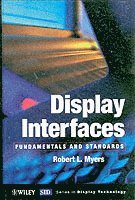
    Display Interfaces

    Fundamentals and Standards

    AvRobert L. Myers

    Inbunden, Engelska, 2002

    Del i serien Wiley Series in Display Technology

    1 718 kr

    Beställningsvara. Skickas inom 5-8 vardagar. Fri frakt över 249 kr.

    Fler format och utgåvor

    E-bok

    1 972 kr

    Beskrivning

    Display technology is evolving at an impressive rate with LCD and flat panel technologies gaining an increasing market share over traditional CRT display applications. Focusing on the development of new industry standards, this timely exposition of display systems and applications covers display timings, interfaces, specifications, measurement procedures and all forms of display control and identification. Reviews interface and graphics subsystem standards, including FPDI (Flat Panel Display Interface), P&D (Plug and Display) and Intel's Digital Video Interface (DVI)Compares and contrasts current and future developments of television and computer industry standardsDescribes the major new display system applications (HDTV, notebook computer, cellphone, cockpit instrumentation etc) and illustrates how user needs have dictated technological requirements (eg power, size and bistability)Provides an accessible treatment of current and future display device development, including guidance on selecting devices gor particular applicationsDesigned to meet the needs of professionals using and implementing display technologies and as a reference for those developing new display systems, this text is a valuable resource for display technology developers and system integrators, video graphics interface engineers and professionals. The comprehensive coverage of this leading edge topic makes it also of interest to postgraduate students in Computer Science and Electrical Engineering.The Society for Information Display (SID) is an international society, which has the aim of encouraging the development of all aspects of the field of information display. Complementary to the aims of the society, the Wiley-SID series is intended to explain the latest developments in information display technology at a professional level. The broad scope of the series addresses all facets of information displays from technical aspects through systems and prototypes to standards and ergonomics

    Produktinformation

    • Utgivningsdatum:2002-08-15
    • Mått:177 x 250 x 25 mm
    • Vikt:737 g
    • Format:Inbunden
    • Språk:Engelska
    • Serie:Wiley Series in Display Technology
    • Antal sidor:304
    • Förlag:John Wiley & Sons Inc
    • ISBN:9780471499466

    Utforska kategorier

    • Elektronik och kommunikationer inom Naturvetenskap och teknik
    • Teknik: allmänt inom Naturvetenskap och teknik
    • Naturvetenskap:allmänt inom Naturvetenskap och teknik

    Mer om författaren

    Robert L. Myers is the author of Display Interfaces: Fundamentals and Standards, published by Wiley.

    Recensioner i media

    "…much can be learned from this book about the details of modern display interfaces." (Color Research and Applications, February 2005) "...The book should feature on the shelf of every technical support or product marketing team that's seriously involved with display technology..." (Display Monitor, 28 October 2002)

    Innehållsförteckning

    • Series Editor’s Foreword xiPreface xiii1 Basic Concepts in Display Systems 11.1 Introduction 11.1.1 Basic components of a display system 11.2 Imaging Concepts 31.2.1 Vector-scan and raster-scan systems; pixels and frames 41.2.2 Spatial formats vs. resolution; fields 71.2.3 Moving images; frame rates 81.2.4 Three-dimensional imaging 101.3 Transmitting the Image Information 112 The Human Visual System 132.1 Introduction 132.2 The Anatomy of the Eye 142.3 Visual Acuity 192.4 Dynamic Range and Visual Response 222.5 Chromatic Aberrations232.6 Stereopsis 242.7 Temporal Response and Seeing Motion 252.8 Display Ergonomics 30References 313 Fundamentals of Color 333.1 Introduction 333.2 Color Basics 343.3 Color Spaces and Color Coordinate Systems 373.4 Color Temperature 423.5 Standard Illuminants 443.6 Color Gamut 453.7 Perceptual Uniformity in Color Spaces; the CIE L*u*v* Space 463.8 MacAdam Ellipses and MPCDs 483.9 The Kelly Chart 493.10 Encoding Color 494 Display Technologies and Applications 534.1 Introduction534.2 The CRT Display 554.3 Color CRTs 574.4 Advantages and Limitations of the CRT 604.5 The “Flat Panel” Display Technologies 614.6 Liquid-Crystal Displays 644.7 Plasma Displays 694.8 Electroluminescent (EL) Displays 714.9 Organic Light-Emitting Devices (OLEDs) 724.10 Field-Emission Displays (FEDs) 734.11 Microdisplays 754.12 Projection Displays 784.12.1 CRT projection 794.13 Display Applications 805 Practical and Performance Requirements of the Display Interface 835.1 Introduction 835.2 Practical Channel Capacity Requirements 845.3 Compression 865.4 Error Correction and Encryption 885.5 Physical Channel Bandwidth 895.6 Performance Concerns for Analog Connections 925.6.1 Cable impedance 925.6.2 Shielding and filtering 955.6.3 Cable losses 965.6.4 Cable termination 985.6.5 Connectors 1005.7 Performance Concerns for Digital Connections 1026 Basics of Analog and Digital Display Interfaces 1056.1 Introduction 1056.2 “Bandwidth” vs. Channel Capacity 1066.3 Digital and Analog Interfaces with Noisy Channels 1076.4 Practical Aspects of Digital and Analog Interfaces 1096.5 Digital vs. Analog Interfacing for Fixed-Format Displays 1116.6 Digital Interfaces for CRT Displays 1126.7 The True Advantage of Digital 1136.8 Performance Measurement of Digital and Analog Interfaces 1136.8.1 Analog signal parameters and measurement 1146.8.2 Transmission-line effects and measurements 1196.8.3 Digital systems 1217 Format and Timing Standards 1237.1 Introduction 1237.2 The Need for Image Format Standards 1237.3 The Need for Timing Standards 1257.4 Practical Requirements of Format and Timing Standards 1267.5 Format and Timing Standard Development 1307.6 An Overview of Display Format and Timing Standards 1317.7 Algorithms for Timings – The VESA GTF Standard 1358 Standards for Analog Video – Part I: Television 1398.1 Introduction 1398.2 Early Television Standards 1398.3 Broadcast Transmission Standards 1418.4 Closed-Circuit Video; The RS-170 and RS-343 Standards 1448.5 Color Television 1468.6 NTSC Color Encoding 1478.7 PAL Color Encoding 1548.8 Secam 1558.9 Relative Performance of the Three Color Systems 1568.10 Worldwide Channel Standards 1578.11 Physical Interface Standards for “Television” Video 1578.11.1 Component vs. composite video interfaces 1578.11.2 The “RCA Phono” connector 1588.11.3 The “F” connector 1598.11.4 The BNC connector 1598.11.5 The N connector 1608.11.6 The SMA and SMC connector families 1608.11.7 The “S-Video”/mini-DIN connector 1608.11.8 The SCART or “Peritel” connector 1619 Standards for Analog Video – Part II: The Personal Computer 1639.1 Introduction 1639.2 Character-Generator Display Systems 1649.3 Graphics 1659.4 Early Personal Computer Displays 1669.5 The IBM PC 1679.6 MDA/Hercules 1679.7 CGA and EGA 1689.8 VGA – The Video Graphics Array 1689.9 Signal Standards for PC Video 1709.10 Workstation Display Standards 1739.11 The “13W3” Connector 1769.12 EVC – The VESA Enhanced Video Connector 1779.13 The Transition to Digital Interfaces 1799.14 The Future of Analog Display Interfaces 18110 Digital Display Interface Standards 18310.1 Introduction 18310.2 Panel Interface Standards 18410.3 Lvds/eia- 644 18510.4 PanelLink ™ and TMDS ™ 18810.5 Gvif ™ 19110.6 Digital Monitor Interface Standards 19110.7 The VESA Plug & Display ™ Standard 19110.8 The Compaq/VESA Digital Flat Panel Connector – DFP 19310.9 The Digital Visual Interface ™ 19410.10 The Apple Display Connector 19610.11 Digital Television 19710.12 General-Purpose Digital Interfaces and Video 19710.13 Future Directions for Digital Display Interfaces 19911 Additional Interfaces to the Display 20311.1 Introduction 20311.2 Display Identification 20311.3 The VESA Display Information File (VDIF) Standard 20511.4 The VESA EDID and DDC Standards 20711.5 ICC Profiles and the sRGB Standard 21011.6 Display Control 21211.7 Power Management 21311.8 The VESA DDC-CI and MCCS Standards 21411.9 Supplemental General-Purpose Interfaces 21611.10 The Universal Serial Bus 21711.11 IEEE-1394/” FireWire TM ” 21912 The Impact of Digital Television and HDTV 22312.1 Introduction 22312.2 A Brief History of HDTV Development 22412.3 HDTV Formats and Rates 22712.4 Digital Video Sampling Standards 22912.4.1 Sampling structure 23012.4.2 Selection of sampling rate 23012.4.3 The CCIR-601 standard 23112.4.4 4:2:0 Sampling 23212.5 Video Compression Basics 23312.5.1 The discrete cosine transform (DCT) 23512.6 Compression of Motion Video 23712.7 Digital Television Encoding and Transmission 24112.8 Digital Content Protection 24212.9 Physical Connection Standards for Digital Television 24412.10 Digital Cinema 24512.11 The Future of Digital Video 24713 New Displays, New Applications, and New Interfaces 24913.1 Introduction 24913.2 Color, Resolution, and Bandwidth 25113.3 Technological Limitations for Displays and Interfaces 25313.4 Wireless Interfaces 25513.5 The Virtual Display – Interfaces for HMDs 25713.6 The Intelligent Display – DPVL and Beyond 25913.7 Into the Third Dimension 26113.8 Conclusions 264Glossary 267Bibliography, References, and Recommended Further Reading 279Printed Resources 279Fundamentals, Human Vision, and Color Science 279Display Technology 280Television Broadcast Standards and Digital/High-Definition Television 280Computer Display Interface Standards 281Other Interfaces and Standards 281On-Line Resources 281Standards Organizations and Similar Groups 282Other Recommended On-Line Resources 283Index 285