• Fri frakt över 249 kr
  • •
  • Snabba leveranser
  • •
  • Billiga böcker
Kundservice

Du är på sajten för privatpersoner.

Företag, bibliotek eller offentlig verksamhet?

Du handlar på classic.bokus.com, där alla dina funktioner finns intakta.
Till classic.bokus.com
Bokus logotyp. Gå till startsidan.
  • Erbjudanden
  • Student
  • Topplistor
  • Barn & ungdom
  • Bokus Play
  • E-böcker
  • Ljudböcker
  • Pocketböcker
  • Spel och pussel

Pocketfynda! Hundratals böcker för 49 kr/st →

Sidfot

Mina sidor

    Hjälp

    • Kundservice
    • Vanliga frågor och svar
    • Frakt och leverans
    • Retur vid ångerrätt
    • Reklamera vara
    • Betalning
    • Köpvillkor
    • Allmänna villkor
    • Information om webbplatsens tillgänglighet

    Om Bokus

    • Om oss
    • Pressrum
    • För studenter
    • För företag
    • För bibliotek och offentlig verksamhet
    • För leverantörer
    • Hållbarhet

    Populärt

    • Aktuella erbjudanden
    • Presentkort
    • Studentlitteratur
    • Nya böcker
    • Topplistor
    • Signerade böcker
    • Engelska böcker

    Inspiration

    • Boktips
    • BookTok
    • Barnbokskaraktärer
    • Populära författare
    Logotyp för Bokus
    Följ oss på Facebook (extern länk)Följ oss på Instagram (extern länk)Följ oss på YouTube (extern länk)Följ oss på TikTok (extern länk)
    bokus @ CookiesAnpassa cookiesIntegritetspolicyKöpvillkor
    Till Citymail hemsida (extern länk)Till Budbee hemsida (extern länk)Till Postnord hemsida (extern länk)Till Schenker hemsida (extern länk)Till Early Bird hemsida (extern länk)Till Walleys hemsida (extern länk)
    1. Data och IT
    2. Programmeringsböcker
    3. Programvaruutveckling

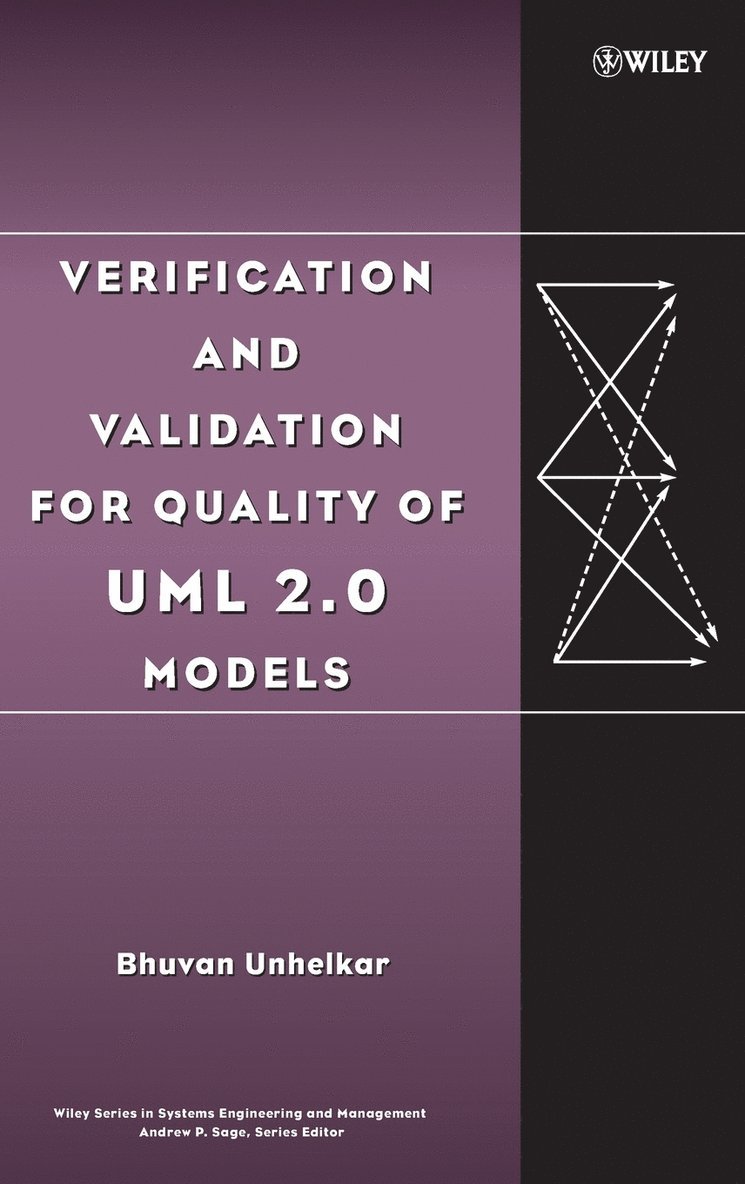
    Verification and Validation for Quality of UML 2.0 Models

    AvBhuvan Unhelkar

    Inbunden, Engelska, 2005

    Del 42 i serien Wiley Series in Systems Engineering and Management

    1 550 kr

    Beställningsvara. Skickas inom 5-8 vardagar. Fri frakt över 249 kr.

    Fler format och utgåvor

    E-bok

    1 803 kr

    Beskrivning

    A practical approach to enhancing quality in software models using UML Version 2.0 "Despite its increasing usage, many companies are not taking the best advantage of UML and, occasionally, individuals have experienced frustration in applying its standards. Perhaps this is because they have not yet read this book!"-From the Foreword by Prof. Brian Henderson-Sellers This book presents a practical checklist approach to enhancing the quality of software models created with the Unified Modeling Language (UML) Version 2.0. The foundation for quality is set by the discussion on the nature and creation of UML models. This is followed by a demonstration of how to apply verification and validation checks to these models with three foci: syntactical correctness, semantic meaningfulness, and aesthetic symmetry. The quality work is carried out within three distinct yet related modeling spaces:* Model of problem space (MOPS)* Model of solution space (MOSS)* Model of background space (MOBS) Readers can then choose a specific quality approach according to their roles in their projects. Verification and validation checks are also organized according to these three modeling spaces, making it easier for the reader to focus on the appropriate diagrams and quality checks corresponding to their modeling space. In addition, a major element of this publication is the Strengths, Weaknesses, Objectives, and Traps (SWOT) analysis. This analysis is performed on each UML diagram, enabling readers to fully comprehend these diagrams, their advantages and limitations, and the way in which they can be used in practical projects for modeling. A consistent case study of the Lucky Insurance System is provided throughout the chapters to illustrate the creation of good quality UML diagrams, followed by application of quality checks to them. With its emphasis on quality in UML-based projects, this book is an essential resource for all quality professionals, including quality analysts, process consultants, quality managers, test designers, and testers.

    Produktinformation

    • Utgivningsdatum:2005-08-12
    • Mått:163 x 242 x 26 mm
    • Vikt:642 g
    • Format:Inbunden
    • Språk:Engelska
    • Serie:Wiley Series in Systems Engineering and Management
    • Antal sidor:312
    • Förlag:John Wiley & Sons Inc
    • ISBN:9780471727835

    Utforska kategorier

    • Programvaruutveckling inom Data och IT

    Mer om författaren

    BHUVAN UNHELKAR, PhD, is founding Principal of MethodScience and a highly acclaimed trainer and presenter in the field of software engineering. Author of seven books, Dr. Unhelkar is also a professor at the School of Computing and Information Technology, University of Western Sydney.

    Recensioner i media

    "...is just the book to help one use the UML effectively...I highly recommend this book." (Software Quality Professional, December 2006) "I recommend this book to all those…using UML in small or medium-sized projects…it will serve as a useful guide for their next UML modeling task." (Computing Reviews.com, November 3, 2005)

    Innehållsförteckning

    • Figures xixForeword xxiiiPreface xxvAcknowledgments xxxiGlossary of Acronyms and Terms xxxiiiAuthor Profile xxxv1 The Quality Strategy for UML 1Chapter Summary 11.1 Modeling and Quality 21.2 Positioning UML for Modeling 41.3 Quality Aspects of UML 51.4 Understanding Modeling Spaces in Software 71.5 Modeling Spaces and UML 71.6 Verification and Validation 141.7 Quality Checks and Skills Levels 191.8 Levels of Quality Checks to UML Diagrams 201.9 Model-Driven Architecture (MDA) and Quality 231.10 Prototyping and Modeling Spaces 23Discussion Topics 24References 252 Nature and Basics of UML Diagrams 27Chapter Summary 272.1 The Nature of UML Diagrams 272.2 Use Case Diagrams 302.3 Activity Diagrams 332.4 Class Diagrams 352.5 Sequence Diagrams 372.6 Communication Diagrams 392.7 Interaction Overview Diagrams 412.8 Object Diagrams 412.9 State Machine Diagrams 432.10 Composite Structure Diagrams 442.11 Component Diagrams 452.12 Deployment Diagrams 462.13 Package Diagrams 472.14 Timing Diagrams 492.15 UML’s Extensibility Mechanisms 502.16 UML Meta-Models and Quality 53Discussion Topics 55References 563 Strengths, Weaknesses, Objectives and Traps (SWOT) of UML Diagrams 57Chapter Summary 573.1 SWOT Analysis of the UML Diagrams 583.2 SWOT of Use Case Diagrams 593.3 SWOT of Activity Diagrams 653.4 SWOT of Classes and Class Diagrams 673.5 SWOT of Sequence Diagrams 703.6 SWOT of Communication Diagrams 733.7 SWOT of Interaction Overview Diagrams 743.8 SWOT of Object Diagrams 753.9 SWOT of State Machine Diagrams 763.10 SWOT of Composite Structure Diagrams 773.11 SWOT of Component Diagrams 783.12 SWOT of Deployment Diagrams 793.13 SWOT of Package Diagrams 803.14 SWOT of Timing Diagrams 82Discussion Topics 82Note 83References 844 V&V of the Quality of MOPS 85Chapter Summary 854.1 UML Diagrams in MOPS 864.2 V&V of Use Cases and Use Case Diagrams in MOPS 884.3 Quality of Activity Diagrams in MOPS 1224.4 Quality of Package Diagrams in MOPS 1294.5 Quality of Classes and Class Diagrams in MOPS 1324.6 Quality of Sequence Diagrams in MOPS 1454.7 Quality of State Machine Diagrams in MOPS 1504.8 Quality of Interaction Overview Diagrams in MOPS 1544.9 Validating the Entire MOPS 1564.10 Summary of Quality Checks for MOPS 158Discussion Topics 158References 1605 V&V of the Quality of MOSS 161Chapter Summary 1615.1 UML Diagrams in the Solution Space (MOSS) 1615.2 Analyzing MOPS for MOSS for a Solution 1635.3 Quality of Classes and Class Diagrams in MOSS 1665.4 Quality of Sequence Diagrams in MOSS 1785.5 Quality of Communication Diagrams in MOSS 1825.6 Quality of Object Diagrams in MOSS 1845.7 Quality of State Machine Diagrams in MOSS 1865.8 Quality of Timing Diagrams in MOSS 1885.9 Converting Models into Systems 1895.10 Cross-Diagram Dependencies 189Discussion Topics 190References 1926 V&V of the Quality of MOBS 193Chapter Summary 1936.1 Working in the Background Space 1946.2 UML Diagrams in the Background Space (MOBS) 1946.3 V&V of Package Diagrams in MOBS 1996.4 Classes and Class Diagrams in the Background Space 2046.5 V&V of Class Diagrams in the Background Space 2086.6 V&V of Robustness through Class Diagrams in MOBS 2106.7 V&V of Component Diagrams in MOBS 2136.8 V&V of Composite Structure Diagrams in MOBS 2186.9 V&V of Deployment Diagrams in MOBS 2196.10 Cross-diagram dependencies in MOBS 222Discussion Topics 223References 2247 Managing the V&V Process 225Chapter Summary 2257.1 Processes and UML 2257.2 Understanding the Process and Process Components 2267.3 Iterations and Increments in a Process 228Discussion Topics 230Note 230References 230Appendix A LUCKY Insurance Case Study 231Appendix B UML CASE Tools 237Appendix C Summary of Checks for V&V of the Quality of MOPS 241Appendix D Summary of Checks for V&V of the Quality of MOSS 251Appendix E Summary of Checks for V&V of the Quality of MOBS 257Appendix F Templates for Actors, Use Cases and Classes in MOPS 263Index 267