• Fri frakt över 249 kr
  • •
  • Snabba leveranser
  • •
  • Billiga böcker
Kundservice

Du är på sajten för privatpersoner.

Företag, bibliotek eller offentlig verksamhet?

Du handlar på classic.bokus.com, där alla dina funktioner finns intakta.
Till classic.bokus.com
Bokus logotyp. Gå till startsidan.
  • Erbjudanden
  • Nyheter
  • Student
  • Topplistor
  • Barn & ungdom
  • Bokus Play
  • E-böcker
  • Pocketböcker
  • Spel & pussel

10% rabatt på allt med kod: NYSTART10 →

Sidfot

Mina sidor

    Hjälp

    • Kundservice
    • Vanliga frågor och svar
    • Frakt och leverans
    • Retur vid ångerrätt
    • Reklamera vara
    • Betalning
    • Köpvillkor
    • Allmänna villkor
    • Information om webbplatsens tillgänglighet

    Om Bokus

    • Om oss
    • Pressrum
    • För studenter
    • För företag
    • För bibliotek och offentlig verksamhet
    • För leverantörer
    • Hållbarhet

    Populärt

    • Aktuella erbjudanden
    • Presentkort
    • Studentlitteratur
    • Nya böcker
    • Topplistor
    • Signerade böcker
    • Engelska böcker

    Inspiration

    • Boktips
    • BookTok
    • Populära bokserier
    • Barnbokskaraktärer
    • Populära författare
    Logotyp för Bokus
    Följ oss på Facebook (extern länk)Följ oss på Instagram (extern länk)Följ oss på YouTube (extern länk)Följ oss på TikTok (extern länk)
    bokus @ CookiesAnpassa cookiesIntegritetspolicyKöpvillkor
    Till Citymail hemsida (extern länk)Till Budbee hemsida (extern länk)Till Postnord hemsida (extern länk)Till Schenker hemsida (extern länk)Till Early Bird hemsida (extern länk)Till Walleys hemsida (extern länk)
    1. Samhälle och politik
    2. Samhälle och kultur
    3. Sociala grupper och identitet
    4. Genusvetenskap

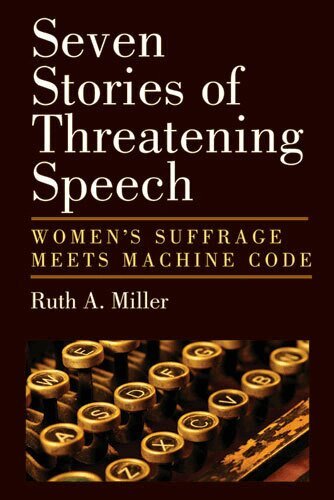
    Seven Stories of Threatening Speech

    Women's Suffrage Meets Machine Code

    AvRuth A. Miller

    Häftad, Engelska, 2012

    389 kr

    Beställningsvara. Skickas inom 5-8 vardagar. Fri frakt över 249 kr.

    Fler format och utgåvor

    E-bok

    588 kr

    Beskrivning

    Ruth A. Miller demonstrates the potential of taking nonhuman linguistic activity—such as the running of machine code—as an analytical model. Via a lively discussion of 19th-century pro- and antisuffragists, Miller tells a new computational story in which language becomes a thing that executes physically or mechanically through systems, networks, and environments, rather than a form for human recognition or representation. Language might be better understood as something that operates but never communicates, that sorts, stores, or reproduces information but never transmits meaning. Miller makes a compelling case that the work that speech has historically done is in need of reevaluation. She severs the link between language and human as well as nonhuman agency, between speech acts and embodiment, and she demonstrates that current theories of electoral politics have missed a key issue: the nonhuman, informational character of threatening linguistic activity.This book thus represents a radical methodological initiative not just for scholars of history and language but for specialists in law, political theory, political science, gender studies, semiotics, and science and technology studies. It takes posthumanist scholarship to an exciting and essential, if sometimes troubling, conclusion.“It is an erudite work by a scholar of enormous talent, who advances a thesis that is richly insightful and deeply provocative.” —Mary Hawkesworth, Rutgers University

    Produktinformation

    • Utgivningsdatum:2012-11-28
    • Mått:152 x 229 x undefined mm
    • Format:Häftad
    • Språk:Engelska
    • Antal sidor:298
    • Förlag:The University of Michigan Press
    • ISBN:9780472035281

    Utforska kategorier

    • Genusvetenskap inom Samhälle och politik

    Mer om författaren

    Ruth A. Miller is Professor of History at the University of Massachusetts, Boston. Visit Ruth A. Miller's website

    Recensioner i media

    “It is an erudite work by a scholar of enormous talent, who advances a thesis that is richly insightful and deeply provocative.”—Mary Hawkesworth, Rutgers University